
Clinical picture. R., a 34-year-old accountant with bipolar I disorder, presented in an outpatient session reporting three nights of shortened sleep following a tight project deadline. He described a growing sense that he was "finally operating at full capacity" and had begun drafting plans for a side business. The clinician introduced the informational sheet on maintaining cycles and walked R. through the worked example, drawing a direct parallel to his current pattern: a performance-oriented belief ("I must deliver perfectly") had driven late-night work, which disrupted sleep, which in turn amplified positive bias and generated further ambitious plans. R. recognised the sequence without prompting and agreed to reinstate a fixed sleep window as a concrete first step, deferring the business plans for review the following week when sleep had stabilised.
What Keeps Bipolar Disorder Going: PDF Worksheet, Tools and Exercises
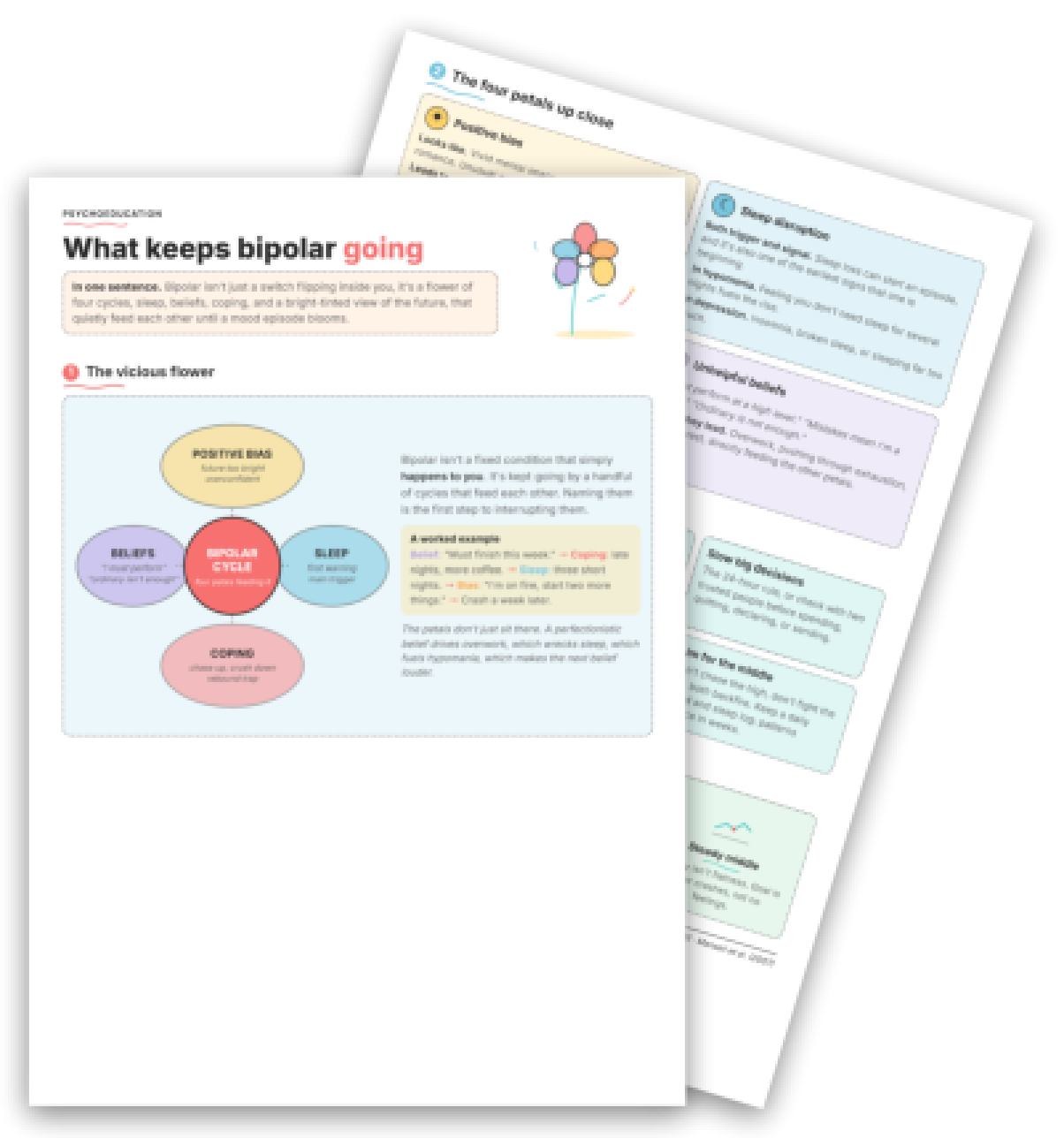
A visual psychoeducation worksheet mapping the four maintenance cycles that sustain bipolar disorder, for clinicians to use as an in-session explanation tool.
Clinical vignettes
Sleep Loss Triggering a Hypomanic Spiral
Beliefs and Coping Sustaining Mood Instability
Clinical picture. M., a 41-year-old teacher with a bipolar II diagnosis, had experienced recurrent brief depressive episodes following periods she described as "good weeks when I finally get things done." Review of her mood diary revealed a consistent pattern: productive stretches characterised by reduced sleep and high output preceded each low by roughly ten days. Using the four-petal framework from the worksheet, the clinician and M. identified that an underlying belief, "ordinary effort is not enough," was driving sustained overwork during euthymic phases and that her main coping response during early low mood was to push harder, amplifying the rebound. This shared formulation shifted M.'s understanding from "my biology just flips" toward a more interactional model, which opened a conversation about pacing and belief work as targets alongside medication review.
Most patients with bipolar disorder can name their episodes. What they cannot easily see is the web of day-to-day cycles that keeps the disorder active between those episodes. This PDF worksheet gives you a printable visual map to use in session, so that a conversation about maintenance factors produces a shared, lasting conceptual reference rather than a quickly-forgotten verbal explanation.
Use this resource with your patients
Handout, exercises and materials ready to use, right inside SessionFuel.
Why Bipolar Maintenance Is Hard to Explain at the Oral Level
Standard bipolar psychoeducation tends to cover episode types, diagnostic criteria, and the rationale for mood stabilizers. The functional maintenance layer, what quietly tips a stable patient back toward the threshold, rarely gets mapped with enough concreteness.
The reason oral explanation falls short here is that the maintaining processes are mutually reinforcing, not sequential. Sleep disruption fuels hypomania; the resulting positive cognitive bias makes perfectionist beliefs louder; those beliefs drive overwork, which wrecks sleep again. When you trace these loops verbally, patients follow the logic in the moment and lose the thread by the next session. A diagram makes the circular causality visible at a glance, in a way that a spoken walkthrough simply cannot replicate.
The fiche addresses this directly. It is a visual support you use during the explanation, not a questionnaire the patient fills in alone.
750+ clinical tools
A library built with and for clinicians, ready to use in session and extend between appointments.
Access all the toolsWhat the Fiche Contains: The Vicious Flower and Its Four Petals
The centrepiece of this PDF worksheet is a diagram called "the vicious flower", placing the bipolar cycle at the centre and four petals around it. Each petal carries a short label naming its mechanism and its self-perpetuating logic:
- Positive bias: future too bright, overconfident, leading to impulsive decisions and ignored warnings
- Sleep disruption: flagged as both first warning and main trigger, a dual role rarely foregrounded in general psychoeducation
- Unhelpful coping: described as chase up, crush down, rebound trap, distinguishing the upward-seeking from the suppressive direction
- Unhelpful beliefs: "I must perform," "ordinary isn't enough", directly feeding overwork, sleep loss, and the next hypomanic rise
A worked example in the fiche shows the chain concretely: a perfectionistic belief drives late nights and extra coffee, which leads to three short nights, which fuels the sense of being "on fire", which launches two new projects, then a crash a week later. "The petals don't just sit there," the fiche notes: each one amplifies the others. That sentence alone is a useful clinical anchor when introducing the diagram.
> Key point: This fiche is a visual support that facilitates the explanation of bipolar maintenance in session. You walk through the diagram with the patient; they leave holding a concrete schema they can consult between appointments. It is a psychoeducation tool, not homework.
Section 2 expands each petal individually, separating for instance the two directions of unhealthy coping and detailing the prodromal value of sleep as a relapse warning sign. Section 3 translates the model into six practical interruption strategies: sleep regularity framed explicitly as "treat sleep as medication", early-sign naming, a 24-hour rule before major decisions, systematic questioning of overly optimistic predictions, softening of perfectionist standards, and daily mood-and-sleep logging. Section 4 condenses these into four short mantras the patient can keep.
Use it with your patients
Share this tool in the mobile app and follow the work between sessions.
When and How to Introduce the Fiche
This worksheet fits naturally after initial formulation and diagnosis disclosure, once the patient understands the broad picture but before skills work begins in earnest. It is especially well-timed when a patient says something like "I understand I have bipolar, but I don't understand why I keep cycling", the fiche gives you a shared vocabulary immediately.
For patients where perfectionist beliefs or maladaptive coping patterns are already on the table from earlier sessions, the vicious flower lets you link those threads explicitly to the maintenance cycle without starting from scratch. Patients presenting primarily with sleep difficulties as a complaint will find the sleep petal immediately recognizable, which can strengthen alliance around a symptom they may not have connected to their mood episodes.
A useful introduction: "I want to show you a diagram that maps the main loops that keep bipolar disorder active day to day, not the episodes themselves, but what feeds them. Let's walk through it together." Avoid handing the fiche over silently. Walk the petals yourself, pausing on the ones most salient for this patient's presentation, and ask which petal they recognize first. That question tends to open a productive case-formulation conversation.
As treatment progresses, pair this sheet with relapse prevention tools and the broader CBT maintaining processes framework. The fiche does not replace mood charting or pharmacological review; it makes both feel purposeful by giving the patient a durable map of why those interventions matter.
Your session continues in your patients' pocket
Use with a patientYour resources, available everywhere
The handouts, exercises, programs and audios above: you choose which ones to make available to your patients, in the mobile app dedicated to them.
And far more than a library
The app goes well beyond resources, to support your patients every day:
Related categories
Explore other clinical resources by category.

Mood
Evidence-based worksheets and clinical tools for mood disorders: CBT, ACT, and positive psychology resources for psychologists and therapists.

Understand
Clinical hub for the therapeutic aim 'Understand': worksheets and tools to build patient insight across CBT, ACT, schema therapy and more.

Build awareness
Clinical worksheets and tools to build awareness in therapy: cognitive distortions, schemas, emotions, ACT and CBT resources for practitioners.

CBT
CBT worksheets, cognitive restructuring exercises & behavioral tools for clinicians. Evidence-based resources for every phase of cognitive behavioral therapy.

Anxiety
Clinical hub for anxiety disorders: CBT and ACT worksheets, psychoeducation sheets, and exercises for assessment and treatment across the anxiety spectrum.

Trauma
Clinical hub on trauma and PTSD: assessment, differential diagnosis, treatment phases, and printable resources for practitioners. 155 chars.