
Clinical picture. T., a woman in her early forties presenting with persistent fatigue and low mood, reported that she had stopped doing anything purely for herself over the preceding year, telling herself she would rest once her to-do list was shorter. The clinician introduced the self-care psychoeducation sheet and drew her attention to the distinction between restorative and avoidant strategies, noting that her nightly hour of scrolling was leaving her foggier rather than recharged. Together they identified one concrete anchor: a ten-minute walk before the school run, chosen because it required no extra time block. At the following session T. reported completing the walk four out of seven days and described a modest but genuine shift in her sense of agency.
Self-Care Tips: PDF Worksheet, Tools and Exercises for Clinical Practice
A printable PDF worksheet, practical tools, and concrete exercises to make self-care psychoeducation stick in session and give patients a lasting visual reference.
Clinical vignettes
Reframing Rest as Non-Negotiable
Specificity as the Missing Ingredient
Clinical picture. M., a man in his late thirties with a history of generalised anxiety, had listed "more time for myself" as a treatment goal for two consecutive months without making any change. The clinician used the informational sheet to highlight the habit-formation principle: vague intentions reliably fail, while a named activity with a fixed day and duration does not. M. settled on a 20-minute guitar practice session on Tuesday and Thursday evenings, anchored to finishing dinner. Six weeks later he had maintained the habit consistently and noted that protecting those slots had made saying no to low-priority requests feel more legitimate rather than selfish.
Most patients agree that self-care matters. Very few can name what they will actually do differently by Thursday. This fiche PDF bridges that gap: it turns a concept patients endorse but rarely operationalize into a concrete, visually structured psychoeducation support you can use directly in session.
Use this resource with your patients
Handout, exercises and materials ready to use, right inside SessionFuel.
Why Self-Care Is Hard to Convey in Session
The clinical obstacle is not a lack of motivation. It is a cluster of cognitive and behavioural patterns that make rest feel illegitimate. Patients in helping roles, those with high self-criticism, or those carrying a burnout trajectory typically hold a belief the fiche names precisely: "I'll rest once everything is done." Said aloud in session, that sentence often lands harder than any reframe you could offer.
A second obstacle is vagueness. "I should take more time for myself" is the kind of intention that evaporates between sessions. Without specificity of activity, duration, and anchor point, self-care remains aspirational rather than behavioural. Verbal psychoeducation alone rarely resolves this: patients agree in the room and revert outside it. A visual support that organises the reasoning, names the barriers, and models a concrete action sequence closes that gap more reliably than oral explanation alone.
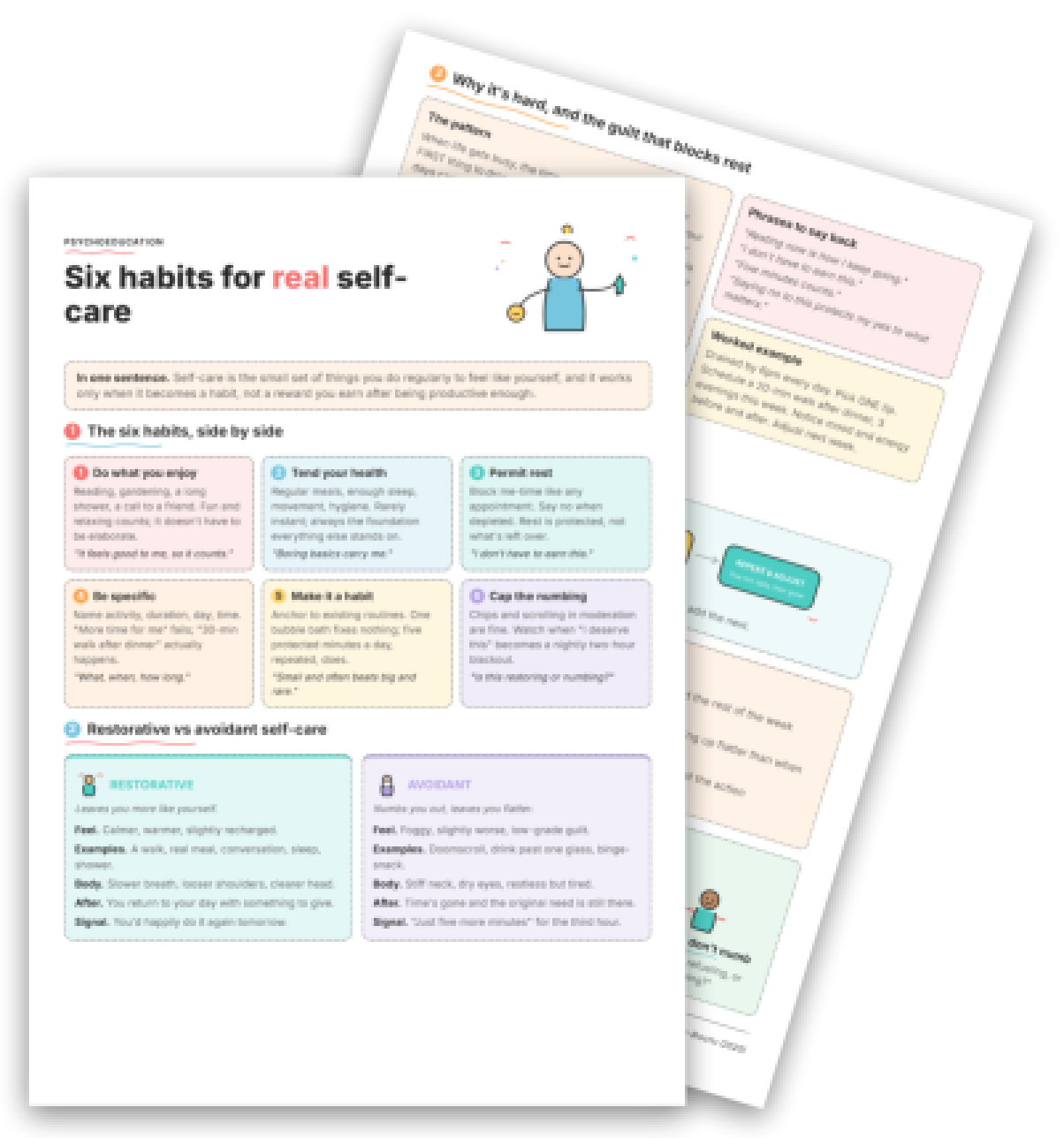
What the Fiche Contains: A Visual Map of Six Habits
The fiche is structured across four panels, each targeting a distinct clinical lever. The first lays out the six self-care habits side by side: do what you enjoy, tend your health, permit rest, be specific, make it a habit, and cap the numbing. Each habit carries a short anchor phrase ("Small and often beats big and rare.", "I don't have to earn this.") designed to surface and gently contest the underlying belief in one line. Seeing all six on a single page helps patients distinguish between foundations they have already partially in place and the ones that are quietly absent.
The second panel, Restorative vs Avoidant Self-Care, is the most clinically generative. Presented as a two-column comparison, it contrasts somatic and affective markers of genuine restoration (slower breath, looser shoulders, returning to the day with something to give) against the markers of numbing (foggy, slightly worse, time gone and the original need still there). Patients who rely heavily on screen-based or avoidant coping often recognise themselves immediately in the avoidant column, which opens a more specific conversation than asking "do you take care of yourself?" ever could.
The third panel names the inner voice that blocks rest and offers direct phrases to counter it. The fourth converts intention into action through a four-step sequence: pick one tip, make it specific, anchor it to an existing routine, repeat and adjust. This maps closely onto the habit-stacking logic and behavioural activation frameworks you may already be using, making the fiche a natural complement rather than a standalone detour.
> Key point: this fiche is a visual psychoeducation support you use in session to explain a concept; it is not a questionnaire the patient fills in alone. Leaving it with them at the end gives them a concrete reference point between appointments.
750+ clinical tools
A library built with and for clinicians, ready to use in session and extend between appointments.
Access all the toolsHow and When to Introduce the Fiche
The fiche fits naturally from the second or third session onward, once avoidance or self-neglect patterns have begun to surface in the formulation. It is particularly well-suited for patients presenting with burnout, persistent low mood with behavioural withdrawal, and those whose coping strategies tilt maladaptive. It also works well alongside assertiveness work when boundary-setting and saying no are active themes.
To introduce it without pathologising: "A lot of what we've been discussing comes back to how you replenish your own resources. I have a one-page visual that organises that quite concretely, let's go through it together."
Work through the Restorative vs Avoidant panel collaboratively: ask the patient to identify which column their current go-to activities fall into. Then move to the specificity step and have them name one habit, one time slot, one existing routine to anchor it to. The "To discuss in session" prompts at the bottom of the fiche flag three clinical indications worth noting: repeated activation of "I haven't earned this break yet", two-hour evening numbing patterns, and repeated failure to commit to even one specific action (which often signals a work-life balance issue or a deeper schema worth exploring).
A practical limit: for patients with severe depressive episodes or strong self-sacrifice schemas, the fiche may need to be introduced alongside explicit schema work rather than as a standalone psychoeducation tool. In those cases, pair it with building new habits or a goal-setting exercise to keep the translation from insight to action concrete.
The fiche does not replace the therapeutic frame. It makes the explanation clearer, shortens the conceptual work, and leaves the patient with a visual they can return to when the inner voice says "I'll rest once everything is done."
Use it with your patients
Share this tool in the mobile app and follow the work between sessions.
Sources
- Duhigg, C. (2012). The Power of Habit: Why We Do What We Do in Life and Business. Random House.
Your session continues in your patients' pocket
Use with a patientYour resources, available everywhere
The handouts, exercises, programs and audios above: you choose which ones to make available to your patients, in the mobile app dedicated to them.
And far more than a library
The app goes well beyond resources, to support your patients every day:
Related categories
Explore other clinical resources by category.

Emotions
Clinical resources on emotion regulation: worksheets, coping tools, CBT, REBT, and ACT exercises for therapists working across diagnoses and age groups.

Transitions
Clinical hub for life transitions: tools, worksheets and exercises to support psychosocial adjustment, role change and identity work in practice.

Understand
Clinical hub for the therapeutic aim 'Understand': worksheets and tools to build patient insight across CBT, ACT, schema therapy and more.

Engage & motivate
Clinical hub: printable worksheets and exercises to build therapeutic engagement and motivation across ACT, CBT, and integrative practice. For clinicians.
CBT
CBT worksheets, cognitive restructuring exercises & behavioral tools for clinicians. Evidence-based resources for every phase of cognitive behavioral therapy.

Positive psychology
Positive psychology clinical resources for therapists: worksheets, exercises & programs on well-being, strengths, gratitude, and resilience-based practice.