
Clinical picture. M., a woman in her late twenties, presented with marked social anxiety and a pattern of withdrawing from work meetings after perceiving negative judgment from colleagues. In session, the clinician introduced the cognitive restructuring worksheet and asked M. to write down the exact thought that had spiked her distress that week: "My colleagues think I am incompetent because I could not answer the director's question." Working through the evidence columns, M. identified that no colleague had made any comment and that her manager had thanked her for her contribution at the end of the meeting. She named the thinking trap as mind-reading and drafted a working thought acknowledging the discomfort while excluding the inferred verdict of others. At re-rating, her belief in the original thought dropped from 85 to 50 out of 100, and she agreed to complete a second worksheet independently before the next session.
Cognitive Restructuring: PDF Worksheet, Tools and Exercises
A printable PDF worksheet with seven structured steps, 15 thinking traps, and a worked example to make cognitive restructuring concrete in session.
Clinical vignettes
Worksheet Reveals Mind-Reading in Social Anxiety
Restructuring Persistent Self-Critical Thought in Depression
Clinical picture. T., a man in his mid-forties receiving treatment for a moderate depressive episode, reported a recurrent automatic thought that surfaced each time he made an error at work: "I always ruin everything; I am useless." The clinician used the cognitive restructuring worksheet to slow the process down, first asking T. to rate his belief at 92 out of 100 and his shame at 80 out of 100, then prompting him to list only observable facts in the evidence-for column. T. struggled to populate the evidence-against column and required the three unlock questions printed on the worksheet to generate any counter-evidence. The resulting working thought, "I made a costly error this time and that matters, but my record over three years includes several projects that went well," felt credible rather than dismissive to him. His belief rating fell modestly to 70, which the clinician framed as a meaningful shift given the chronicity of the pattern, and the worksheet was assigned as a between-session task for the following two weeks.
Cognitive restructuring is one of the most reliably taught CBT techniques, and one of the most reliably misapplied by patients working alone. Explaining the seven-step process verbally, then sending someone home to practise, often produces either avoidance or the very thing the fiche explicitly warns against: reassurance-writing dressed up as a balanced thought. This Cognitive Restructuring PDF worksheet exists precisely to close that gap, giving you a structured visual to walk through together in session before the patient attempts it independently.
Use this resource with your patients
The handout, exercises and materials, ready to use right inside SessionFuel.
Why Cognitive Restructuring Is Hard to Explain Without a Visual
The core difficulty is not conceptual; patients quickly grasp that thoughts affect feelings. The breakdown happens at the level of operationalisation. Without a shared reference, "challenge your thought" collapses into "think more positively", a move their brain immediately rejects because it can feel the difference between a slogan and an accurate appraisal. The second sticking point is the evidence step: most patients conflate feeling-based evidence with factual evidence, a confusion that derails the whole sequence. A visual scaffold that explicitly separates Evidence FOR from Evidence AGAINST, and names the exact trap operating, short-circuits these errors before they become bad habits.
When you pair this fiche with a resource on identifying automatic thoughts or the CBT cognitive model, patients already arrive with a working map of the thought-feeling-behaviour chain. The restructuring worksheet then becomes the natural next instrument.
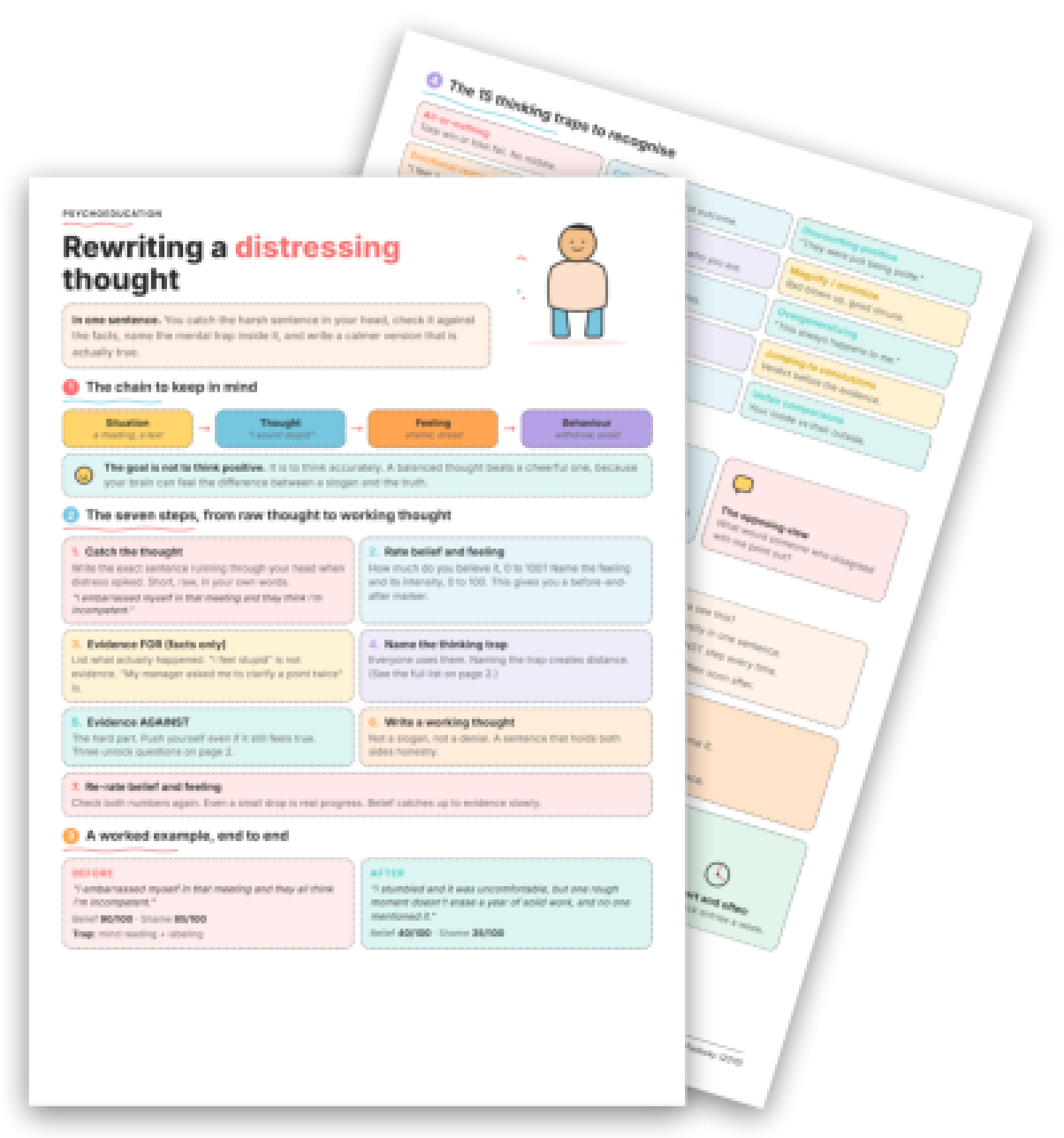
What the Fiche Contains, and What the Visual Layout Does
The worksheet opens with the situation → thought → feeling → behaviour chain rendered as a simple left-to-right diagram, setting the conceptual frame in one glance. Section 2 lays out the seven steps from raw thought to working thought: catch the thought verbatim, rate belief (0-100) and feeling intensity (0-100), list facts-only evidence for, name the thinking trap, push for counter-evidence, write the working thought, re-rate both scores. Each step is a discrete box, patients cannot skip the evidence rows and jump to a nicer phrase because the form makes the jump visible.
Section 3 delivers a complete worked example end to end: "I embarrassed myself in that meeting and they all think I'm incompetent" (Belief 90/100, Shame 85/100) restructured to "I stumbled and it was uncomfortable, but one rough moment doesn't erase a year of solid work" (Belief 40/100, Shame 35/100). Seeing a real shift printed on the page communicates the mechanism more efficiently than any oral explanation.
Section 4 lists all 15 thinking traps, from all-or-nothing thinking and mind reading to what-if thinking and unfair comparisons, in a compact reference grid. Naming a trap mid-session becomes a two-second lookup rather than a memory task. Section 5 offers three unlock questions for counter-evidence (the friend test, the track-record check, the opposing view), and Section 6 spells out the common pitfalls as explicit contrasts: ✗ Writing reassurance instead of a balanced thought / ✓ Hold both sides honestly in one sentence.
Key point: This fiche is a visual support that facilitates the explanation of cognitive restructuring in session. It is not a self-help handout to hand over without guidance; it is an in-session scaffold the clinician uses to walk through the logic once before the patient practises autonomously.
The closing "To discuss in session" box flags three clinical signals worth watching: the same trap recurring across contexts even after it is named; a balanced thought that remains hollow days later; and avoidance of the thought-catching step because the feeling is too intense.
750+ clinical tools
A library built with and for clinicians, ready to use in session and to keep the work going between appointments.
Get access to every toolHow and When to Introduce the Worksheet
Introduce the fiche after the cognitive model is established, typically from the second or third session, once the patient can place their distress inside the situation-thought-feeling-behaviour sequence. It pairs naturally with the ABC Model (REBT) if you are working from a rational-emotive frame, and integrates directly into a longitudinal case formulation as a maintenance-cycle intervention.
A low-barrier introduction: "I'd like to show you a structure we can use together right now for the thought you just described, it takes about ten minutes and gives you something concrete to take home." Walk through the seven steps using the patient's own thought from the session rather than the worked example; the example is there as a reference they can consult alone.
For between-session practice, the Automatic Thoughts guided exercise extends the same logic into a structured four-question homework format. If catastrophising is prominent, the decatastrophizing exercise or the restructuring anxious thoughts worksheet offer targeted complements. The Catching Your Thoughts fiche is a useful precursor for patients who struggle to identify thoughts before evaluating them.
One contraindication worth noting: in active high-distress states or when affect regulation is still fragile, the evidence-weighing steps can feel invalidating. In those presentations, a cognitive defusion approach may reduce reactivity more reliably before restructuring is introduced.
The fiche does not replace the therapeutic frame; it makes the explanation of restructuring precise enough that the patient leaves the session with a method, not just an intention.
Use it with your patients
Share this tool through the patient app and follow their work between sessions.
Sources
- Beck, A. T., Rush, A. J., Shaw, B. F., & Emery, G. (1979). Cognitive Therapy of Depression. Guilford Press.
- Beck, J. S. (2021). Cognitive Behavior Therapy: Basics and Beyond (3rd ed.). Guilford Press.
- Greenberger, D., & Padesky, C. A. (2016). Mind Over Mood: Change How You Feel by Changing the Way You Think (2nd ed.). Guilford Press.
- Wenzel, A., Dobson, K. S., & Hays, P. A. (2016). Cognitive Behavioral Therapy Techniques and Strategies. American Psychological Association.
Your sessions carry on in your patients' pockets
Use it with a patientYour resources, wherever your patients are
From handouts to tests, you choose which resources your patients can access, right in their own mobile app.
And much more than a library
The app goes well beyond resources to support your patients every day:
Related categories
Explore other clinical resources by category.

Cognition
Printable cognitive therapy worksheets and clinical tools for therapists: CBT, ACT, schema work, defusion, distortions, and belief restructuring.

Build awareness
Clinical worksheets and tools to build awareness in therapy: cognitive distortions, schemas, emotions, ACT and CBT resources for practitioners.

Restructure
Clinical hub for cognitive restructuring worksheets: distortion identification, belief disputation, ABC model, and schema work for evidence-based practice.

CBT
CBT worksheets, cognitive restructuring exercises & behavioral tools for clinicians. Evidence-based resources for every phase of cognitive behavioral therapy.
Anxiety
Clinical hub for anxiety disorders: CBT and ACT worksheets, psychoeducation sheets, and exercises for assessment and treatment across the anxiety spectrum.

Trauma
Clinical hub on trauma and PTSD: assessment, differential diagnosis, treatment phases, and printable resources for practitioners. 155 chars.