
M., a trainee counsellor in her second placement year, brought a client with chronic low mood to supervision, describing the work as technically adequate but somehow airless. Her supervisor noticed that M. spoke in a flat, apologetic tone and paused before each sentence, as though bracing for correction. Rather than reviewing session content, the supervisor invited M. to sit with Eye 4 and name what she felt in the hour before each session with this client. M. identified a quiet dread, which she had been attributing to her own inexperience. Naming it as data rather than deficit allowed the pair to consider whether the client's own anticipated shame was being carried into the room before either of them had spoken.
HandoutIntegrative
The Seven Eyes of Supervision: PDF Worksheet, Tools and Exercises
A visual reference for clinicians who supervise or receive supervision: map all seven foci, surface parallel process, and turn case review into genuine reflection.
Clinical vignettes
Locating the Dread in Eye Four
The Parallel Process Becomes Visible
R., an experienced CBT therapist, described a case where the client repeatedly dismissed every suggestion and the alliance felt politely stalled. In supervision, R. found himself defending the same CBT tools the client had rejected, growing quietly irritable when the supervisor raised alternatives. The supervisor paused and moved to Eye 5, noting aloud that the conversational pattern between them resembled what R. had just described. R. recognised the echo immediately. This observation did not resolve the clinical impasse, but it reframed the stuckness as information about the relational field rather than evidence that the treatment had failed.
Supervision sessions can default quickly to case management: what was tried, what to try next. Hawkins and Shohet's Process Model reframes that default by naming seven distinct foci a supervisor can hold, but describing all seven verbally rarely moves the conversation. This PDF worksheet gives supervisors and supervisees a shared visual map so the model becomes immediately usable rather than abstractly memorable.
Use this resource with your patients
Handout, exercises and materials ready to use, right inside SessionFuel.
Why the Seven Eyes Resist Verbal Explanation
The challenge is not complexity. Each of the seven foci is individually intelligible. The difficulty is keeping all seven simultaneously in view so the pair can choose consciously where to look, rather than habituating to two or three favoured angles and quietly skipping the rest.
In practice, supervisors who work primarily from a CBT cognitive model tend to gravitate toward Eye 2 (interventions) and Eye 1 (the client's presentation). Those with a relational or psychodynamic background often linger at Eye 3 (the therapeutic bond) and Eye 4 (the therapist's felt reactions). Eye 5, the parallel process, is the one most clinicians know conceptually but rarely name explicitly mid-session. Eyes 6 and 7, the supervisor's own pulls and the wider systemic context, are the most frequently dropped.
Without a visible structure, this selective attention stays invisible. The worksheet makes it legible.
What the Fiche Contains: A Visual Map for All Seven Foci
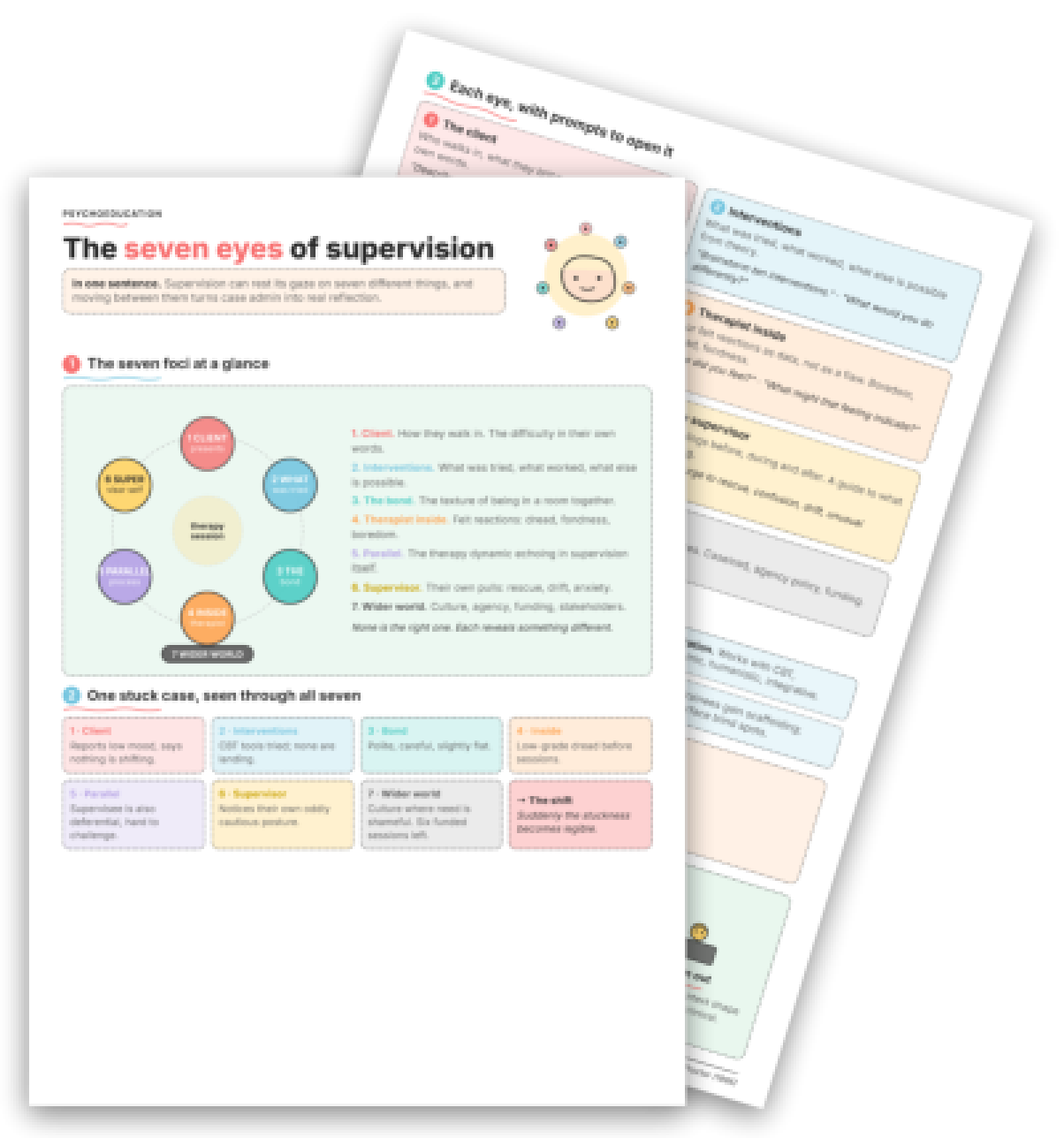
The PDF worksheet opens with a diagram showing the therapy session at the centre, and seven labelled positions orbiting it: Client, Interventions, The Bond, Inside Therapist, Parallel Process, Supervisor Self, Wider World. The layout does what the spoken word cannot: it shows all seven at once and gives each equal weight on the page.
A second panel works a single stuck case through all seven lenses in sequence. The worked example runs from "Reports low mood, says nothing is shifting" at Eye 1 to "Culture where need is shameful. Six funded sessions left" at Eye 7, ending with the observation: "Suddenly the stuckness becomes legible." Seeing the same clinical picture shift meaning seven times across one page is a faster demonstration than any explanation.
The third panel gives concrete prompts for each eye: for Eye 3, "If you were two animals, which?"; for Eye 4, "What might that feeling indicate?"; for Eye 5, "Are client dynamics playing out here, between us, right now?" These are ready to read aloud in session rather than paraphrase from memory.
A final panel addresses common confusions clinicians raise: the model is not a therapy approach, it is not tied to any single orientation, and parallel process is relational rather than mystical.
> To remember: the fiche is a visual support that facilitates the explanation of the Seven Eyes model in supervision; it gives the pair a shared reference, not a form to fill out independently.
Clinical library
750+ clinical tools
A library built with and for clinicians, ready to use in session and extend between appointments.
Access all the toolsSeveral resource types
Psychoeducation handouts
Understand at a glance
Interactive exercises
To do and fill in
Interactive programs
A structured path
Audios
Meditation and relaxation
Psychometric tests
Automatic scoring
How to Introduce the Fiche in Supervision
This resource is most useful at two moments: when a supervisory relationship is being established, to set a shared language early; and when supervision feels stuck or is consistently landing on the same two or three foci.
Open simply: "I'd like us to work from a map today that gives us seven different places to look at this case. Let's see which angle opens something up." Lay the diagram panel between you. The supervisee can point to an eye before speaking rather than narrating through all seven by default.
For trainees, the scaffolding function is primary: the worksheet helps them understand why the supervisor is asking about their felt reactions as data rather than more interventions. For experienced clinicians, the value is surfacing blind spots, particularly Eyes 6 and 7 (supervisor self and wider systemic context).
Eye 5 is worth a direct prompt whenever supervision stalls: the fiche frames it as "The therapy dynamic re-enacted between supervisor and supervisee", which is precise enough to open rather than close the conversation. Clinicians who notice [their own automatic responses in session often find this the most generative lens of the seven.
Watch for supervisees who consistently select Eye 2 (interventions) and resist Eye 4. That pattern itself warrants naming, and the understanding formulation approach and the longitudinal case formulation worksheets can complement the supervision work once the relational layer has been opened.
One practical limit: the model assumes a degree of relational safety. In a first supervision session, or when the alliance is fragile, introducing the full seven-eye framework may feel evaluative. In those contexts, starting with Eyes 1 and 2, then gradually widening the lens across subsequent sessions, is more workable than presenting all seven at once.
The fiche does not replace clinical supervision itself; it keeps the map visible so the pair can choose, rather than drift, into whatever they attend to next.
Use it with your patients
Share this tool in the mobile app and follow the work between sessions.
Sources
- Hawkins, P., McMahon, A. (2020). Supervision in the Helping Professions (5th ed.). Open University Press.
- Hawkins, P., Shohet, R. (2012). Supervision in the Helping Professions (4th ed.). Open University Press.
- Inskipp, F., Proctor, B. (1993). The Art, Craft and Tasks of Counselling Supervision, Part 1: Making the Most of Supervision. Cascade Publications.
Patient mobile app
Your session continues in your patients' pocket
Use with a patientYour resources, available everywhere
The handouts, exercises, programs and audios above: you choose which ones to make available to your patients, in the mobile app dedicated to them.
Psychoeducation handoutsInteractive exercisesInteractive programsAudiosPsychometric tests
And far more than a library
The app goes well beyond resources, to support your patients every day:
Standardized tests
Therapy journal
Gamification
Wellbeing challenges
Introspection prompts
Therapist homework
Related categories
Explore other clinical resources by category.

Integrative
Integrative therapy clinical resources: worksheets, psychoeducation programs, and exercises for eclectic, multimodal practice across orientations.

Anxiety
Clinical hub for anxiety disorders: CBT and ACT worksheets, psychoeducation sheets, and exercises for assessment and treatment across the anxiety spectrum.
Trauma
Clinical hub on trauma and PTSD: assessment, differential diagnosis, treatment phases, and printable resources for practitioners. 155 chars.

Mood
Evidence-based worksheets and clinical tools for mood disorders: CBT, ACT, and positive psychology resources for psychologists and therapists.

Identity
Clinical resources for self-identity work in therapy: CBT, ACT, schema tools for clinicians addressing self-concept, core beliefs, and identity disruption.

Emotions
Clinical resources on emotion regulation: worksheets, coping tools, CBT, REBT, and ACT exercises for therapists working across diagnoses and age groups.