
Clinical picture. M., a man in his late thirties presenting with persistent low mood and occupational burnout, described chronic procrastination and frequent mental blanking at work as evidence that he was "fundamentally lazy." The clinician introduced the brain-lobes worksheet mid-session, pointing to the frontal lobe section and its note that planning, focus, and impulse inhibition degrade when the system is under sustained load. M. read the relevant passage aloud, paused, and said it was the first time the behaviour had felt like a physiological state rather than a character flaw. Over the following two weeks he reported using the framing to interrupt self-critical rumination, with modest but noticeable effect on task initiation.
What Does the Brain Do? PDF Worksheet, Tools and Exercises
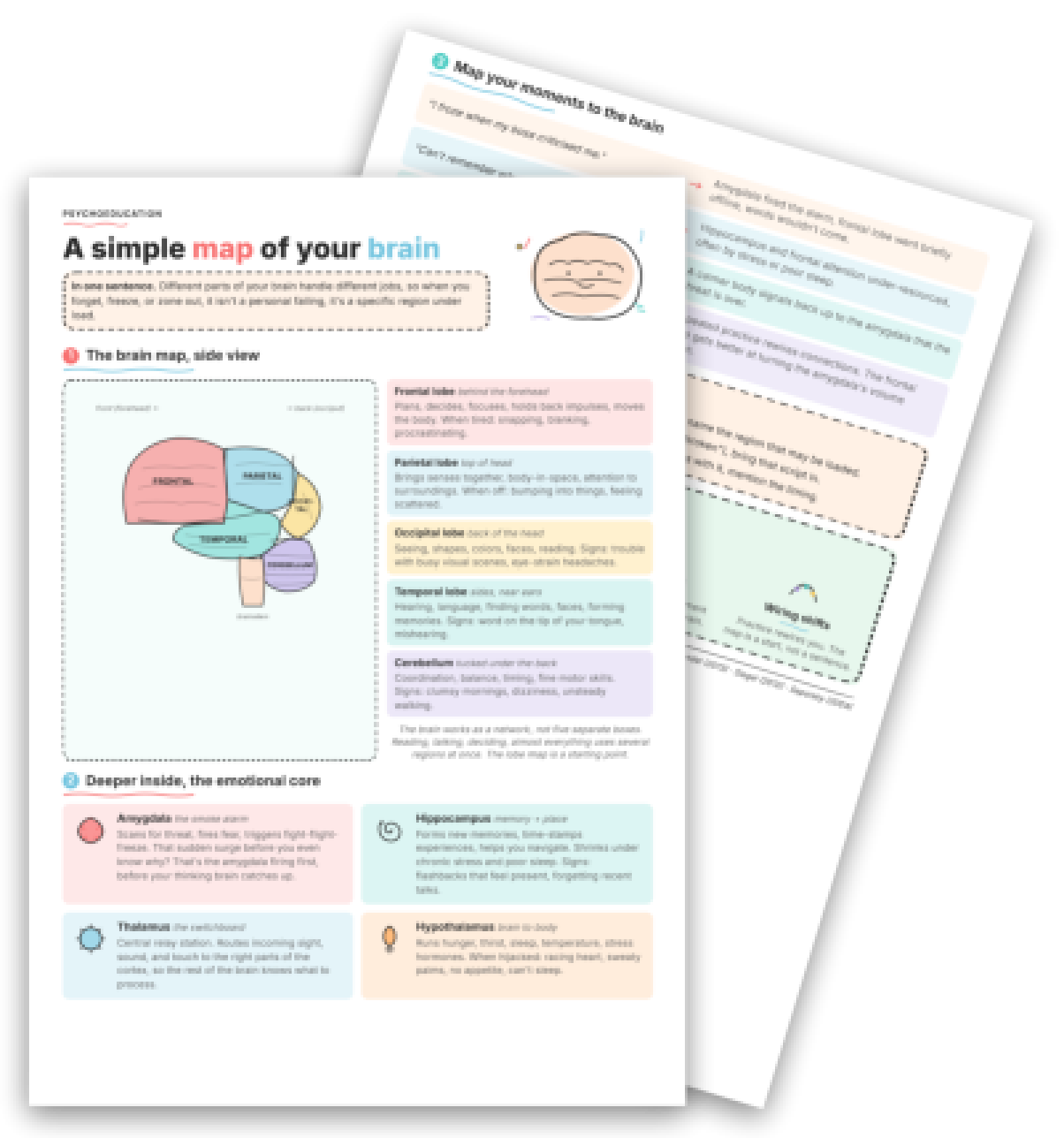
A visual PDF worksheet mapping brain regions to clinical symptoms, so patients stop reading blanking, freezing, and forgetting as personal failings.
Clinical vignettes
Reframing Procrastination via Brain Mapping
Normalising Trauma Reactivity with Amygdala Psychoeducation
Clinical picture. T., a woman in her mid-forties with a PTSD diagnosis following a road traffic collision, found it distressing that her body would flood with alarm before she had any conscious sense of threat, which she interpreted as losing her mind. The clinician used the amygdala section of the worksheet to walk through the sequence: the smoke-alarm region fires first, and the thinking brain catches up only afterwards. T. found the thalamus-as-switchboard diagram useful in understanding why certain sounds, not only visual cues, triggered the response. She left the session with the sheet and returned the following week reporting that naming "amygdala firing" in the moment had reduced, slightly, the secondary fear of the fear itself.
Telling a patient that their freeze response involves the amygdala rarely lands when the explanation stays verbal. They nod, leave the room, and by the next session the "I'm broken" narrative has fully rebounded. This PDF worksheet gives you a ready-made visual that anchors the neurobiological reframe before the session ends, without you sketching on a whiteboard.
Use this resource with your patients
Handout, exercises and materials ready to use, right inside SessionFuel.
Why brain-behavior links resist oral explanation
When you walk a patient through the fight-flight-freeze cascade in words alone, most retain the metaphor and lose the mechanism. The spatial relationship between regions, frontal lobe going briefly offline while the amygdala fires, stays abstract without a diagram. That abstraction is clinically costly. Clinicians working in TCC, EMDR, or trauma-informed frameworks all hit the same wall: the reframe disappears once the patient is back in their daily context, and the self-critical interpretive script rebounds in its place.
For patients carrying shame around memory gaps, poor concentration, or emotional dysregulation, the problem compounds. The narrative "I should be able to control this" competes directly with everything you are building in session. The Fight-Flight-Freeze Response worksheet addresses the cascade itself; what this fiche PDF adds is the spatial map that shows why the cascade produces the specific symptoms your patient is attributing to personal failure.
What the fiche contains: three panels, one shared vocabulary
The fiche is organized across three visual panels and a closing discussion block, none of which requires the patient to fill in anything. You guide, they look.
Panel 1 presents a labeled side-view brain map covering five regions: frontal lobe, parietal lobe, occipital lobe, temporal lobe, and cerebellum. Each entry carries a brief functional description and a "when under load" behavioral signal. The frontal lobe reads: "Plans, decides, focuses, holds back impulses. When tired: snapping, blanking, procrastinating." Patients who have never understood why they procrastinate under pressure recognize themselves in that line without any self-labeling from you.
Panel 2 moves into the emotional core: amygdala, hippocampus, thalamus, and hypothalamus. The amygdala is named "the smoke alarm" that fires before the thinking brain catches up, a formulation that maps directly onto interpretive bias work and the Autonomic Nervous System fiche. The hippocampus entry explicitly names the effect of chronic stress and poor sleep on memory consolidation, making it a natural bridge to sleep hygiene work or PTSD memory discussions.
Panel 3, titled "Map your moments to the brain," does the clinical translation explicitly. Four common patient statements, freezing under criticism, forgetting what was just read, anxiety dropping with slow breathing, therapy gradually changing reactions, are each mapped to a neurological mechanism. This is the panel you return to mid-session: the patient points to their own experience on the page rather than listening to you narrate it. The breath-amygdala connection in Panel 3 pairs naturally with the How Breathing Affects Feelings worksheet for patients who respond to somatic entry points.
The fiche closes with a "To discuss in session" prompt list and a four-item "Remember" block. Its core clinical message: "Symptoms = a region under load, not you broken."
> Key point: This fiche is a visual support that facilitates the explanation of brain-behavior links in session. It is not a questionnaire to complete independently. The patient leaves with a printed map, a shared vocabulary, and a durable reframe they can consult between appointments.
Clinical library
750+ clinical tools
A library built with and for clinicians, ready to use in session and extend between appointments.
Access all the toolsSeveral resource types
Psychoeducation handouts
Understand at a glance
Interactive exercises
To do and fill in
Interactive programs
A structured path
Audios
Meditation and relaxation
Psychometric tests
Automatic scoring
When and how to propose it
The fiche works best early in the care pathway, second or third session, once the presenting picture is mapped and the working alliance is forming. Three profiles benefit most:
- Patients with high shame around cognitive symptoms (memory gaps, blanking, concentration difficulties), where the "region under load" framing reduces self-blame from the first session
- Trauma presentations, where the amygdala-hippocampus panel supports the broader nervous system regulation framework alongside threat response mapping
- Psychoeducation-heavy early sessions in CBT or EMDR, where you need a shared biological vocabulary before moving to cognitive restructuring or body stress response work
A straightforward introduction: "I want to show you a map that explains what happened physiologically when you froze, it'll help us both put a name to it." Avoid framing it as reading material to study at home; frame it as a reference map they can keep.
Debrief the following session by returning to Panel 3: which of the four mapped moments resonates most? What does the patient now call that experience? For patients who want more physiological depth, the Autonomic Nervous System fiche extends the framework. For those where memory is a central complaint, Strategies for Memory Problems continues the work concretely.
The fiche does not replace the clinical formulation. It gives the patient a visual anchor they can return to the moment the "I'm broken" narrative resurfaces between sessions.
Use it with your patients
Share this tool in the mobile app and follow the work between sessions.
Sources
- LeDoux, J. E. (2015). Anxious: Using the Brain to Understand and Treat Fear and Anxiety. Viking.
- Queensland Brain Institute, University of Queensland. Lobes of the Brain.
- Johns Hopkins Medicine. Brain Anatomy and How the Brain Works.
- OpenStax (2024). The Brain: Structure and Function. OpenStax Introduction to Behavioral Neuroscience.
Patient mobile app
Your session continues in your patients' pocket
Use with a patientYour resources, available everywhere
The handouts, exercises, programs and audios above: you choose which ones to make available to your patients, in the mobile app dedicated to them.
Psychoeducation handoutsInteractive exercisesInteractive programsAudiosPsychometric tests
And far more than a library
The app goes well beyond resources, to support your patients every day:
Standardized tests
Therapy journal
Gamification
Wellbeing challenges
Introspection prompts
Therapist homework
Related categories
Explore other clinical resources by category.

Trauma
Clinical hub on trauma and PTSD: assessment, differential diagnosis, treatment phases, and printable resources for practitioners. 155 chars.

Neurodevelopment
Clinical hub for neurodevelopmental disorders: psychoeducation, worksheets and intervention tools for ADHD, ASD, learning disorders and related conditions.

Cognition
Printable cognitive therapy worksheets and clinical tools for therapists: CBT, ACT, schema work, defusion, distortions, and belief restructuring.

Understand
Clinical hub for the therapeutic aim 'Understand': worksheets and tools to build patient insight across CBT, ACT, schema therapy and more.

CBT
CBT worksheets, cognitive restructuring exercises & behavioral tools for clinicians. Evidence-based resources for every phase of cognitive behavioral therapy.

Anxiety
Clinical hub for anxiety disorders: CBT and ACT worksheets, psychoeducation sheets, and exercises for assessment and treatment across the anxiety spectrum.