
Clinical picture. M., a 34-year-old warehouse worker, was referred to a psychologist three weeks after a workplace fall in which he struck his head on a shelving unit. He had not lost consciousness, and an emergency department scan showed no structural damage, yet he remained convinced something had been missed because his headaches, fatigue, and word-finding difficulties persisted. The clinician used the informational sheet to walk M. through what a concussion actually is, emphasising that the absence of a blackout does not invalidate the diagnosis and that cellular energy disruption, not structural damage, explains his symptoms. M. responded with visible relief to the timeline diagram, noting that he had assumed symptom fluctuation meant deterioration. By the following session he reported reduced health anxiety and had begun the graduated return-to-activity steps outlined in the sheet.
Concussion: PDF Worksheet, Tools and Exercises for Clinical Practice
A visual psychoeducation PDF worksheet covering concussion mechanics, symptom timelines, and graduated return to activity, for clinical use at the bedside or in consultation.
Clinical vignettes
Normalising Symptoms After a Fall
Managing Premature Return to Sport
Clinical picture. A., a 19-year-old university-level rugby player, was seen ten days after a head knock during a match; a team medic had cleared her to resume contact training within five days, and she had complied, after which symptoms worsened. She presented with irritability, light sensitivity, and disrupted sleep, and attributed these to anxiety rather than the injury. The clinician introduced the informational sheet as a shared reference point, reviewing the typical days-to-weeks symptom window and the step-by-step pacing model. A. recognised that she had moved from rest directly to full training, skipping intermediate stages. She agreed to restart the graduated protocol and, over the following two weeks, reported progressive symptom reduction without the spikes she had experienced after the premature return.
Explaining concussion verbally in a first consultation rarely lands. Patients hear "mild TBI," register the word "mild," and promptly under-report symptoms, or they arrive primed by alarming online content and over-interpret every fluctuation as permanent damage. This concussion PDF worksheet provides a structured visual support you can walk through with the patient in session, replacing unanchored reassurance with a shared, concrete reference.
Use this resource with your patients
Handout, exercises and materials ready to use, right inside SessionFuel.
Why Concussion Psychoeducation Resists Verbal Explanation
The central difficulty is the mismatch between subjective severity and formal classification. "Mild" is a descriptor of injury type, not symptom burden, and patients do not hear it that way. Without a clear frame, the clinician ends up spending the session managing catastrophic appraisals rather than establishing a rehabilitation plan.
Equally challenging is symptom heterogeneity. Dizziness, photosensitivity, irritability, word-finding difficulty, and broken sleep feel to most patients like unrelated problems. Without a coherent map, they misattribute symptoms, which fuels health anxiety about persistent physical complaints and entrenches avoidance patterns. The consultation loses traction fast.
A third sticking point is the non-linear recovery trajectory. Patients interpret a bad afternoon as proof of permanent damage when it is simply a normal feature of post-concussion symptom variance. Getting this across at the oral level, without either minimising the patient's experience or alarming them further, is genuinely hard to do consistently session after session.
What the Fiche Contains: A Visual Map for In-Session Use
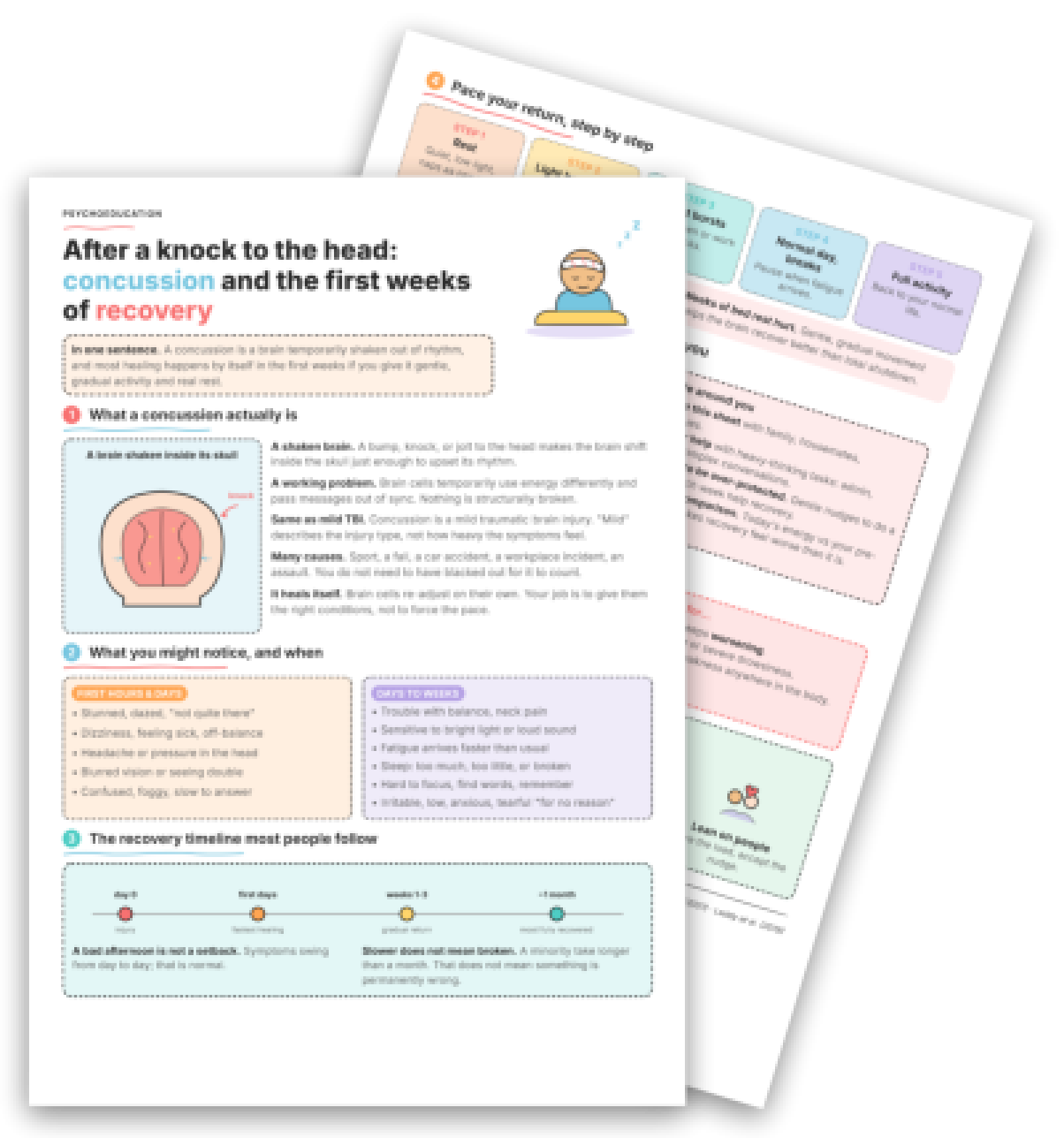
The fiche organises its content across six clearly labelled panels, moving logically from mechanism to management.
- Panel 1 establishes the neurophysiological rationale. A concussion is framed as "a working problem": brain cells temporarily use energy differently and pass messages out of sync, with nothing structurally broken. This framing targets catastrophising directly and gives you clinical language the patient can actually hold onto.
- Panel 2 maps the symptom timeline in two columns (first hours and days; days to weeks), including the less-obvious late presentations: irritability, mood lability, word-finding difficulty, and sleep disruption. Seeing these clustered visually normalises what otherwise feels like a constellation of unrelated complaints.
- Panel 3 presents a linear recovery timeline from day 0 to approximately one month, with the explicit note that "a bad afternoon is not a setback", a sentence worth pointing to rather than just saying.
- Panel 4 details a five-step graduated return to activity, from complete rest through to full engagement. Each step is described in plain behavioural terms, and the instruction to pause at any flare is explicitly decoupled from regression or damage.
- Panel 5 covers sleep hygiene, hydration, mood tolerance, and the social environment, including guidance on briefing family members and colleagues. This maps cleanly onto the sleep hygiene worksheet if disrupted sleep is the dominant concern.
- Panel 6 lists specific urgent red flags (worsening headache, repeated vomiting, seizures, new focal weakness) clearly separated from the slower-moving symptoms that warrant a routine follow-up. Patients who can distinguish these two categories present to emergency services less reflexively and to their clinician more reliably.
> Key takeaway: the fiche is a visual support that facilitates in-session explanation of concussion. You walk through it with the patient; they do not complete it independently. The clinical payoff is a shared vocabulary, faster psychoeducation, and a concrete take-home reference that competes with online searching.
When cognitive complaints are prominent, pair the fiche with strategies for memory problems. When mood symptoms dominate alongside physical complaints, it establishes the shared language needed before introducing anxiety psychoeducation tools or screening for emerging depressive features.
750+ clinical tools
A library built with and for clinicians, ready to use in session and extend between appointments.
Access all the toolsWhen and How to Propose the Fiche
The optimal moment is early: first or second consultation, once the clinical picture is clear and catastrophic appraisals are already visible in the room. For patients referred by a GP or neurologist with no prior psychoeducation, it can anchor the entire initial framing.
A workable introduction: "I'd like to go through something with you that maps exactly what you've been describing. It's not a test; it's a way for us to look at the picture together so you have something reliable to refer to between sessions."
Debrief priorities once you have walked through it together:
- Ask which symptoms in Panel 2 the patient recognises. This normalises presentation, reduces shame around mood and cognitive changes, and supports adaptive coping rather than avoidance.
- Locate the patient on the graduated return ladder (Panel 4): where do they currently sit, and what is the realistic next step?
- Address any residual catastrophic appraisals about the recovery curve directly. Cognitive restructuring tools can layer in from the second or third session once the psychoeducation is consolidated.
For patients with prominent health anxiety, the "working problem, not damage" framing in Panel 1 maps naturally onto a Theory A / Theory B discussion in subsequent sessions. For post-concussion presentations following assault or road traffic accidents, complement the fiche with common reactions to trauma once the acute recovery phase is underway, since PTSD features are frequently missed in the early medical management window.
The fiche does not replace formulation or the therapeutic relationship. It makes the first phase of psychoeducation faster, more consistent, and more likely to produce a patient who paces their own recovery rather than oscillating between collapse and overexertion.
Use it with your patients
Share this tool in the mobile app and follow the work between sessions.
Sources
- McCrory, P., Meeuwisse, W. H., Dvorak, J., Aubry, M., Bailes, J., Broglio, S., Cantu, R. C., et al. (2017). Consensus statement on concussion in sport: the 5th International Conference on Concussion in Sport held in Berlin, October 2016. British Journal of Sports Medicine.
- Centers for Disease Control and Prevention (CDC) (2025). Concussion Basics - HEADS UP. CDC.
- Centers for Disease Control and Prevention (CDC) (2023). Updated Mild Traumatic Brain Injury (mTBI) Management Guideline for Adults. CDC.
Your session continues in your patients' pocket
Use with a patientYour resources, available everywhere
The handouts, exercises, programs and audios above: you choose which ones to make available to your patients, in the mobile app dedicated to them.
And far more than a library
The app goes well beyond resources, to support your patients every day:
Related categories
Explore other clinical resources by category.

Neurodevelopment
Clinical hub for neurodevelopmental disorders: psychoeducation, worksheets and intervention tools for ADHD, ASD, learning disorders and related conditions.

Cognition
Printable cognitive therapy worksheets and clinical tools for therapists: CBT, ACT, schema work, defusion, distortions, and belief restructuring.

Health
Somatic health clinical resources for practitioners: worksheets, psychoeducation, and exercises for somatic symptom disorder, chronic pain, and more.

Understand
Clinical hub for the therapeutic aim 'Understand': worksheets and tools to build patient insight across CBT, ACT, schema therapy and more.

CBT
CBT worksheets, cognitive restructuring exercises & behavioral tools for clinicians. Evidence-based resources for every phase of cognitive behavioral therapy.
Anxiety
Clinical hub for anxiety disorders: CBT and ACT worksheets, psychoeducation sheets, and exercises for assessment and treatment across the anxiety spectrum.