
Clinical picture. M., a woman in her mid-thirties, presents with recurrent relational difficulties and a longstanding sense of being peripheral in friendships, even when evidence of closeness is available. She describes the pattern as confusing rather than distressing, which itself slows engagement. The clinician introduces the informational sheet on the 18 schemas mid-session, walking through the three-level diagram to distinguish an automatic thought from the underlying lens. M. identifies the Social Isolation schema with little prompting, noting that the phrase "outside even when included" matches something she has never had words for. She leaves the session with the sheet and returns the following week having circled two further schemas, which opens a more specific formulation conversation than had been possible in the previous three months.
Young's 18 Early Maladaptive Schemas: PDF Worksheet, Tools and Exercises
A printable PDF fiche clinicians can use in session to map all 18 schemas, their domains, and the three coping styles that keep them alive.
Clinical vignettes
Naming the Lens, Not the Thought
Coping Style Recognised Before Schema
Clinical picture. T., a man in his late twenties referred for anger dysregulation, initially resists schema-focused framing, stating he has no interest in revisiting childhood. The clinician uses the coping-style section of the sheet as an entry point rather than the schema list itself, describing overcompensation in neutral, behavioural terms. T. recognises the pattern of starting conflicts before he can be rejected and agrees, cautiously, to read the Abandonment schema description at home. At the next session he reports that the soil description, specifically parental inconsistency, fits his history in a way he had not previously articulated. The sheet functions here as a low-threat bridge into material the patient had been actively avoiding.
Naming an early maladaptive schema in words is one thing; getting a patient to feel the difference between the schema itself and the automatic thought it generates is another. Most patients hear the explanation, nod, and walk away having absorbed the vocabulary without the structure. This PDF fiche gives the concept a visual spine you can point to together in session, so the architecture lands rather than evaporates.
Use this resource with your patients
Handout, exercises and materials ready to use, right inside SessionFuel.
Why the Schema Model Resists Oral Explanation
The core difficulty is the depth hierarchy. Patients readily identify automatic thoughts, and many have encountered the idea of core beliefs through earlier CBT work. What schema therapy adds, the distinction between a belief and a lens formed by unmet need, is genuinely harder to convey verbally. Without a visual, the three layers collapse into each other.
The other sticking point is the three coping styles. Surrender, avoidance, and overcompensation are clinically precise categories, but patients who use avoidance primarily will describe their pattern in avoidance language, not schema language. They rarely see that a colleague who bullies (overcompensation) and a partner who withdraws (avoidance) may be running the same underlying Defectiveness schema. Pointing to a page that organises both within a single framework immediately shifts that.
A third resistance comes from the sheer number of schemas. Listing all 18 in session feels like a taxonomy lecture. The fiche structures them by domain of unmet need, which is how Young organised them clinically, so the patient sees not a menu of pathologies but a map of developmental gaps.
750+ clinical tools
A library built with and for clinicians, ready to use in session and extend between appointments.
Access all the toolsWhat the Fiche Contains: a Visual Map for In-Session Use
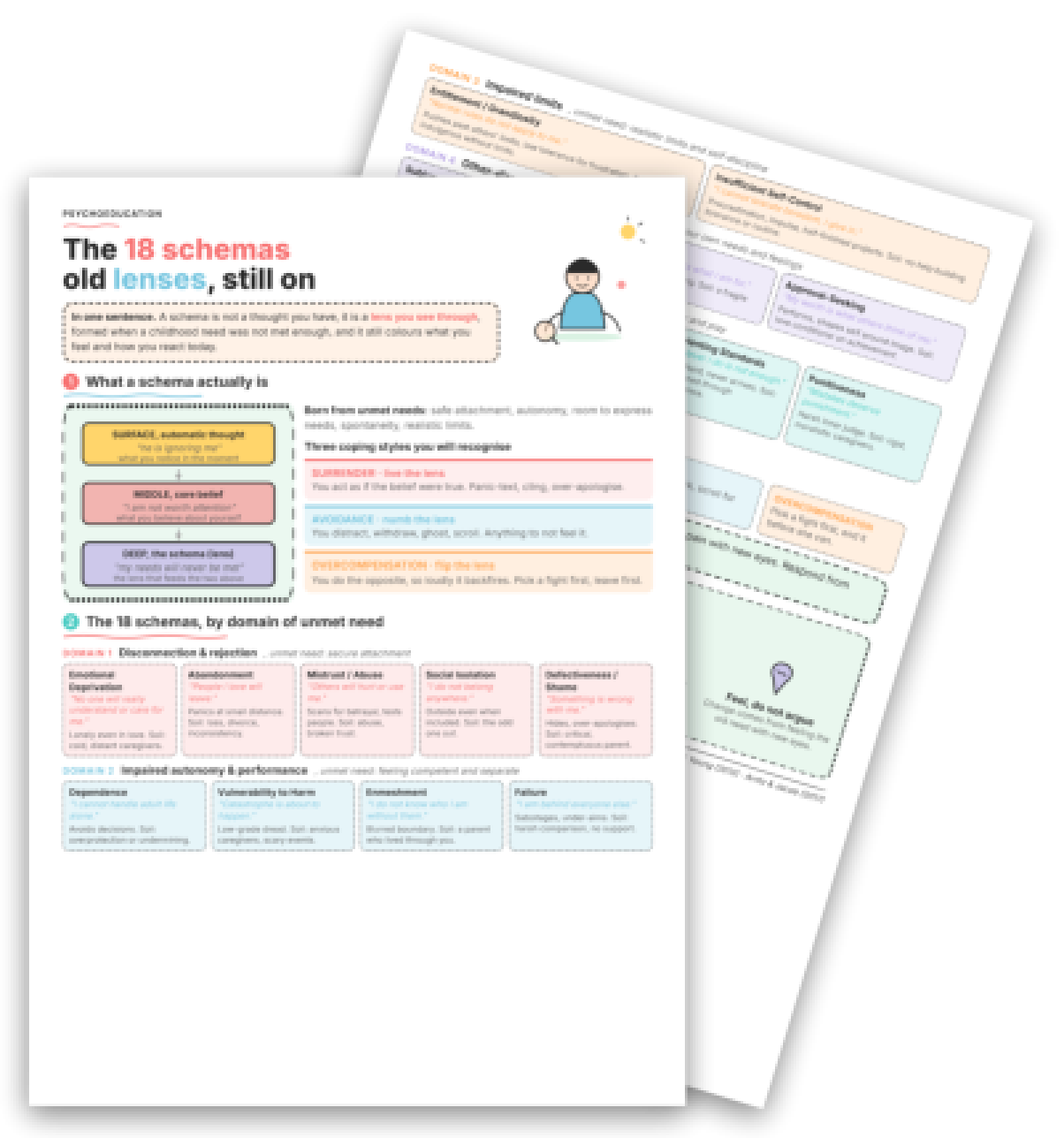
The support opens with a three-layer diagram (surface automatic thought / core belief / deep schema), grounded in an example: "he is ignoring me" → "I am not worth attention" → "my needs will never be met." That single column does more in thirty seconds than five minutes of oral explanation, because the patient can see where their own cognitions sit and which layer the therapist is targeting.
The second panel presents all three coping styles with brief behavioural descriptors. Surrender is framed as acting as if the belief were true; avoidance as numbing the lens; overcompensation as flipping it. This is the vocabulary you can use when mapping the schema maintenance cycles that sustain the problem.
The third, largest panel organises all 18 schemas across five domains: Disconnection and Rejection, Impaired Autonomy and Performance, Impaired Limits, Other-Directedness, and Overvigilance and Inhibition. Each schema carries a one-sentence summary and a brief developmental note. For example, the Abandonment schema is described as "panics at small distance" with a soil of "loss, divorce, inconsistency", which opens the developmental history directly without the clinician having to narrate it.
A final section uses a cancelled dinner to show the same event producing three different schema-driven responses, then proposes a fourth option: "Name the schema. Feel the old pain with new eyes. Respond from today, not from age six."
> Key takeaway: this fiche is a visual support that facilitates the in-session explanation of the schema model; the patient leaves with a concrete reference, not a worksheet to complete alone.
Use it with your patients
Share this tool in the mobile app and follow the work between sessions.
When and How to Introduce the Fiche
The fiche fits naturally in the psychoeducation phase, once the initial formulation is underway and there is enough alliance to name developmental material without it feeling pathologising. A second or third session, after anamnèse, works well. For patients who have done prior CBT, you can introduce it as the layer beneath the automatic thoughts they already know: "You've worked with thoughts before. This map shows where those thoughts come from."
Introduce it schema-first, not all-18-first. Use the three-layer diagram together, locate the patient's own recent automatic thought on it, then open the domain map only to the one or two areas that feel live. The fiche's own reminder, "focus on the 2 to 4 that tighten your chest most", gives you a ready phrasing to hand the patient so they take home a selective, personal reference rather than a full catalogue.
The visual structure is particularly useful with patients who over-identify with abandonment fears in relationships, those whose presenting pattern maps onto self-sacrifice or subjugation, and patients exploring the emotional deprivation schema who struggle to articulate what exactly was absent in early attachment. For defectiveness and shame presentations, showing the developmental soil column alongside how past experience shapes present reactions can reduce the shame of the schema itself.
As a contraindication: avoid introducing the full 18-schema map with patients in acute crisis or those still consolidating a basic sense of safety. The breadth of the map can feel confirming of a global defectiveness they are not yet equipped to hold. In those cases, a more targeted tool, such as a downward arrow technique to surface one specific belief, is a better entry point before widening to the schema framework.
Debrief by asking which two or three descriptions produced the strongest somatic reaction, not which ones the patient intellectually agreed with. That distinction, schema therapy versus standard core beliefs work, is itself a useful clinical moment the fiche opens up.
Pair it with a broader introduction to the model via the schema therapy overview, or ground the coping styles more deeply using the dedicated coping styles in schema therapy fiche. The fiche does not replace the therapeutic work; it compresses a complex conceptual introduction into a shared visual that holds its meaning between sessions.
Your session continues in your patients' pocket
Use with a patientYour resources, available everywhere
The handouts, exercises, programs and audios above: you choose which ones to make available to your patients, in the mobile app dedicated to them.
And far more than a library
The app goes well beyond resources, to support your patients every day:
Related categories
Explore other clinical resources by category.

Identity
Clinical resources for self-identity work in therapy: CBT, ACT, schema tools for clinicians addressing self-concept, core beliefs, and identity disruption.

Relationships
Clinical worksheets and tools on relational functioning: attachment, schemas, assertiveness, and communication skills for therapists. Printable PDF resources.

Understand
Clinical hub for the therapeutic aim 'Understand': worksheets and tools to build patient insight across CBT, ACT, schema therapy and more.

Build awareness
Clinical worksheets and tools to build awareness in therapy: cognitive distortions, schemas, emotions, ACT and CBT resources for practitioners.
CBT
CBT worksheets, cognitive restructuring exercises & behavioral tools for clinicians. Evidence-based resources for every phase of cognitive behavioral therapy.

Schema therapy
Schema therapy clinical resources for practitioners: worksheets, exercises, and programs targeting early maladaptive schemas, core beliefs, and schema modes.