
Clinical picture. M., a man in his late twenties with a first-episode psychosis diagnosis, reports a near-constant conviction that colleagues are monitoring him at work, triggered most acutely when he catches someone glancing in his direction. During a session focused on the maintaining-cycles worksheet, the clinician maps with him how his attention narrows to every face that turns his way, while neutral or friendly interactions fall outside his awareness entirely. M. recognises, with some surprise, that he spends several hours each evening mentally replaying coworkers' expressions, a habit he had framed as "just being careful." The clinician does not challenge the belief directly but invites M. to notice what happens to conviction strength on evenings when he deliberately engages in an absorbing activity instead of reviewing the day's faces. Over the following fortnight M. reports that conviction intensity fluctuates more than he expected, which opens space for further collaborative formulation work.
What Keeps Psychosis Going: PDF Worksheet, Tools and Exercises
A visual psychoeducation PDF fiche helping clinicians explain the four maintenance cycles that sustain distressing psychotic experiences, with tools and exercises for targeted behavioral experiments.
Clinical vignettes
Attention Loop Sustaining Paranoid Belief
Safety Behaviour Narrowing a Patient's World
Clinical picture. R., a woman in her early forties with a longstanding diagnosis of schizophrenia, has progressively restricted her movements over two years, leaving home only before 8 a.m. to avoid neighbours she believes are coordinating against her. When the clinician introduces the petal diagram from the informational sheet, R. identifies her early-morning exits as a safety behaviour and acknowledges that the belief has not weakened despite strict adherence to the routine; if anything, it has grown. The clinician reflects, without confrontation, that the avoidance prevents any disconfirming experience from occurring. R. agrees to a graded step as a between-session experiment: collecting her post at a slightly later time on one occasion, with the explicit aim of observing what happens to the belief rather than testing whether it is true. She returns reporting no adverse event and a brief, self-noted drop in certainty, which the pair document as early formulation evidence.
Explaining what sustains psychosis is often harder than explaining what it is. Most patients, and many relatives, focus on the unusual experience itself (the voice, the belief, the vision) and miss the four loops quietly feeding it. Verbal explanation alone rarely shifts that. This fiche PDF gives you a concrete visual structure to make the CBT maintenance model of psychosis legible in session, without the explanation collapsing into a lengthy theoretical monologue.
Use this resource with your patients
Handout, exercises and materials ready to use, right inside SessionFuel.
Why the Maintenance Model Is Hard to Convey Verbally
The cognitive model of psychosis, grounded in work by Morrison (2001), Garety et al. (2001), and Freeman (2007), holds that distress is driven less by the anomalous experience itself than by the interpretation attached to it and the behavioural responses that follow. Patients often arrive already convinced the experience is the problem. Reframing maintenance as a set of learnable habits, not a fixed state, asks for a conceptual shift that is surprisingly hard to land without a visual anchor.
Three things routinely get lost at the oral stage. First, patients conflate content (what the voice says) with the sustaining loop (what they do with it). Second, attentional hypervigilance and thought suppression are largely automatic; naming them is not enough to make them visible. Third, safety and avoidance behaviours feel protective, and they were well-meant. Telling someone their coping strategies maintain their distress, without showing how, tends either to feel accusatory or to produce intellectual assent that goes nowhere behaviourally. You can also see this pattern in what keeps OCD going and what keeps anxiety going, where the same visual format resolves the same clinical impasse.
750+ clinical tools
A library built with and for clinicians, ready to use in session and extend between appointments.
Access all the toolsWhat the Fiche Contains: A Flower That Shows the Loops
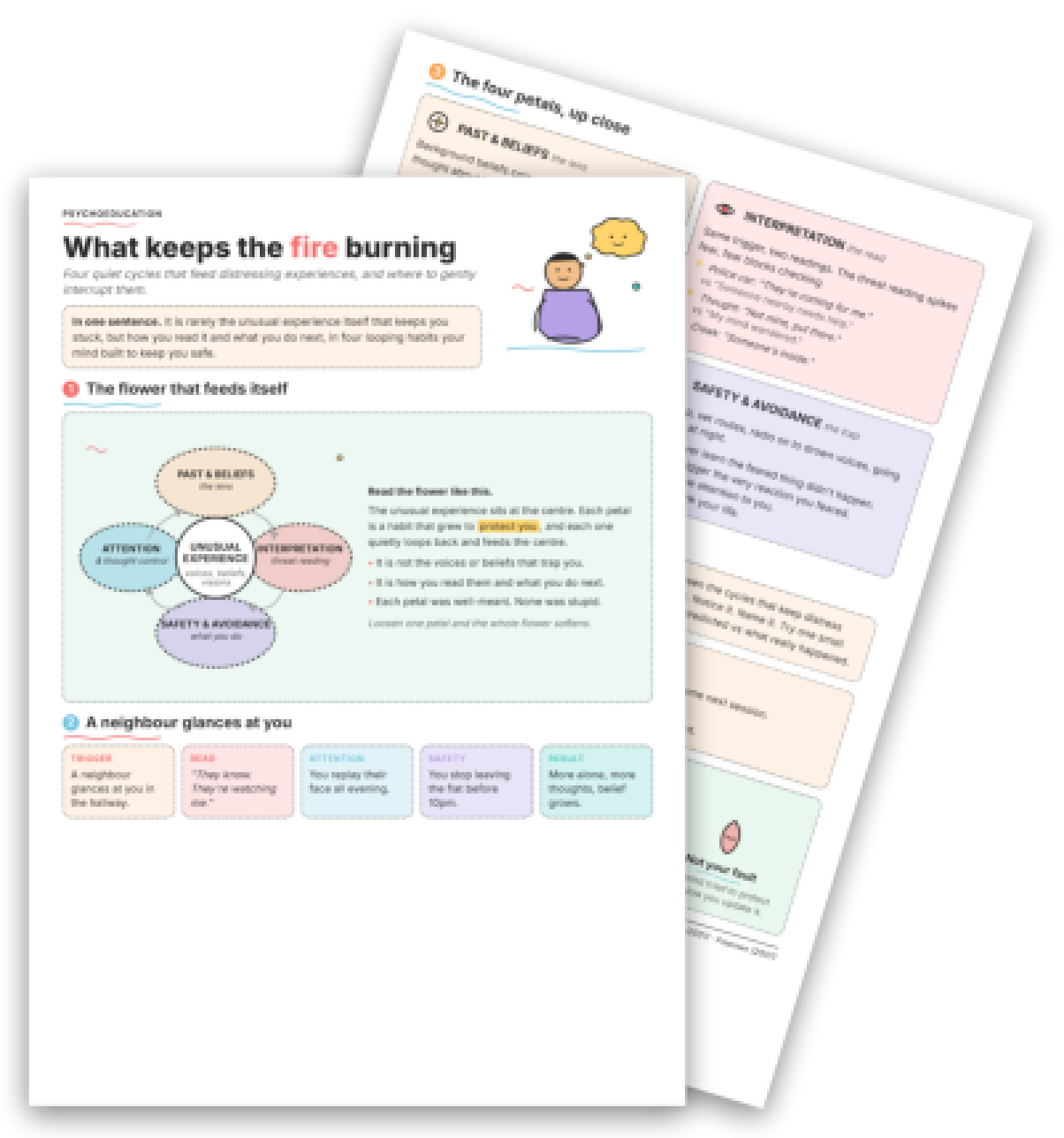
The fiche PDF is structured across four panels. Panel 1 presents the central metaphor: "The flower that feeds itself." The unusual experience sits at the centre; four petals surround it, Past & Beliefs, Interpretation, Attention & Thought Control, and Safety & Avoidance, each looping back to reinforce the centre. The visual layout does something that speech cannot: it shows simultaneity. Patients see instantly that all four petals are active at once, not sequential.
Panel 2 walks through a concrete worked example. A neighbour glances in a hallway; the threat read is "They know. They're watching me." Attention replays their face all evening. The safety behaviour is to stop leaving the flat before 10pm. The outcome: "More alone, more thoughts, belief grows." This single narrative thread, rendered visually, typically produces more recognition in a patient than three minutes of explanation.
Panel 3 unpacks each petal with specific examples: beliefs ("Worrying keeps me safe"), interpretation contrasts (a police car meaning persecution vs. "Someone nearby needs help"), selective attention pulling toward threat, and a full list of safety and avoidance behaviours (hood up, set routes, radio on to drown voices). Panel 4 describes the intervention logic: "Pick one petal first, usually a safety behaviour or a thought-control habit." Three "To discuss in session" prompts guide the debrief, and a summary box closes with four key take-aways.
> Key point: This fiche is a visual support that facilitates the explanation of the maintenance model in session. It is not a self-report questionnaire. The clinician uses it to map the patient's own patterns onto the flower, petal by petal, then leaves it as a concrete reference between appointments.
Use it with your patients
Share this tool in the mobile app and follow the work between sessions.
How and When to Introduce It
This fiche fits naturally into early formulation work, once an initial therapeutic alliance is established and the patient has begun to reflect on their experience rather than simply report it. It works well alongside a broader psychoeducation step, pairing it with everyday unusual experiences can help normalise the starting point before mapping the loops.
For patients with high threat interpretation and active psychological safety crutches, the Safety & Avoidance petal is usually the most clinically productive entry point, as Freeman's work consistently shows. For those with strong thought suppression patterns, the Attention petal lands first.
Introduce it plainly: "I'd like to show you a diagram that maps out how distress tends to stay high, not because of the experience itself, but because of four habits that grew around it. Let's see which ones feel familiar." After walking through the flower together, use the "To discuss in session" prompts verbatim to anchor the debrief. For a patient not yet ready to drop a safety behaviour, the fiche itself models the graduated logic: "If dropping a safety behaviour feels too big, agree on a much smaller first experiment."
One clinical note: the fiche is deliberately non-diagnostic in tone. It does not label the patient; it names habits that are "well-meant" and explicitly frames the task as updating, not arguing with, what the mind built to protect them. That framing protects the alliance while opening the door to changing avoidance patterns. The fiche does not replace clinical formulation or risk assessment; it makes one layer of that formulation visible and portable.
Your session continues in your patients' pocket
Use with a patientYour resources, available everywhere
The handouts, exercises, programs and audios above: you choose which ones to make available to your patients, in the mobile app dedicated to them.
And far more than a library
The app goes well beyond resources, to support your patients every day:
Related categories
Explore other clinical resources by category.

Understand
Clinical hub for the therapeutic aim 'Understand': worksheets and tools to build patient insight across CBT, ACT, schema therapy and more.

Build awareness
Clinical worksheets and tools to build awareness in therapy: cognitive distortions, schemas, emotions, ACT and CBT resources for practitioners.

CBT
CBT worksheets, cognitive restructuring exercises & behavioral tools for clinicians. Evidence-based resources for every phase of cognitive behavioral therapy.
Anxiety
Clinical hub for anxiety disorders: CBT and ACT worksheets, psychoeducation sheets, and exercises for assessment and treatment across the anxiety spectrum.

Trauma
Clinical hub on trauma and PTSD: assessment, differential diagnosis, treatment phases, and printable resources for practitioners. 155 chars.

Mood
Evidence-based worksheets and clinical tools for mood disorders: CBT, ACT, and positive psychology resources for psychologists and therapists.