
Clinical picture. M., a woman in her late thirties, presented with longstanding generalised anxiety centred on her performance at work. She described spending evenings re-reading sent emails, asking colleagues for reassurance, and scrolling her phone when intrusive thoughts became difficult to tolerate. Using the four-petal worksheet, the clinician walked through a recent worry episode with her and mapped each behaviour onto the model: the checking covered the uncertainty petal, the scrolling the cognitive-avoidance petal. M. was visibly surprised to see that habits she had understood as sensible precautions appeared, on the diagram, as inputs that fed the centre rather than exits from it. She left the session with the worksheet and was asked simply to notice, not yet change, which petal she reached for first.
Generalized Anxiety & Worry: PDF Worksheet, Tools and Exercises
A printable PDF worksheet explaining the four-petal worry loop that keeps GAD going, with visual tools and exercises clinicians can use directly in session.
Clinical vignettes
Recognising the Loop in Session
When Worry Feels Responsible
Clinical picture. T., a man in his mid-forties, sought help for persistent health-related worry; he had cancelled two medical appointments in the preceding month to avoid feared bad news. Early in treatment he reported feeling guilty on the occasional evening when he was not actively worrying about his family, interpreting the absence of worry as negligence. The clinician introduced the informational sheet and focused attention on the positive-beliefs petal, normalising the paradox: the conviction that worry signals care makes it feel irresponsible to reduce it, which sustains the loop independently of any real threat. T. acknowledged that this captured something he had never been able to articulate. Subsequent sessions used this formulation as a reference point when exploring behavioural experiments around the avoidance petal.
Explaining the maintenance of generalized anxiety in session is clinically straightforward on paper, but patients hear the oral explanation, nod, and still feel convinced that their worry is useful and necessary. This PDF worksheet provides a structured visual support to make the worry loop tangible, shareable, and immediately actionable in your work with GAD presentations.
Use this resource with your patients
Handout, exercises and materials ready to use, right inside SessionFuel.
Why the GAD Worry Loop Resists Verbal Explanation
The core difficulty with generalized anxiety in psychoeducation is not explaining what worry is; it is showing patients why it keeps going despite causing suffering. The four maintaining processes identified by Dugas, Wells, and Borkovec sit in a reinforcing cycle, each one feeling genuinely protective from the inside. A patient who is over-researching, suppressing intrusive thoughts, and avoiding situations is not behaving irrationally; they are following the internal logic of the loop perfectly.
When you describe this verbally, patients often register one mechanism and miss the others. They grasp intolerance of uncertainty but miss how their positive beliefs about worry ("worrying shows I care") keep the habit felt as responsible rather than pathological. They recognize thought suppression as a problem in theory, then continue doing it. The absence of a spatial, visible representation makes it hard for patients to see how the four habits feed one common centre. A diagram solves exactly that.
What the Fiche Contains: A Shared Visual Map of the Loop
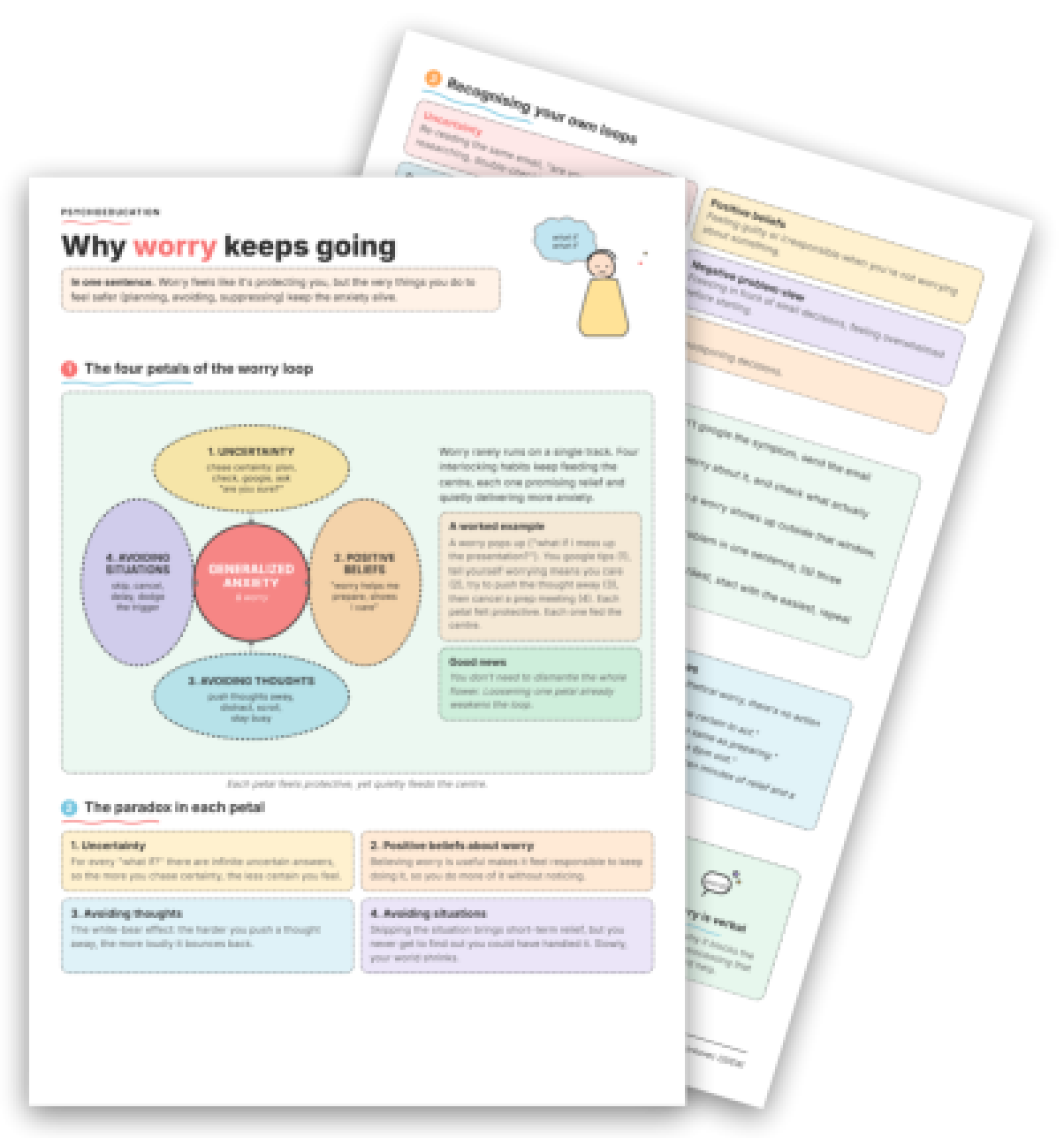
The fiche PDF organizes the content across five numbered sections, all grounded in the CBT model of GAD.
Section 1 introduces the four-petal flower metaphor: uncertainty intolerance (checking, googling, seeking reassurance), positive beliefs about worry (worry as preparation, as care), cognitive avoidance (thought suppression, compulsive distraction), and behavioural avoidance (cancelling, postponing, delegating). A worked example runs through all four petals with a single worry trigger: "What if I mess up the presentation?" This is the structural centrepiece of the fiche and the tool you will most likely point to during the session itself.
Section 2 maps the paradox in each petal: certainty-chasing produces less certainty, not more; the white-bear effect means suppression rebounds; behavioural avoidance prevents the disconfirmatory learning that would actually reduce anxiety. The fiche states this precisely: "Skipping the situation brings short-term relief, but you never get to find out you could have handled it. Slowly, your world shrinks." This wording tends to land for patients who intellectually accept exposure theory but have not yet connected it to their daily patterns.
Section 3 provides a recognition guide for each petal: re-reading the same email, feeling guilty when not worrying, compulsive scrolling, freezing in front of small decisions, delegating to avoid commitment. Pointing to these concretely in session is faster and more precise than asking open-ended questions about avoidance.
Section 4 maps one exit strategy per petal, including the worry slot (15 minutes daily), graded re-entry for behavioural avoidance, and the real/hypothetical problem sort. Section 5 contrasts worry with preparing, with the inner phrases: "I don't need to be certain to act" and "Avoiding gives me ten minutes of relief and a smaller life." These phrases can anchor between-session practice or feed directly into the patient's self-monitoring.
> Key clinical point: This fiche is not a self-administered questionnaire; it is a visual support you use in session to explain the worry loop. The diagram externalises the maintenance cycle in a way that words alone rarely achieve, and the patient leaves with a concrete reference they can consult between appointments.
750+ clinical tools
A library built with and for clinicians, ready to use in session and extend between appointments.
Access all the toolsWhen and How to Introduce the Fiche
The natural entry point is after initial assessment, once you have mapped the patient's dominant maintaining processes. If reassurance-seeking and intolerance of uncertainty are prominent, open the fiche at the flower diagram and ask the patient to identify which petals feel most familiar. That act of recognition, done collaboratively, is itself therapeutic: it shifts the patient from "I have uncontrollable anxiety" to "I have a loop with identifiable entry points."
For patients who hold strong positive beliefs about worry, Section 2 is the lever. "Let me show you the paradox that keeps this running" is a low-stigma framing that fits equally well in TCC, ACT (where defusion from positive beliefs about worry is often necessary before acceptance work), or schema-informed approaches where the belief functions as a coping style.
A brief debrief question after handing it over: "Which of these four habits do you recognise most in your week?" This activates the patient's self-observation without requiring homework compliance, and it feeds naturally into tools like the fear of uncertainty exposure hierarchy or the worry self-monitoring exercise in subsequent sessions.
Contraindication worth noting: in high-severity presentations with marked comorbid depression and very low behavioural activation, the "loosen one petal" message can feel overwhelming. In those cases, introduce Section 4 (the exit strategies) later, once some momentum is established.
The fiche does not replace case formulation or the therapeutic alliance; it makes a specific, clinically dense explanation faster to deliver and easier for the patient to take home.
Use it with your patients
Share this tool in the mobile app and follow the work between sessions.
Sources
- Wells, A. (1995). Meta-cognition and worry: A cognitive model of generalized anxiety disorder. Behavioural and Cognitive Psychotherapy.
- Dugas, M. J., & Robichaud, M. (2006). Cognitive-Behavioral Treatment for Generalized Anxiety Disorder: From Science to Practice. Routledge.
- Wells, A. (2009). Metacognitive Therapy for Anxiety and Depression. Guilford Press.
Your session continues in your patients' pocket
Use with a patientYour resources, available everywhere
The handouts, exercises, programs and audios above: you choose which ones to make available to your patients, in the mobile app dedicated to them.
And far more than a library
The app goes well beyond resources, to support your patients every day:
Related categories
Explore other clinical resources by category.
Anxiety
Clinical hub for anxiety disorders: CBT and ACT worksheets, psychoeducation sheets, and exercises for assessment and treatment across the anxiety spectrum.

Understand
Clinical hub for the therapeutic aim 'Understand': worksheets and tools to build patient insight across CBT, ACT, schema therapy and more.

Build awareness
Clinical worksheets and tools to build awareness in therapy: cognitive distortions, schemas, emotions, ACT and CBT resources for practitioners.

CBT
CBT worksheets, cognitive restructuring exercises & behavioral tools for clinicians. Evidence-based resources for every phase of cognitive behavioral therapy.

Metacognitive
Metacognitive Therapy (MCT): clinical resources, worksheets, and exercises for practitioners targeting CAS, rumination, and metacognitive beliefs.

Trauma
Clinical hub on trauma and PTSD: assessment, differential diagnosis, treatment phases, and printable resources for practitioners. 155 chars.