
Clinical picture. A., a 24-year-old university student, presented with longstanding preoccupation focused on perceived asymmetry of the nose, spending two to three hours daily checking in mirrors and photographing his face at different angles. During the third session, the clinician introduced the four-loop worksheet and invited A. to place his own behaviours and thoughts onto each petal. He quickly recognised that zooming in during mirror checks amplified distress rather than resolving it, and that his emotional reasoning ('I feel deformed, so I must be') was sustaining the negative body image rather than reflecting reality. By the end of the session A. was able to articulate the self-feeding nature of one loop, naming that checking provided momentary relief but reset the cycle within minutes. This shared formulation reduced his sense of personal defect and opened space to discuss attention-retraining as a starting point.
What Keeps BDD Going: PDF Worksheet, Tools and Exercises
A printable PDF worksheet and psychoeducation tools to explain BDD's four maintaining loops visually in session, with exercises grounded in CBT practice.
Clinical vignettes
Mapping the Loops in a Young Adult
Rituals and Avoidance in a Mid-Life Patient
Clinical picture. M., a 41-year-old woman referred by her GP, described avoiding social meals and wearing high-collared clothing year-round to conceal what she experienced as a severely scarred neck, a feature her dermatologist rated as clinically minimal. The clinician used the worksheet to map M.'s ritual cluster: touching the area repeatedly throughout the day, seeking reassurance from her partner each morning, and comparing her neck to images online. Reviewing the 'rituals' petal together, M. noted that reassurance-seeking briefly quieted the anxiety but that the urge returned within the hour, illustrating the short-relief trap the sheet describes. She acknowledged, cautiously, that the loop rather than the neck itself might be driving most of her distress. A plan to begin delaying one reassurance request per day was agreed as a modest first step, without framing this as a cure.
Explaining BDD maintenance in session is notoriously difficult: patients arrive convinced the problem is their appearance, not their relationship with it. This PDF worksheet gives you a concrete visual anchor to shift that frame, session by session.
Use this resource with your patients
Handout, exercises and materials ready to use, right inside SessionFuel.
Why BDD maintenance resists verbal explanation
The core obstacle is epistemic. When a patient says "I know my nose is deformed," they are not describing a belief to be restructured, they are reporting a fact. Oral psychoeducation tends to stall at that wall. Telling a patient that body image is opinion, not measurement lands abstractly when they are flooded with shame and hypervigilance.
The second difficulty is the multiplicity of maintaining processes. In BDD, attentional narrowing, emotional reasoning, safety behaviors, and distorted self-imagery do not operate sequentially, they feed each other in real time. Naming them one by one in session rarely conveys how tightly interlocked they are. A diagram does.
A third sticking point is the social comparison loop: checking filtered images, comparing to others, camouflaging. Patients experience these as rational coping. The visual structure of the fiche reframes them as rituals that sustain distress, not reduce it.
What the fiche contains: a four-petal maintenance model
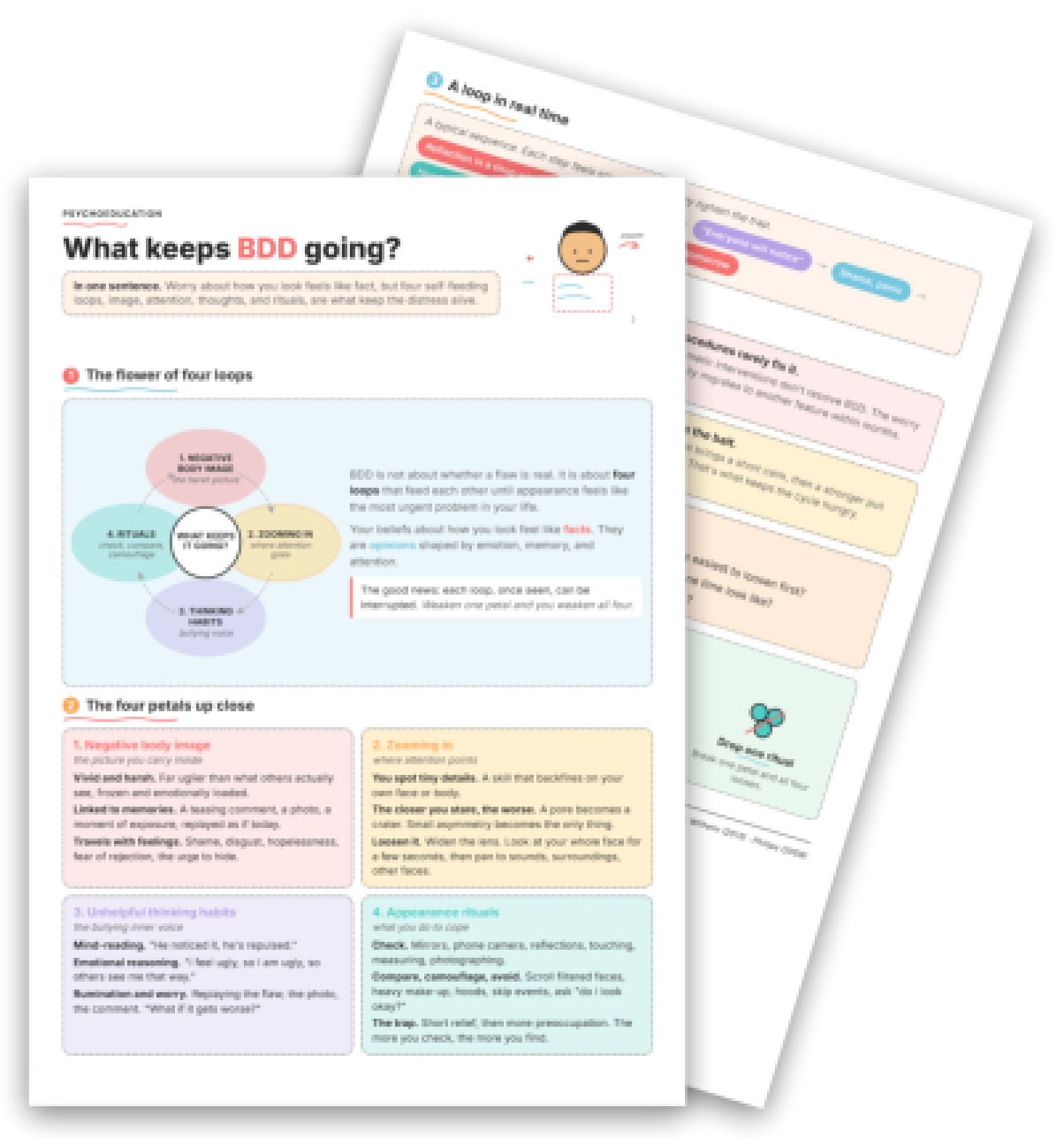
The PDF worksheet is organized around a central "flower of four loops": negative body image, zooming in, thinking habits, and rituals. Each petal is then unpacked in a dedicated panel with short, clinically precise descriptions.
The negative body image panel names the phenomenology directly: "vivid and harsh, far uglier than what others actually see, frozen and emotionally loaded", and crucially, it links the image to memory, naming "a teasing comment, a photo, a moment of exposure, replayed as if today." That last phrase often opens significant material without you needing to ask.
The zooming in panel describes the selective attention mechanism with a concrete behavioral instruction: "widen the lens, look at your whole face for a few seconds, then pan to sounds, surroundings, other faces." This gives you and the patient a shared reference for attentional retraining work.
The thinking habits panel names mind-reading, emotional reasoning, and rumination as "the bullying inner voice", a framing that supports defusion work without requiring ACT fluency.
The rituals panel maps checking, comparing, camouflaging, and avoidance, and spells out the trap: "short relief, then more preoccupation." A loop-in-real-time sequence (reflection in a shop window → zoom in → shame → cancel friends → short relief → worse tomorrow) makes the vicious cycle visible as a single connected chain.
A "Things worth knowing" section covers four clinical realities practitioners often struggle to introduce directly: mirrors worsen accuracy rather than confirm it; cosmetic procedures do not resolve BDD; "the flaw can be real, and the loops can still be what's destroying your life;" and relief from rituals is the bait that feeds the cycle.
Closing discussion prompts ("Which petal feels easiest to loosen first?") are ready to use as session debrief tools.
> Key takeaway: this fiche is a visual support that facilitates the explanation of BDD maintenance in session, not a questionnaire for solo completion, but a psychoeducation map you work through together, leaving the patient with a concrete reference to take home.
750+ clinical tools
A library built with and for clinicians, ready to use in session and extend between appointments.
Access all the toolsWhen and how to introduce the fiche
The fiche fits naturally after the initial formulation phase, once you have enough shared material to populate the four loops with the patient's own examples. Using it too early, before rapport is solid, risks feeling confrontational.
For patients who present with recognized BDD features but limited insight, you might frame it as: "I'd like to show you something that describes how appearance worry tends to sustain itself, not about whether the concern is real, but about the patterns around it." That framing sidesteps the insight impasse.
The loop-in-real-time diagram is particularly useful for patients who present with OCD-spectrum reassurance-seeking and multiple checking rituals: it makes the behavioral sequence visible before any exposure hierarchy work begins.
Debrief by asking which petal the patient recognizes most strongly, and which feels most accessible to interrupt. The fiche does not replace the CBT formulation of BDD, it makes the explanation of maintaining processes clear and leaves the patient with a durable reference between sessions.
Use it with your patients
Share this tool in the mobile app and follow the work between sessions.
Sources
- Veale, D. (2001). Cognitive-behavioural therapy for body dysmorphic disorder. Advances in Psychiatric Treatment, 7, 125-132.
- Wilhelm, S., Phillips, K. A., Steketee, G. (2013). Cognitive-Behavioral Therapy for Body Dysmorphic Disorder: A Treatment Manual. Guilford Press.
- National Institute for Health and Care Excellence (NICE) (2005). Obsessive-compulsive disorder and body dysmorphic disorder: treatment (CG31).
Your session continues in your patients' pocket
Use with a patientYour resources, available everywhere
The handouts, exercises, programs and audios above: you choose which ones to make available to your patients, in the mobile app dedicated to them.
And far more than a library
The app goes well beyond resources, to support your patients every day:
Related categories
Explore other clinical resources by category.

Anxiety
Clinical hub for anxiety disorders: CBT and ACT worksheets, psychoeducation sheets, and exercises for assessment and treatment across the anxiety spectrum.

Understand
Clinical hub for the therapeutic aim 'Understand': worksheets and tools to build patient insight across CBT, ACT, schema therapy and more.

Build awareness
Clinical worksheets and tools to build awareness in therapy: cognitive distortions, schemas, emotions, ACT and CBT resources for practitioners.

CBT
CBT worksheets, cognitive restructuring exercises & behavioral tools for clinicians. Evidence-based resources for every phase of cognitive behavioral therapy.

Trauma
Clinical hub on trauma and PTSD: assessment, differential diagnosis, treatment phases, and printable resources for practitioners. 155 chars.

Mood
Evidence-based worksheets and clinical tools for mood disorders: CBT, ACT, and positive psychology resources for psychologists and therapists.