
Clinical picture. J., a man in his late thirties presenting with recurrent depressive episodes and longstanding social withdrawal, was referred to a weekly outpatient group. At the first session, he offered only his first name and fell silent when asked to say more about himself. The clinician introduced the My Personal Story exercise between sessions, providing the structured prompt sheet and inviting J. to write a self-introduction covering who he is, where he lives, what he enjoys, and the broad phases of his life. When he read his text aloud the following week, the group noted that he had described a period of sustained caregiving for an ill parent, a detail he had never volunteered before. This opening allowed the clinician to explore how that phase had shaped his current difficulties, and J. reported feeling, for the first time, that the group held a coherent picture of him.
Personal Story: Guiding Patients to Narrate Their Life History
A structured self-introduction exercise for group therapy that turns a patient's life history into a clinically usable narrative between sessions.
Clinical vignettes
Narrative Avoidance in Group Intake
Fragmented Self-Presentation in Complex Trauma
Clinical picture. A., a woman in her mid-forties with a diagnosis of PTSD following multiple adverse life events, consistently described herself in purely symptomatic terms and struggled to locate any sense of personal continuity. The clinician proposed the My Personal Story exercise as a between-session writing task, framing it as an opportunity to introduce herself to the group as a whole person rather than as a set of difficulties. A. returned the following week with a brief but structured text: she had named her city, two leisure activities she still practiced, and three distinct life phases including a decade of professional stability she had not mentioned in prior individual sessions. Reading it aloud took several pauses, yet the act of completing the exercise appeared to help her tolerate a linear account of her own history. The clinician used specific passages as anchors for subsequent group work on identity and temporal continuity.
Why Life Narration Is Harder Than It Looks in Group Therapy
Asking a patient to introduce themselves to a group sounds simple. In practice, many patients freeze. They do not know where to start, they minimise their story, or they jump straight to the hardest chapters without any scaffolding. The difficulty is not shyness alone: most patients have never been invited to hold their own history as something worth telling, coherently, from beginning to present.
This is where words said in passing during a session rarely suffice. The work of building a coherent self-narrative requires time, privacy, and a structure the patient can follow without the pressure of an audience. It connects directly to how clinicians use tools like the Life Story: Past, Present, Future worksheet to help patients build continuity across life chapters, or how Personal Values work anchors identity in something more durable than circumstance. Life narration is also the entry point into deeper work on core beliefs, because the story a patient chooses to tell, and the parts they skip, is clinically rich data.
Use this resource with your patients
Handout, exercises and materials ready to use, right inside SessionFuel.
What the Exercise Contains
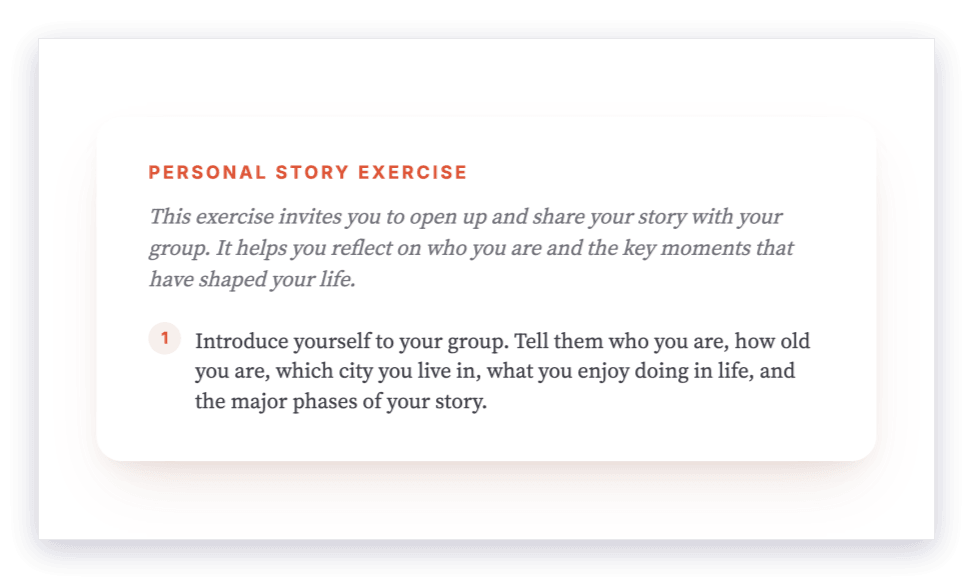
This exercise consists of one carefully framed open question inviting the patient to introduce themselves to their group: who they are, their age, where they live, what they love doing in life, and the major phases of their personal history. The scope is deliberately broad. It does not ask for the hardest memories first; it opens with presence and identity, then invites the patient to name the landmarks of their lived experience in their own words and at their own pace.
The image above lists this question as a static preview. The full guided exercise, with patient-facing instructions and writing space, is experienced by the patient directly in the app on their own, what you see here is only a structural overview, not the patient's actual experience.
That single question does a great deal of work. It asks for identity, geography, interests, and life arc simultaneously, which means the patient must make choices: what to include, what to foreground, how to frame transitions between phases. Those choices are the clinical material. Patients who struggle with social isolation often produce a very sparse answer. Those dealing with enmeshment may find it hard to describe themselves outside relational roles. Patients with a defectiveness/shame schema may write a story that is almost entirely about failure.
This exercise is available to patients through the mobile application that is the dedicated patient-side interface of SessionFuel: you assign it to your patient directly from your SessionFuel account, and they complete it on their own on their phone, between two sessions, at the time that suits them.
750+ clinical tools
A library built with and for clinicians, ready to use in session and extend between appointments.
Access all the toolsHow to Use It in Your Practice
This exercise suits group therapy contexts above all: new members preparing to introduce themselves before a first session, or any patient who needs to consolidate a self-presentation before stepping into a shared therapeutic space. It also fits individual work when the therapeutic relationship is still young and you want to understand how the patient organises their own story before offering any formulation.
Introduce it simply: "Before our next meeting, I'd like you to take a few quiet minutes and write something. Imagine you are introducing yourself to the group. Tell them who you are." The autonomy matters here. Done between sessions, without the pressure of your gaze, patients often write more honestly than they would speak.
When the patient brings back what they have produced, the debriefing is where the clinical work happens. Notice the structure of the narrative: is it chronological or fragmented? Notice what is absent, what receives one sentence versus several paragraphs. You can cross-reference what emerges with tools like Tracing the Origin of Core Beliefs or My Beliefs when the story reveals recurring self-limiting themes. If the patient has written about passions and strengths, the List of 100 Strengths and Qualities or the Strengths Exploration worksheet can extend that thread productively. And when the exercise surfaces loneliness or disconnection, resources on loneliness or the social exclusion schema become natural next steps.
Key insight: The story a patient chooses to tell about themselves, what they include, what they skip, and what words they use, is a first-pass clinical formulation they have written themselves.
Use it with your patients
Share this tool in the mobile app and follow the work between sessions.
Adapting the Exercise
For patients who find the question too open, you can suggest they start with the simplest layer: name, age, city, one thing they enjoy. The richer personal history can follow once they feel the structure is safe. For patients who have already done I Am Unique: A Guided Clinical Exercise for Holistic Self-Worth or the Celebrating Personal Successes exercise, this self-introduction can serve as a synthesis: a moment where scattered self-knowledge takes on the shape of a story.
Your session continues in your patients' pocket
Use with a patientYour resources, available everywhere
The handouts, exercises, programs and audios above: you choose which ones to make available to your patients, in the mobile app dedicated to them.
And far more than a library
The app goes well beyond resources, to support your patients every day:
Related categories
Explore other clinical resources by category.

Identity
Clinical resources for self-identity work in therapy: CBT, ACT, schema tools for clinicians addressing self-concept, core beliefs, and identity disruption.

Transitions
Clinical hub for life transitions: tools, worksheets and exercises to support psychosocial adjustment, role change and identity work in practice.

Humanistic
Printable clinical resources for humanistic therapy: worksheets, exercises, and psychoeducation programs for practitioners using person-centered and experiential approaches.

Systemic & narrative
Systemic family narrative therapy resources for clinicians: worksheets, psychoeducation programs, and exercises for couples, families, and groups.

Anxiety
Clinical hub for anxiety disorders: CBT and ACT worksheets, psychoeducation sheets, and exercises for assessment and treatment across the anxiety spectrum.
Trauma
Clinical hub on trauma and PTSD: assessment, differential diagnosis, treatment phases, and printable resources for practitioners. 155 chars.