
Clinical picture. A., a woman in her late forties, was referred following six months of persistent dizziness after a vestibular neuritis episode. She had significantly restricted her activities, avoided supermarkets and screen use, and held a firm belief that her symptoms indicated ongoing neurological damage. The clinician introduced the Understanding Balance informational sheet and walked through the three-stream model, explaining how the brain reweights inputs when one signal becomes unreliable. A. recognised her pattern immediately: she had been scanning her visual field constantly and gripping surfaces, behaviours the sheet frames as over-reliance on compensatory streams rather than signs of structural harm. By the end of the session she could articulate the mismatch mechanism in her own words, which provided a working rationale for the graduated exposure work planned for subsequent appointments.
Understanding Balance: PDF Worksheet, Tools and Exercises for Clinical Practice
A visual psychoeducation fiche clinicians can use in session to explain how the vestibular system works, why dizziness occurs, and how the brain maintains a perpetuating loop.
Clinical vignettes
Psychoeducation Reframes Chronic Dizziness
Normalising Scroll-Induced Dizziness in a Young Adult
Clinical picture. T., a man in his mid-twenties, presented with intermittent dizziness triggered almost exclusively by scrolling on his phone while commuting and by busy visual environments. Physical investigations were unremarkable, yet he remained convinced something was being missed medically. The clinician used the Understanding Balance sheet to illustrate the everyday-mismatch examples, specifically the moving-vehicle and patterned-aisle scenarios, noting that these represent normal sensory conflict rather than pathology. T. was visibly relieved that the experience had a named mechanism and that others without any diagnosis encountered it in the same contexts. He agreed to a brief self-monitoring log to track triggering situations, which gave both clinician and patient a concrete starting point for symptom management without reinforcing health anxiety.
Patients presenting with persistent dizziness almost universally arrive with a catastrophic frame: something structural is wrong, something is being missed. Correcting that belief verbally, mid-session, rarely sticks. This fiche PDF gives you a one-page visual support to walk through how balance actually works and, critically, why dizziness does not equal damage.
Use this resource with your patients
Handout, exercises and materials ready to use, right inside SessionFuel.
Why Balance Is So Hard to Explain at Oral Level
The fundamental difficulty is not complexity. It is that patients have no felt experience of how the balance system normally runs, so when it misfires they fill the gap with worst-case biomedical attributions. Tell a patient that "three sensory streams are integrated by the brain," and you get a polite nod followed by unchanged hypervigilance.
The second obstacle is the perpetuating loop itself: over-monitoring ("am I dizzy now?"), safety behaviors such as gripping trolleys or scanning the floor, and situational avoidance all feel protective, so challenging them without a clear rationale meets resistance. Patients need to see why their compensatory strategies are the problem, not the solution, before they will experiment with dropping them.
This fiche resolves both obstacles. It is not a questionnaire. It is a clinician-held visual tool that makes a mechanistic explanation concrete enough to create genuine buy-in.
What the Fiche Contains: A Visual Framework for the Session
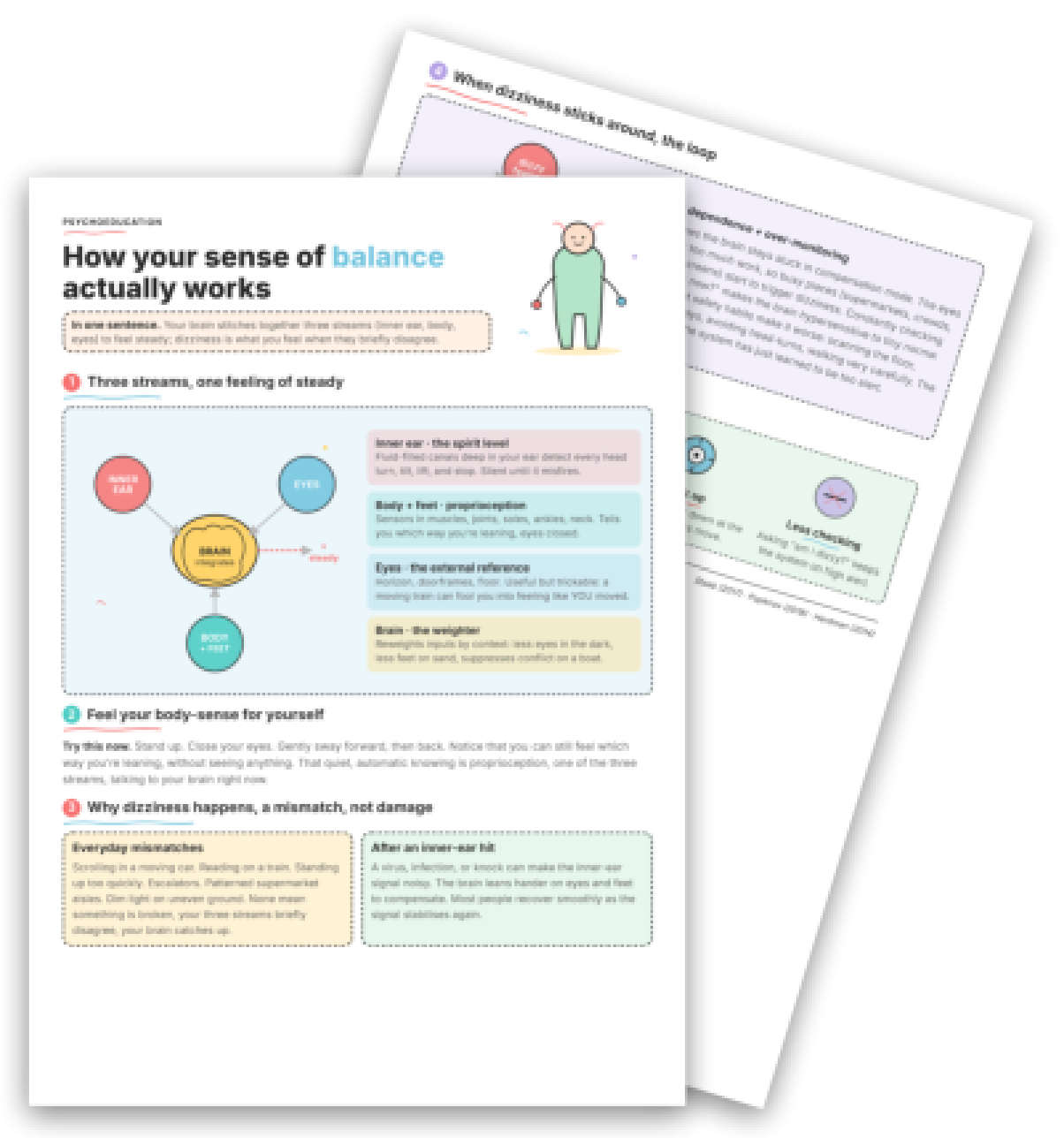
The fiche opens with a clear diagram labelled Three streams, one feeling of steady, showing the inner ear, body plus feet, and eyes each feeding a central brain integration node. The visual layout, arrows converging on a single output, shows instantly what a verbal list of "contributors" cannot: that steady is a product of convergence, and dizziness is what happens when those inputs briefly disagree.
Section 2 embeds a brief somatic experiment the patient can try in the room: "Stand up. Close your eyes. Gently sway forward, then back." This turns proprioception from an abstract term into a directly felt phenomenon, often the moment a patient's posture actually changes.
Section 3 distinguishes everyday mismatches from post-infection inner-ear disruption, with concrete examples ("Scrolling in a moving car. Reading on a train."). The framing, none mean something is broken, is stated plainly, which you can echo and reinforce immediately.
Section 4 is clinically the most useful. It maps the visual dependence and over-monitoring loop with a simple four-node diagram: dizzy feeling, scary thought, more anxiety, back to dizzy feeling. Alongside it, the fiche names the specific psychological safety crutches that maintain the system on high alert. This panel directly supports case formulation work and pairs naturally with your explanation of the CBT model of PPPD.
Section 5 closes with four short take-home principles: Not damage. Brain relearns. Look up. Less checking. Brief enough to retain; specific enough to act on.
> Key point: the fiche is a visual support that facilitates in-session explanation. The diagrams and somatic prompt do work that spoken description alone cannot: they let the patient see the mechanism, experience one stream of it immediately, and leave the room with a concrete reference.
750+ clinical tools
A library built with and for clinicians, ready to use in session and extend between appointments.
Access all the toolsHow and When to Propose It
This fiche fits naturally in a first or second session with any patient presenting with unexplained dizziness, health anxiety overlapping with vestibular symptoms, or a confirmed PPPD diagnosis. It is also useful when a patient with panic disorder misattributes dizziness during a panic episode as evidence of neurological illness.
A low-barrier introduction: "Before we talk about what we can do, I want to show you what we think is happening. There is a short diagram that explains it better than I can in words alone."
Work through the fiche together rather than handing it over. Pause at the loop diagram in Section 4 and ask the patient to name which behaviors on the list they recognize in their own week. That micro-debrief turns the visual into a shared formulation rather than a handout.
One practical limit: patients with an active undiagnosed vestibular condition should have a medical workup in progress before you consolidate a calibration model. The fiche supports this by framing habituation-based recovery as contingent on the signal stabilising, which creates space to hold both medical and psychological strands without contradiction.
The fiche does not replace the clinical relationship or the case formulation. What it does is give both clinician and patient the same map to look at, cutting down the time spent on conceptual groundwork and moving more quickly toward graduated exposure work and the reduction of over-monitoring.
Use it with your patients
Share this tool in the mobile app and follow the work between sessions.
Sources
- Staab, J. P., Eckhardt-Henn, A., Horii, A., Jacob, R., Strupp, M., Brandt, T., Bronstein, A. (2017). Diagnostic criteria for persistent postural-perceptual dizziness (PPPD): Consensus document of the committee for the Classification of Vestibular Disorders of the Barany Society. Journal of Vestibular Research.
- Kandel, E. R., Schwartz, J. H., Jessell, T. M., Siegelbaum, S. A., Hudspeth, A. J. (2012). Principles of Neural Science, Fifth Edition. McGraw-Hill.
Your session continues in your patients' pocket
Use with a patientYour resources, available everywhere
The handouts, exercises, programs and audios above: you choose which ones to make available to your patients, in the mobile app dedicated to them.
And far more than a library
The app goes well beyond resources, to support your patients every day:
Related categories
Explore other clinical resources by category.

Anxiety
Clinical hub for anxiety disorders: CBT and ACT worksheets, psychoeducation sheets, and exercises for assessment and treatment across the anxiety spectrum.

Health
Somatic health clinical resources for practitioners: worksheets, psychoeducation, and exercises for somatic symptom disorder, chronic pain, and more.

Understand
Clinical hub for the therapeutic aim 'Understand': worksheets and tools to build patient insight across CBT, ACT, schema therapy and more.

CBT
CBT worksheets, cognitive restructuring exercises & behavioral tools for clinicians. Evidence-based resources for every phase of cognitive behavioral therapy.

Integrative
Integrative therapy clinical resources: worksheets, psychoeducation programs, and exercises for eclectic, multimodal practice across orientations.

Trauma
Clinical hub on trauma and PTSD: assessment, differential diagnosis, treatment phases, and printable resources for practitioners. 155 chars.