
Clinical picture. M., a 34-year-old man, presented with recurrent jealous episodes directed at his partner of three years, triggered most often by her professional socialising. Between sessions, his therapist introduced the structured self-reflection exercise, asking him to describe the most recent jealous episode in writing before rating the excessiveness of his thoughts on the 1-to-10 scale. M. rated his intrusive thoughts at 8 and his subsequent checking behaviour at 7, then noted, with some surprise, that he had sent his partner fourteen messages during a single evening. Completing question four prompted him to articulate, unprompted, that the checking had eroded rather than restored his sense of security. At the following session this written account served as a concrete starting point for examining the gap between his protective intent and the relational cost of his actions.
Jealousy in Relationships: A Guided Self-Reflection Exercise
Help patients examine jealous thoughts, rate their reactions, and map the relational cost of jealousy with a structured between-session homework tool.
Clinical vignettes
Mapping Jealousy After a Work Event
Self-Reflection Reveals Avoidance Pattern
Clinical picture. T., a woman in her late twenties, was seen for anxiety with a secondary focus on jealousy that had led to two relationship breakdowns. Her therapist assigned the exercise as homework after a session in which T. struggled to identify specific triggers, describing her jealousy only in vague terms. Working through the questions at home, she wrote about a moment when her current partner had laughed with a colleague during a video call; she rated her thoughts as 6 out of 10 for excessiveness, then recognised through question three that her actual response had been to withdraw entirely rather than to confront. The exercise helped her see withdrawal as a behavioural response to jealousy, a pattern she had not previously labelled as such. Question five led her to draft a short personal statement about what acting from trust, rather than fear, might look like for her going forward.
Why Jealousy Is Hard to Work With Clinically
Jealousy sits at the intersection of attachment fear, cognitive distortion, and behavioral dysregulation, and patients rarely arrive ready to question it. The feeling is vivid and urgent; the behaviors it drives can feel entirely justified in the moment. What makes clinical work on jealousy genuinely difficult is that the disproportionality is almost invisible to the patient while it is happening. Explaining this verbally often lands as a lecture, not an insight.
Jealousy also tends to feed a self-confirming interpersonal loop: controlling or checking behaviors create relational distance, which the patient reads as confirming their suspicion, which intensifies the jealousy. A tool that asks the patient to slow down and observe their own cognitions and conduct, on their own time, can bypass the defensiveness that a direct in-session challenge sometimes triggers. Pairing this exercise with your work on fear of a partner leaving or emotional dependency adds useful clinical depth.
Use this resource with your patients
Handout, exercises and materials ready to use, right inside SessionFuel.
What the Exercise Contains
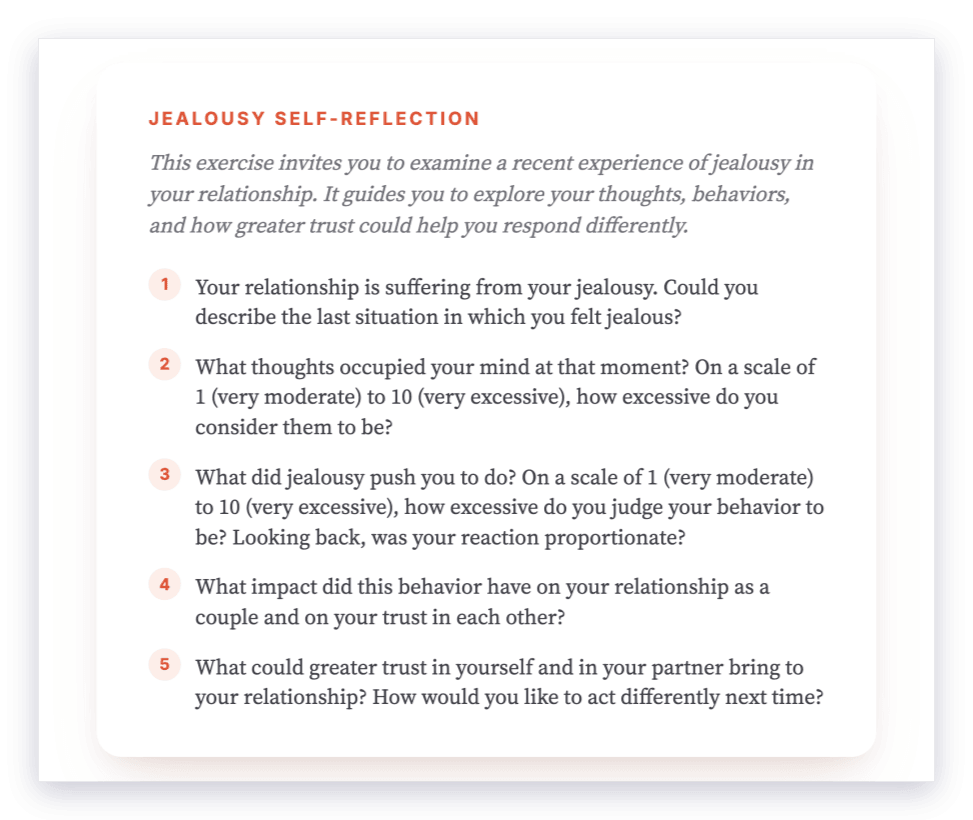
The exercise is built around five structured questions. The image above lists them in order with a short orienting introduction.
Please note: this image is a static preview of the question list only. The full guided exercise, with patient-facing instructions and space to write, is experienced by the patient autonomously inside the app, not in this preview.
- The patient recalls a specific recent situation in which they felt jealous, grounding the work in concrete experience rather than generalities.
- They name the thoughts that occupied them and rate their own perceived excessiveness on a 1-to-10 scale, an accessible entry point into cognitive distortion awareness.
- They identify what the jealousy drove them to do, rate the behavior on the same scale, and reflect with hindsight on whether the reaction was proportionate, which mirrors the logic of a reciprocal CBT formulation.
- They examine the impact on the couple and on mutual trust, making the relational cost tangible rather than abstract.
- They imagine what greater self-confidence and trust in their partner could bring, and describe how they would prefer to act next time, building a forward-facing behavioral intention.
Key insight: The self-rating scales in questions 2 and 3 are clinically significant: they invite the patient to act as observer of their own mind, a first step toward genuine cognitive flexibility without requiring the clinician to say "your reaction was excessive."
This exercise is available to your patients through the mobile patient app that is the dedicated patient-side interface of SessionFuel: you assign it directly from your SessionFuel account, and your patient completes it on their own phone, between appointments, before bringing their answers back to the next consultation.
750+ clinical tools
A library built with and for clinicians, ready to use in session and extend between appointments.
Access all the toolsUse it with your patients
Share this tool in the mobile app and follow the work between sessions.
Assigning It as Between-Session Homework
This exercise suits patients who are already aware that jealousy is straining their relationship and are motivated to work on it, even if their insight into their own patterns remains partial. It works well alongside psychoeducation on attachment styles in romantic relationships and beliefs that damage relationships.
Introduce it as a structured observation task rather than a self-criticism exercise. You might frame it as: "I'd like you to look at one recent moment, not to judge yourself, but to see it more clearly." This framing reduces shame-driven avoidance.
When the patient returns with their answers, the material is rich. The gap between the thought-excessiveness rating and the behavior-excessiveness rating often reveals something important: patients who score their thoughts moderately but their behaviors highly are showing you where the behavioral impulse outstrips reflection. That gap becomes a concrete therapeutic lever. The fifth question, about preferred future behavior, opens directly into assertive communication work, nonviolent communication for couples, or exploration of relationship values.
The exercise also pairs naturally with tools addressing the cognitive layer: mind-reading distortions, jumping to conclusions, and arbitrary inference are almost always present in jealousy-driven thought spirals. Naming them after the patient has already described their own thoughts, in their own words, lands with considerably more clinical traction.
For couples seen together, the patient's written answers can serve as a starting point for a structured dialogue, for instance using fair fighting rules or the couple's strengths exploration to hold both the difficulty and the relational resources in view at the same time.
Your session continues in your patients' pocket
Use with a patientYour resources, available everywhere
The handouts, exercises, programs and audios above: you choose which ones to make available to your patients, in the mobile app dedicated to them.
And far more than a library
The app goes well beyond resources, to support your patients every day:
Related categories
Explore other clinical resources by category.

Identity
Clinical resources for self-identity work in therapy: CBT, ACT, schema tools for clinicians addressing self-concept, core beliefs, and identity disruption.

Relationships
Clinical worksheets and tools on relational functioning: attachment, schemas, assertiveness, and communication skills for therapists. Printable PDF resources.

Build awareness
Clinical worksheets and tools to build awareness in therapy: cognitive distortions, schemas, emotions, ACT and CBT resources for practitioners.
CBT
CBT worksheets, cognitive restructuring exercises & behavioral tools for clinicians. Evidence-based resources for every phase of cognitive behavioral therapy.
Anxiety
Clinical hub for anxiety disorders: CBT and ACT worksheets, psychoeducation sheets, and exercises for assessment and treatment across the anxiety spectrum.

Trauma
Clinical hub on trauma and PTSD: assessment, differential diagnosis, treatment phases, and printable resources for practitioners. 155 chars.