
Clinical picture. M., a woman in her mid-thirties, presented with persistent low mood and social withdrawal following a third significant relationship ending in two years; she described an entrenched belief that being single confirmed she was fundamentally unlovable. The clinician introduced the structured written exercise between sessions, asking M. to work through each question in sequence and bring her responses to the next appointment. At question three, M. identified several counter-examples: longstanding close friendships, positive feedback from colleagues, and a previous relationship she had chosen to end herself. By question five she had listed two concrete actions, resuming a pottery class and scheduling a weekend trip with a friend, framing these as ends in themselves rather than strategies to meet a partner. At follow-up she reported a modest but genuine reduction in ruminative thinking and noted that the exercise had made the distortions feel less self-evident.
Negative Thoughts About Being Single: A Guided CBT Exercise
Help patients challenge the cognitive distortions sustaining singlehood distress and rebuild genuine wellbeing with a structured autonomous homework exercise.
Clinical vignettes
Reappraising Singlehood After Repeated Setbacks
Challenging Permanence Beliefs in a Single Man
Clinical picture. T., a man in his late twenties, sought help for anxiety that had intensified after several peers announced engagements; he endorsed the automatic thought that his singlehood was a fixed trait rather than a circumstance, and he had begun declining social invitations to avoid perceived judgment. The clinician assigned the guided questionnaire as written homework, with the instruction to answer each question without self-censoring. Question four, addressing the non-predictive nature of his current situation, proved most generative: T. wrote at length about how his career and friendships had changed substantially over five years, weakening the assumption that his relational life was uniquely static. He remained ambivalent about some conclusions, which the clinician used as productive material in the subsequent session rather than treating as resistance. Avoidance of social events decreased incrementally over the following month, though broader mood remained a target for ongoing work.
Why This Is Clinically Hard to Address With Words Alone
Patients who struggle with being single rarely present it as a discrete problem. The distress is woven into identity: the thought "I am single" quickly becomes "I am unlovable," "something is wrong with me," or "this will never change." These are not simple complaints. They are fused cognitive appraisals that carry the full weight of negative automatic thoughts, overgeneralization, and fortune-telling about the future, often layered over a deeper belief about self-worth.
What makes this particularly difficult in the consulting room is that verbal reassurance backfires. Telling a patient "you will meet someone" or "you are a great person" tends to bounce off, not because they are unconvinced of your good intentions, but because their core beliefs filter out disconfirming data automatically. The work needs to happen at the level of structured self-examination, and it needs time and distance from the session to take root.
Use this resource with your patients
Handout, exercises and materials ready to use, right inside SessionFuel.
What This Exercise Contains
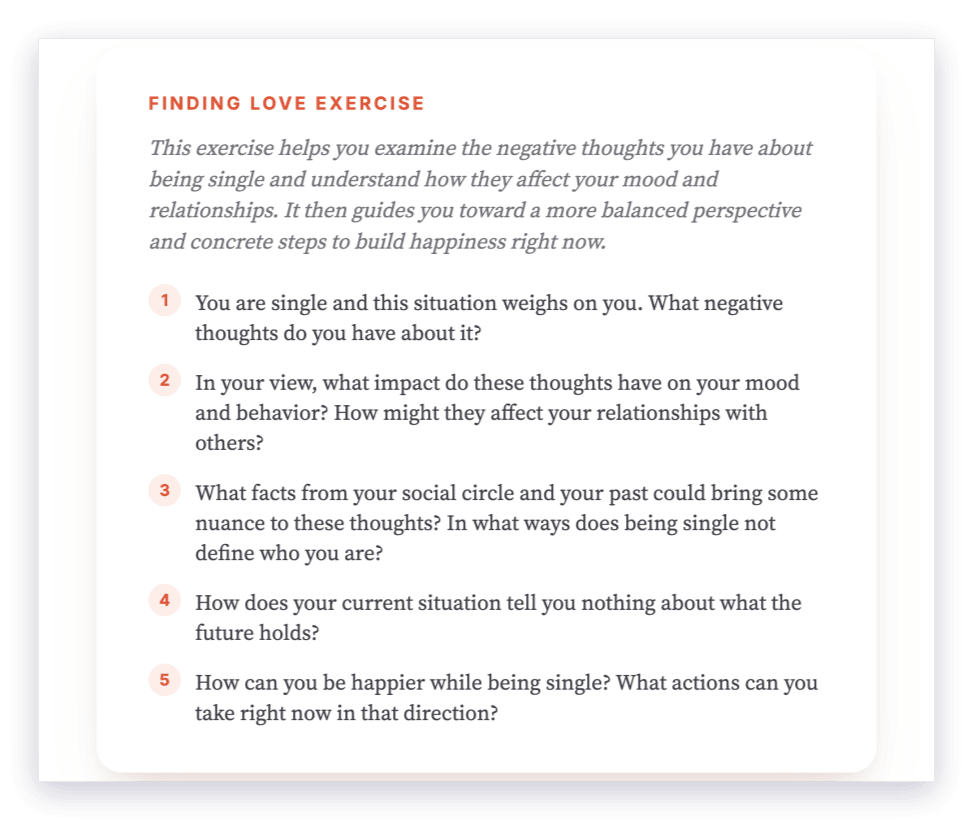
The exercise walks patients through five sequential questions that map directly onto the key cognitive and behavioral levers at play.
The image above lists the five questions in order with a brief introductory prompt. This is a static preview only. The full guided exercise, including the patient-facing instructions and the space to write responses, is experienced by the patient on their own inside the app, not in this image.
The sequence is deliberate. The first two questions invite patients to name and externalize their negative thoughts about singlehood, then trace their real consequences on mood, behavior, and social relationships. This mirrors the logic of evaluating thought utility: before challenging a thought, a patient must see what it costs them in daily life.
Questions three and four then shift the clinical register. Question three asks patients to gather facts from their own environment and personal history that nuance the negative appraisal, and to examine how relationship status does not define identity. This is a contained counter-evidence exercise, close in spirit to what you might do with the Interpersonal Beliefs and Styles worksheet. Question four targets the fortune-telling dimension directly: the patient is asked to articulate why their current situation carries no predictive weight about the future, a move that also surfaces and challenges catastrophizing patterns.
The fifth question closes with behavioral activation: what actions can the patient take now to build wellbeing within their current reality? This pivot from cognitive work to concrete behavior is essential, and it prevents the exercise from becoming purely ruminative.
This exercise is available to patients through the mobile application that is the dedicated patient-side interface of SessionFuel: once you assign it in your SessionFuel account, your patient receives it directly on their phone and completes it on their own, at their own pace, between appointments.
750+ clinical tools
A library built with and for clinicians, ready to use in session and extend between appointments.
Access all the toolsHow to Integrate It Into Your Practice
This exercise suits patients who intellectually acknowledge that their single status is not catastrophic yet remain caught in constant social comparison, feelings of not being good enough, or a pervasive sense of loneliness that has calcified into a self-narrative. It is also well adapted for patients where you have already introduced the CBT model and who are ready to apply it autonomously to emotionally charged material.
When introducing it, name the purpose plainly: you are asking them to do the restructuring work themselves, not just read or listen. Framing it as an experiment ("let us see what comes up when you sit with these questions on your own") reduces resistance.
When the patient brings their responses back, the clinical yield is high. The written answers give you direct access to the automatic thought layer, the specific cognitive distortions in operation (overgeneralization, labeling, fortune-telling), and the behavioral patterns sustaining distress. If question three reveals very sparse counter-evidence, that points toward a deeper core belief about the self that warrants its own thread. If question five produces a flat or empty behavioral list, that is a signal about action inertia or avoidance worth exploring directly.
Key insight: The exercise turns singlehood distress from an ambient mood state into examinable, structured material: automatic thoughts become visible, their downstream costs become nameable, counter-evidence becomes a patient's own discovery rather than the clinician's argument.
Use it with your patients
Share this tool in the mobile app and follow the work between sessions.
Clinical Articulations Worth Considering
For patients where the distress traces back to relational beliefs formed early, pairing this exercise with the 12 Beliefs That Damage Relationships worksheet can help situate the singlehood narrative inside a broader schema pattern. For patients marked by self-deprecation in social interactions, question five of this exercise can serve as a natural bridge toward behavioral activation work and, eventually, to rebuilding genuine social confidence.
Your session continues in your patients' pocket
Use with a patientYour resources, available everywhere
The handouts, exercises, programs and audios above: you choose which ones to make available to your patients, in the mobile app dedicated to them.
And far more than a library
The app goes well beyond resources, to support your patients every day:
Related categories
Explore other clinical resources by category.

Identity
Clinical resources for self-identity work in therapy: CBT, ACT, schema tools for clinicians addressing self-concept, core beliefs, and identity disruption.

Relationships
Clinical worksheets and tools on relational functioning: attachment, schemas, assertiveness, and communication skills for therapists. Printable PDF resources.

CBT
CBT worksheets, cognitive restructuring exercises & behavioral tools for clinicians. Evidence-based resources for every phase of cognitive behavioral therapy.

Anxiety
Clinical hub for anxiety disorders: CBT and ACT worksheets, psychoeducation sheets, and exercises for assessment and treatment across the anxiety spectrum.

Trauma
Clinical hub on trauma and PTSD: assessment, differential diagnosis, treatment phases, and printable resources for practitioners. 155 chars.

Mood
Evidence-based worksheets and clinical tools for mood disorders: CBT, ACT, and positive psychology resources for psychologists and therapists.