
Self-Identity in Clinical Practice: Assessment and Therapeutic Tools
Self-identity, also described in the literature as self-concept or sense of self, sits at the core of most presentations a clinician encounters across outpatient, inpatient, and private-practice settings. This page is designed for mental health professionals seeking structured, evidence-based printable resources to address self-identity disruptions within individual or group therapy. The fiches, worksheets, and exercises gathered here span several therapeutic orientations, including CBT, ACT, schema therapy, and positive psychology, so they can be integrated into a personalised care plan regardless of your primary modality. Each resource targets a specific mechanism through which a fragmented, rigid, or devalued sense of self maintains psychological distress.

What Clinicians Mean by Self-Identity
Self-identity refers to the relatively stable set of beliefs, values, roles, and personal narratives through which an individual understands who they are across time and context. It is not a unitary trait but a dynamic psychological structure that integrates autobiographical memory, interpersonal experience, affective appraisal, and culturally situated meaning-making. In clinical work, the concept overlaps with self-concept clarity, identity coherence, and the sense of personal continuity described in phenomenological approaches.
A disrupted sense of self rarely announces itself as the chief complaint. Patients more often present with relational difficulties, persistent low mood, impulsivity, or an inability to make decisions that feel authentic. The clinician's task is to recognise when identity dysregulation underlies these surface presentations and to choose interventions that address the structural level, not only symptom relief.
The Developmental and Relational Roots of Self-Identity
Self-identity consolidates across adolescence and early adulthood but remains sensitive to relational experience throughout life. Attachment history is a particularly powerful organiser: early patterns of felt security or insecurity shape the internal working models through which the self is perceived in relation to others. The Attachment Styles in Romantic Relationships: PDF Worksheet, Tools and Exercises is a clinically useful starting point when mapping how a patient's relational template has shaped their self-perception, particularly the degree to which their sense of worth is contingent on external validation.
Schema theory adds another layer. Early maladaptive schemas encode core beliefs about the self that were adaptive responses to adverse developmental conditions but become identity-constricting in adult life. Reviewing 12 ACT Schemas and Modes of Thinking: PDF Worksheet, Tools and Exercises with a patient can make visible the cognitive architecture sustaining a devalued or unstable self-concept.
Identifying Self-Identity Disruptions During Assessment
Clinical Signs and Presentation Variants
Self-identity difficulties present along a broad spectrum. At one end, mild identity uncertainty is developmentally normative and situationally triggered (career transitions, relationship breakdown, migration). At the other end, chronic identity diffusion manifests as a persistent inability to articulate values, preferences, or life direction, and is a DSM criterion for borderline personality organisation. Between these poles, clinicians commonly see overcompliant identity (the self defined entirely by the expectations of others), defensive identity rigidity (an inflexible self-concept that forecloses growth), and shame-organised identity (the self experienced as fundamentally defective).
Useful screening questions include: "How would you describe yourself to someone who does not know you?", "What do you believe you are entitled to in relationships?", and "When you imagine your life in five years, do you see a recognisable version of yourself there?" Patients who struggle to answer, who answer only in relational terms ("I am my children's mother"), or who answer with exclusively negative content warrant deeper identity-focused assessment.
The Role of Core Beliefs
Core beliefs about the self are the cognitive substrate of identity. Distorted or absolutist beliefs that the self is unlovable, incompetent, or inherently bad both reflect and perpetuate identity disturbance. The worksheet 12 Beliefs That Damage Relationships: PDF Worksheet, Tools and Exercises is particularly effective for surfacing relational core beliefs that implicitly define how the patient understands their own worth and position in the social world.
> Clinical vignette: A 34-year-old patient presented for burnout. Standardised assessment revealed no mood disorder. Session three, she said: "I have never known what I actually want. I just know what other people need from me." Identity work, not fatigue management, became the treatment focus. The Assertive Rights: PDF Worksheet, Tools and Exercises for Clinical Practice was introduced in session four to begin articulating a personal value base from which authentic choice could emerge.
Comorbidities and Differential Diagnosis
When Self-Identity Disruption Is Part of a Larger Picture
Identity disturbance is a transdiagnostic feature, but its clinical weight varies. In borderline personality disorder, it is a defining criterion; in complex PTSD, it presents as a damaged or shattered self-concept secondary to chronic relational trauma. It appears in eating disorders as a body-image-dominated self-definition: the CBT Model of Bulimia Nervosa: PDF Worksheet, Tools and Exercises explicitly maps how self-worth overevaluation in terms of shape and weight locks patients into a restricting, purging cycle that is also an identity-maintenance strategy.
Depression frequently co-occurs with identity rigidity, particularly when the patient holds a globally negative self-schema that depression then confirms. Distinguishing between a depressive episode that has temporarily coloured self-perception and a structurally entrenched negative identity requires careful longitudinal formulation.
Defensive Presentations: Anger and Concealed Vulnerability
Not all identity difficulties present as passivity or low self-esteem. Some patients defend a fragile sense of self through externalisation and reactive anger. The The Anger Iceberg: PDF Worksheet, Tools and Exercises for Clinical Practice is a valuable psychoeducational tool for these cases, helping both patient and clinician see the shame, fear, or abandonment-related pain that the anger is concealing. Abandonment anxiety, in particular, is often an identity threat: the patient whose sense of self depends on a specific relationship experiences the loss of that relationship as existential. The The Abandonment Schema: PDF Worksheet, Tools and Exercises for Clinical Practice addresses this mechanism directly.
Schema Therapy and ACT Perspectives on Self-Identity Work
Schema-Focused Formulation
Schema therapy offers a structured model for understanding how early maladaptive schemas consolidate into an enduring, self-reinforcing identity narrative. The clinician's role is to help the patient distinguish between the schema-driven self ("I am worthless") and the healthy adult self capable of meeting core emotional needs. Psychoeducation about schema modes, supported by 12 ACT Schemas and Modes of Thinking: PDF Worksheet, Tools and Exercises, provides patients with a map of the internal states that drive self-undermining behaviour.
The ACT Perspective: Self-as-Context
In Acceptance and Commitment Therapy, self-identity is approached through the distinction between the conceptualised self (the story the patient tells about who they are) and self-as-context (the observing, continuous awareness in which experience arises). Fusing with a rigid or negative self-concept is understood as a form of cognitive fusion that narrows behavioural repertoire. The The ACT Hexaflex: PDF Worksheet, Tools and Exercises for Clinical Practice is an effective psychoeducational scaffold for introducing this framework, while Psychological Flexibility: PDF Worksheet, Tools and Exercises for ACT Practice supports the patient's gradual capacity to hold self-relevant thoughts without being governed by them.
For moments of acute identity-related decision-making (relationship exits, career pivots, value conflicts), The Choice Point: PDF Worksheet, Tools and Exercises for ACT Practice provides a concise, session-ready structure that asks patients whether a contemplated action moves them toward or away from their chosen values.
Building a Positive and Flexible Self-Identity
From Deficit Reduction to Identity Construction
A complete self-identity intervention does not stop at reducing distorted self-beliefs. The second phase involves actively constructing a richer, more flexible, and more value-congruent sense of self. Positive psychology techniques are well-suited to this phase. The Best Possible Self: PDF Worksheet, Tools and Exercises for Clinical Practice is a structured imagery and writing exercise that invites patients to project themselves into a future in which their strengths have been fully expressed, generating motivational and identity-consolidating effects that are well-supported in the empirical literature.
Parallel work on mindset is often necessary. Patients with a fixed self-identity frequently believe their character traits are immutable, which forecloses therapeutic change. Introducing the concept of neuroplasticity and cognitive malleability through Adopting a Growth Mindset: PDF Worksheet, Tools and Exercises for Clinical Practice can shift this assumption and open the patient to identity revision as a legitimate, ongoing process rather than a threat.
Assertiveness as Identity Expression
Assertiveness is not simply a communication skill; it is the behavioural expression of a coherent, valued self. Patients who cannot assert needs or boundaries often lack a sufficiently consolidated identity to draw the line from: they do not assert because they do not know, at a felt level, what they want or what they deserve. The Assertiveness: PDF Worksheet, Tools and Exercises for Clinical Practice and the Assertiveness Ladder: PDF Worksheet, Tools and Exercises for Clinical Practice are best introduced once initial identity clarification work has begun, rather than as stand-alone communication exercises, so that the behavioural change is grounded in an evolving sense of self.
Addressing cognitive distortions that undermine interpersonal confidence, such as mind reading, is equally important at this stage. Patients who chronically assume negative evaluations by others will find assertiveness threatening regardless of skill level. The Mind Reading: PDF Worksheet, Tools and Exercises for Clinical Practice targets this specific distortion and integrates naturally into a broader identity-focused CBT sequence.
Sequencing Resources Within the Care Plan
A coherent sequencing of these tools across a treatment arc might follow this logic:
- Assessment and psychoeducation phase: introduce core belief and schema mapping (relational beliefs worksheet, schemas and modes fiche, abandonment schema fiche).
- Formulation sharing: present the identity formulation collaboratively; use the anger iceberg and attachment styles worksheets to enrich the shared model.
- Defusion and values clarification: deploy ACT-oriented resources (hexaflex, psychological flexibility, choice point) to loosen fusion with the pathological self-concept.
- Identity construction: introduce growth mindset and best possible self exercises to build a forward-looking, agency-based self-narrative.
- Behavioural consolidation: integrate assertiveness tools and cognitive distortion work to translate identity gains into daily interpersonal functioning.
Group therapy formats can follow the same arc, with the psychoeducational fiches serving as shared anchors across sessions.
Points of Vigilance and Clinical Limits
When Self-Identity Work Requires Pacing
Pushing identity reconstruction too quickly in patients with severe personality pathology or a dissociative presentation risks destabilisation. In these cases, safety, affect regulation, and trauma-informed stabilisation take precedence. Identity work is introduced incrementally, and any resource that invites deep self-reflection should be piloted in session before being assigned as between-session homework.
Some patients with entrenched shame-based identity experience psychoeducational exercises as confirming their defectiveness ("Even my identity is wrong"). The clinician's relational stance, warmth, and collaborative framing of any worksheet are at least as important as the content of the fiche itself. No printed tool substitutes for a strong therapeutic alliance.
Scope of These Resources
The fiches and worksheets on this page are clinical adjuncts, not standalone treatments. They are most effective when embedded in a structured formulation-driven therapy. When a patient presents with identity disruption in the context of an active psychotic episode, severe dissociation, or acute suicidality, clinical stabilisation takes absolute precedence over identity-focused intervention.
Tools in this category

Handout
Core Beliefs: Examining the Evidence, PDF Worksheet, Tools and Exercises
A visual PDF worksheet helping clinicians explain how core beliefs filter incoming evidence, and giving patients a concrete audit they can run between sessions.
Self & identityThoughts & cognition

Handout
Core Beliefs: PDF Worksheet, Tools and Exercises for Clinical Practice
A visual PDF worksheet with tools and exercises to make the core beliefs model concrete and clinically usable in session, built on Beck, Young, and Padesky.
Thoughts & cognitionSelf & identity

Handout
Countering Negative Thoughts: PDF Worksheet, Tools and Exercises
A structured PDF worksheet clinicians can use as a visual support in session to explain cognitive countering, build a shared vocabulary, and give patients a concrete take-home reference.
Thoughts & cognitionSelf & identity
Feature
Daily Affirmations: Supporting Inner Dialogue in Therapy
A daily touchpoint that keeps cognitive restructuring and self-compassion alive between consultations, one credible message at a time.
AnxietyMood & depression
Feature
Daily Therapeutic Journal: Tracking Mood Over Time
A structured between-session journaling tool that builds emotional granularity, captures daily patterns, and gives clinicians a dated qualitative record to work from.
AnxietyMood & depression
Feature
Daily Wellbeing Challenges: Building Between-Session Momentum
One rotating daily action across self-compassion, activation, connection, and values themes to sustain patient engagement and reinforce therapeutic gains.
AnxietyMood & depression
Feature
DASS-21: Tracking Depression, Anxiety and Stress Over Time
A standardized self-report repeated at regular intervals gives clinicians an objective, comparable measure of three distinct clinical dimensions.
AnxietyMood & depression
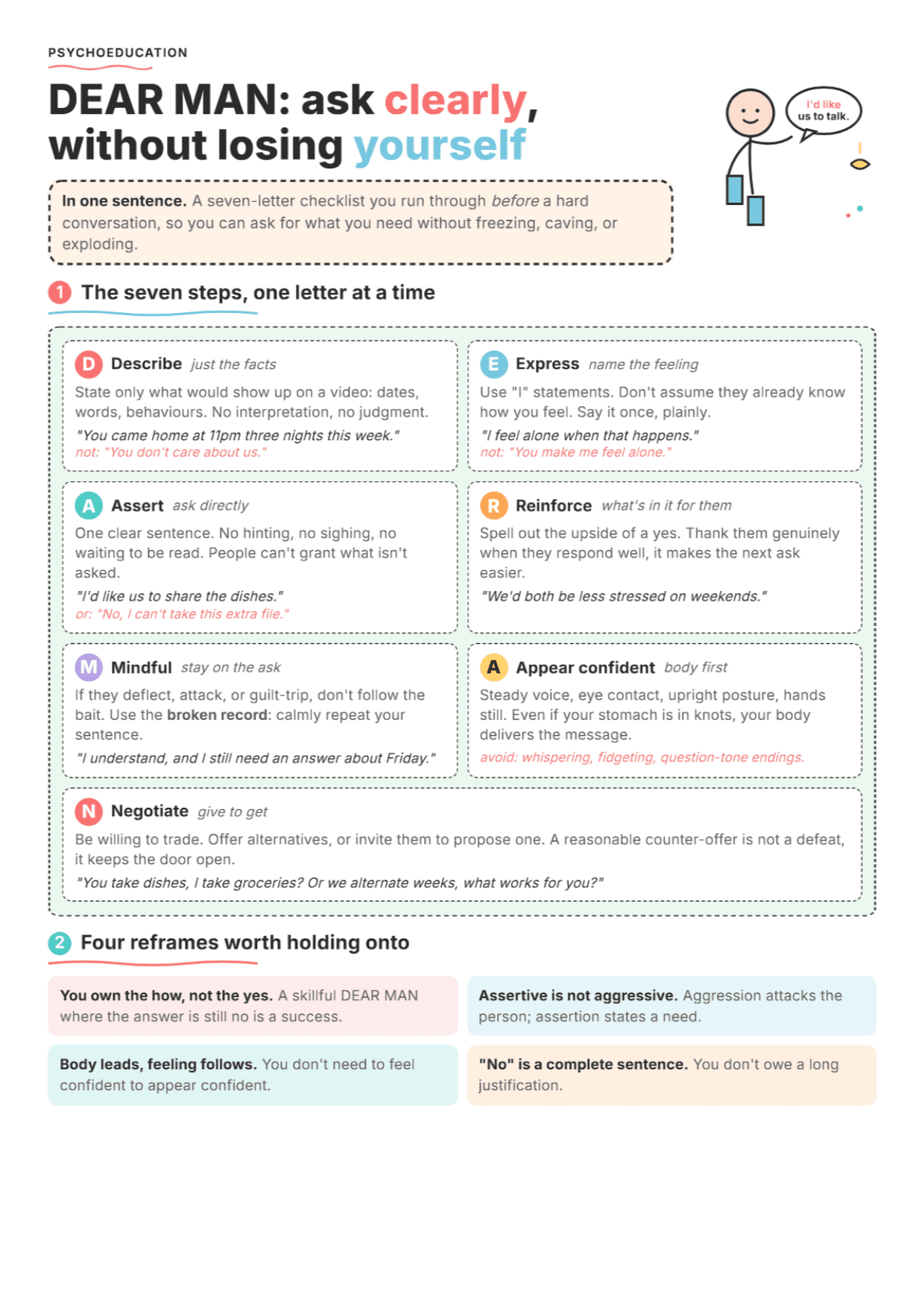
Handout
DBT DEAR MAN Skill: PDF Worksheet, Tools and Exercises
A printable PDF worksheet, clinical tools, and structured exercises to help patients ask for what they need assertively using the DBT DEAR MAN framework.
RelationshipsSelf & identity
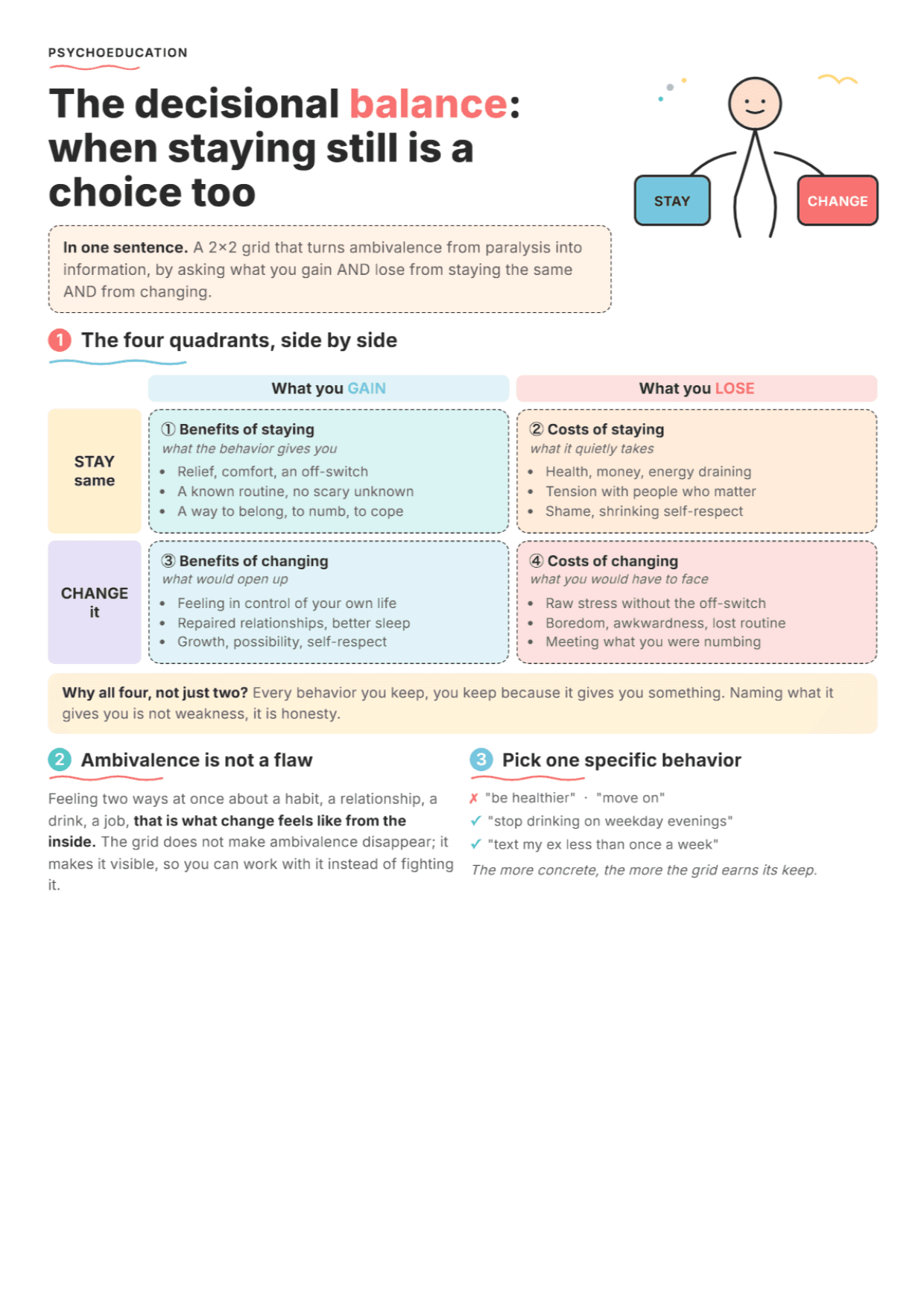
Handout
Decisional Balance: PDF Worksheet, Tools and Exercises for Clinical Practice
A printable PDF worksheet, visual tools, and structured exercises to make ambivalence visible and clinically workable in motivational interviewing and behavior-change sessions.
Behaviours & addictionsSelf & identity