
Engage & Motivate Clients: Clinical Tools for Therapeutic Momentum
Therapeutic engagement and motivation are among the most determinative factors in treatment outcome, yet they are rarely addressed with the same rigour as symptom-focused interventions. This category brings together printable worksheets, structured exercises, and psychoeducational tools specifically selected to help clinicians build and sustain client engagement across a range of presentations and therapeutic orientations. Whether you are working within ACT, CBT, positive psychology, or an integrative framework, the resources here are designed to be deployed at key inflection points in the care trajectory: intake, plateau, relapse, or transition. Each tool has a clear clinical rationale and can be introduced in session or assigned as between-session work.

The gap between attendance and active participation
Therapeutic engagement is not synonymous with attendance. A client can show up reliably while remaining at a safe psychological distance from the work, disconfirming hypotheses, avoiding affect, and producing the appearance of collaboration without any of its substance. Recognising this distinction early allows you to shift your clinical stance before disengagement becomes entrenched. The literature on premature dropout consistently identifies poor early alliance and low perceived relevance of treatment as the two most modifiable predictors.
Motivation, understood here as the energisation and direction of goal-directed behaviour, is itself a clinical target rather than a precondition for therapy. Waiting for a client to become motivated before intervening is a category error. The resources grouped in this category treat motivation as something that emerges from, and is shaped by, the therapeutic process itself.
Engagement across the care trajectory
Engagement concerns are not limited to the early sessions. They recur at every transition: when a formulation is shared, when an exposure hierarchy is introduced, when a client achieves partial goals and loses momentum, or when life circumstances shift and the original treatment rationale no longer resonates. Clinicians benefit from having tools that can re-anchor the work at these junctures without reverting to generic psychoeducation.
Clinical Mechanisms Underpinning Motivation Work
Values, discrepancy, and psychological flexibility
Across theoretical models, three mechanisms recur in the motivation literature. First, values clarification: helping clients articulate what genuinely matters to them creates an intrinsic motivational substrate that is far more durable than extrinsic incentives or avoidance-based drivers. Second, cognitive discrepancy: awareness of the gap between current behaviour and valued living generates discomfort that can be channelled therapeutically rather than defended against. Third, psychological flexibility, the capacity to contact the present moment and act in accordance with values even in the presence of difficult thoughts and feelings, mediates the translation of motivation into sustained behaviour change.
The Psychological Flexibility: PDF Worksheet, Tools and Exercises for ACT Practice provides a structured way to introduce this third mechanism to clients who need a concrete framework before they can engage with values-based work. Pairing it with the broader model map offered in the The ACT Hexaflex: PDF Worksheet, Tools and Exercises for Clinical Practice gives the clinician a coherent two-step psychoeducational sequence: first the construct, then the full hexagonal architecture that contextualises it.
The role of self-efficacy and growth orientation
Self-efficacy beliefs are proximal determinants of engagement: clients who doubt their capacity to change will selectively avoid challenging tasks, interpret ambiguous feedback negatively, and disengage at the first sign of difficulty. Targeting these beliefs directly, rather than simply encouraging persistence, is more efficient. The Adopting a Growth Mindset: PDF Worksheet, Tools and Exercises for Clinical Practice operationalises Dweck's framework for clinical use, helping clients identify their implicit theories about change and practise reframing setbacks as process information rather than evidence of fixed limitation.
Identifying Engagement Difficulties in Session
Clinical signs worth tracking
Before selecting a specific tool, it is worth mapping where in the engagement cycle the difficulty lies. Common presentations include:
- Pre-contemplative ambivalence: the client acknowledges a problem but attributes it entirely to external factors; the cost of change feels disproportionate.
- Action-phase stall: the client endorses the treatment rationale but fails to complete between-session tasks; avoidance is often the operative mechanism.
- Maintenance deficit: early gains are consolidated, but the client has not internalised a framework for self-directed continuation; dependence on the therapeutic relationship is the risk.
- Values disconnection: stated goals are socially compliant ("my partner wants me to stop drinking") rather than personally meaningful; sustaining effort in the absence of intrinsic ownership is fragile.
Each of these patterns calls for a different intervention emphasis, which is why the tools in this category are intentionally varied rather than interchangeable.
Differential considerations
Low motivation and poor engagement can be epiphenomena of untreated depression (anergia, anhedonia), ADHD (task initiation deficits), personality structure (dismissive attachment, chronic shame), or cultural mismatch between the client's explanatory model and the treatment frame. Ruling these out, or integrating them into the formulation, prevents a reflexive application of motivational tools to a problem that requires a different primary intervention.
Using the Worksheets in Session: Practical Integration
Anchoring to decision points
One of the most clinically productive moments for engagement work is what ACT calls the choice point: the instant when habitual avoidance or approach behaviour is triggered, and the client faces an implicit fork in the road. The The Choice Point: PDF Worksheet, Tools and Exercises for ACT Practice makes this implicit moment explicit and visible. Used mid-treatment, it can re-energise a client who has intellectually grasped the model but is not yet applying it behaviourally.
> A client with health anxiety had been engaging well in sessions for six weeks but continued to seek reassurance compulsively at home. Introducing the Choice Point worksheet in session 7 shifted the frame from "you must stop checking" to "at this moment, which direction moves you toward the life you described?" Within two sessions, self-monitoring logs showed a marked reduction in reassurance-seeking, not because the urge had diminished, but because the client now had a usable decision architecture.
Building toward a preferred future
Positive imagery and prospective cognition are underused in engagement work. The Best Possible Self: PDF Worksheet, Tools and Exercises for Clinical Practice draws on the well-validated Best Possible Self paradigm to generate an emotionally vivid representation of a valued future. This is particularly useful with clients who are stuck in problem-saturated narratives: it temporarily bypasses ruminative patterns and activates the approach system. Assign it between sessions with explicit instructions to write in the first person, present tense, and to include sensory detail.
Building behavioural repertoires alongside motivation
Motivation without skill is insufficient for sustained change. For clients whose disengagement is partly driven by assertiveness deficits (avoidance of conflict, difficulty making requests, inability to set limits), the Assertiveness Ladder: PDF Worksheet, Tools and Exercises for Clinical Practice provides a graduated, stepwise framework. Pairing it with motivational work reinforces the message that behaviour change is incremental rather than categorical.
Sequencing Resources Within the Care Plan
A suggested stepwise approach
The following sequence is not prescriptive, but it reflects a coherent clinical logic that many practitioners find useful:
- Clarify the motivational substrate: use values-based or prospective tools (Best Possible Self, ACT Hexaflex) early in treatment to establish a shared therapeutic direction.
- Assess and address self-efficacy: introduce growth mindset material when you observe avoidance of challenging tasks or catastrophic interpretation of setbacks.
- Map the decision architecture: deploy the Choice Point worksheet when the client has sufficient psychoeducational grounding to use it actively rather than passively.
- Build competency where gaps exist: target specific skill deficits (assertiveness, flexibility) that are maintaining disengagement.
- Re-anchor as needed: return to any of these tools at transitions, after setbacks, or when the therapeutic relationship itself becomes a site of avoidance.
Adapting to presentation and setting
In time-limited contexts (six to twelve sessions), prioritise the tools most directly linked to the formulated driver of disengagement. In longer-term work, the full sequence can unfold more gradually, with tools revisited and deepened as the client's capacity for self-reflection increases. In group settings, the psychoeducational fiches (ACT Hexaflex, Growth Mindset) double as shared reference documents that facilitate between-member discussion.
Points of Vigilance and Clinical Limits
When motivational tools are contraindicated or insufficient
Worksheets and structured exercises carry an implicit assumption: that the client can engage reflectively with written material and translate insight into behaviour. This assumption fails in several circumstances. Acute dissociation, severe executive dysfunction, active suicidality, and certain psychotic presentations all require a different primary approach. Using engagement tools with a floridly depressed client who is already self-critical about their "lack of willpower" risks reinforcing a shame spiral rather than interrupting it.
Clinician enthusiasm for a particular model (ACT, growth mindset frameworks) can also inadvertently foreclose the client's own motivational language. The tools work best when introduced as invitations rather than prescriptions, and when the clinician is genuinely curious about which framework resonates rather than committed to one in advance.
The alliance as primary vehicle
No worksheet substitutes for a strong therapeutic alliance. The tools in this category are catalysts; they accelerate and concretise work that the relational context makes possible. If the alliance is rupturing or has not yet consolidated, the most technically sophisticated worksheet will be experienced as cold, homework-like, or irrelevant. Repair the alliance first; introduce structured tools once the client experiences the clinician as genuinely attuned.
Tools in this category

Handout
Self-Care Tips: PDF Worksheet, Tools and Exercises for Clinical Practice
A printable PDF worksheet, practical tools, and concrete exercises to make self-care psychoeducation stick in session and give patients a lasting visual reference.
Emotions & stressLife transitions
Handout
Setting Life Goals: PDF Worksheet, Tools and Exercises for Clinicians
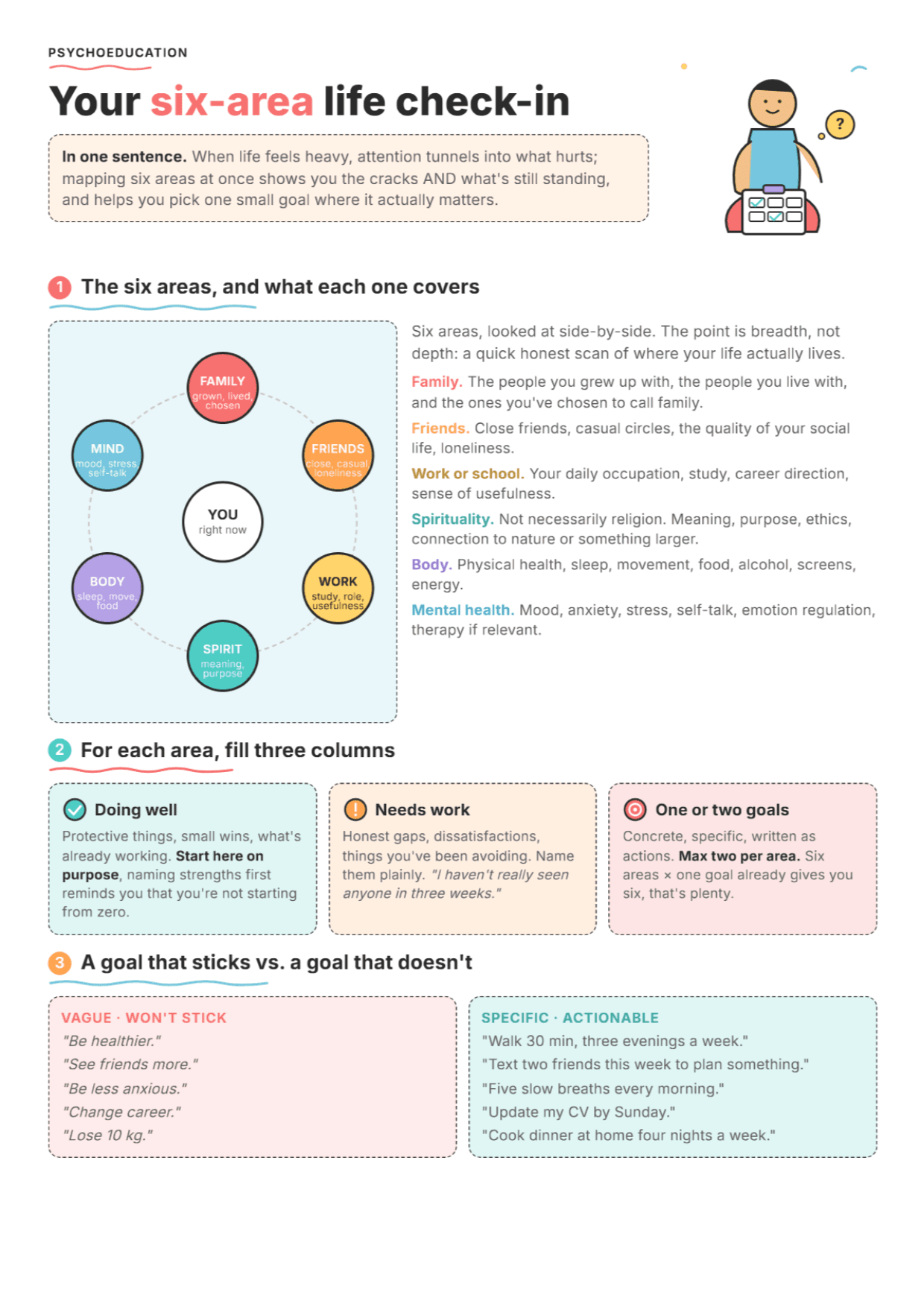
A structured six-area visual check-in helping patients break attentional tunnel vision, name strengths alongside gaps, and commit to specific, actionable goals in session.
Life transitionsSelf & identity

Handout
Setting Personal Limits: PDF Worksheet, Tools and Exercises for Clinical Practice
A visual PDF worksheet built around eight rehearsal scenarios, three communication style columns, and a borrowable phrase bank, to make limit-setting concrete in session.
Self & identityRelationships
Handout
SMART Goals: PDF Worksheet, Tools and Exercises for Clinical Practice
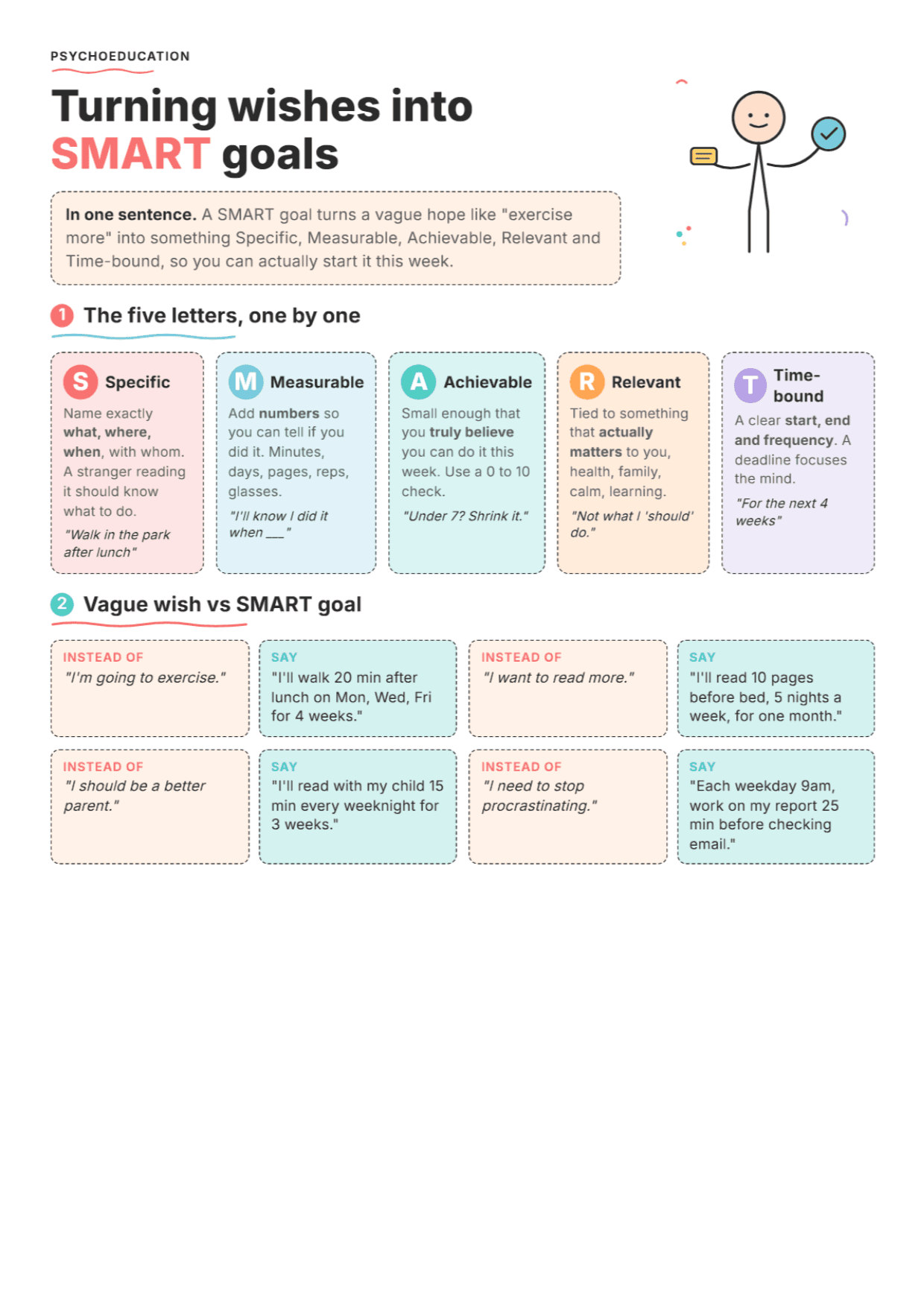
A printable PDF worksheet, clinical tools, and concrete exercises to help patients turn vague intentions into structured, achievable SMART goals in therapy.
Life transitionsMood & depression
Handout
Social Self-Care Activities: PDF Worksheet, Tools and Exercises
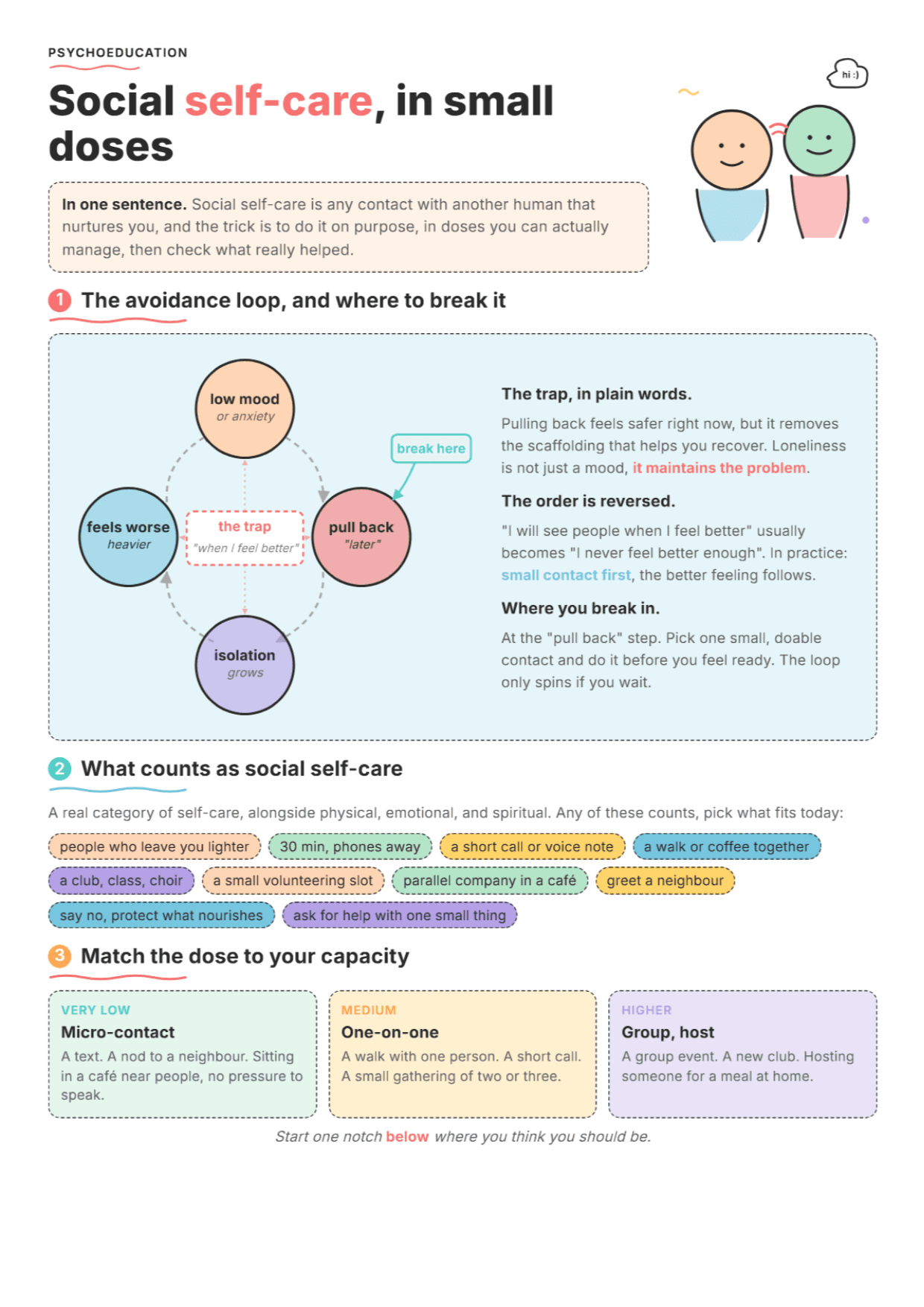
A printable PDF worksheet, clinical tools, and structured exercises to help patients break isolation, dose social contact, and track what genuinely restores them.
Mood & depressionTrauma & PTSD

Handout
Solution-Focused Brief Therapy: PDF Worksheet, Tools and Exercises
A printable psychoeducation fiche to explain SFBT's core logic visually in session, establish a shared vocabulary, and orient patients toward exceptions and forward-looking goals.
Life transitions

Handout
Sources of Workplace Stress: PDF Worksheet, Tools and Exercises
A visual PDF worksheet and practical tools to help clinicians name the five sources of occupational stress in session, shift self-blame, and map concrete actions with patients.
Emotions & stressLife transitions

Handout
Speaking to Your Future Self: PDF Worksheet, Tools and Exercises
A printable PDF worksheet, clinical tools and guided exercises helping patients prepare compassionate self-talk for their most predictable hard moments, before the crisis arrives.
AnxietyMood & depression

Handout
Stages of Change: PDF Worksheet, Tools and Exercises for Clinical Practice
A visual psychoeducation worksheet placing patients on the change spiral, naming ambivalence precisely, and reframing relapse as data rather than defeat.
Behaviours & addictionsEmotions & stress