
Humanistic Therapy: Printable Clinical Resources for Practitioners
Humanistic therapy, encompassing person-centered, existential, and experiential approaches, forms one of the most influential theoretical orientations in contemporary clinical practice. This page is addressed to psychologists, psychotherapists, and counselors who ground their work in humanistic psychology or who draw on its principles selectively within an integrative frame. Here you will find a curated set of printable worksheets, structured exercises, and psychoeducation programs specifically designed to support humanistic clinical work. Each resource has been developed to be used directly in session, assigned between appointments, or integrated into a broader care plan.

The Person-Centered Premise and Actualizing Tendency
Humanistic psychology rests on a set of philosophical commitments that distinguish it sharply from behavioral and classical psychodynamic models. At its core is the conviction that each individual carries an innate actualizing tendency: a directional drive toward growth, integration, and the realization of personal potential. In clinical terms, this means the practitioner's primary task is not to correct pathology but to create the relational conditions under which the client's own growth resources can be mobilized.
Carl Rogers' formulation of the necessary and sufficient conditions (empathy, unconditional positive regard, and congruence) remains the conceptual backbone of person-centered work. These are not mere techniques; they constitute the therapeutic mechanism itself. The quality of the relational encounter is therefore both the medium and the active ingredient of change.
Existential and Experiential Currents Within Humanistic Practice
Humanistic practice is not monolithic. Existential therapy, Gestalt therapy, emotion-focused therapy, and motivational approaches all draw on humanistic premises while emphasizing different clinical levers. What unites them is the primacy of subjective experience, the irreducible significance of the present moment, and attention to meaning-making as a therapeutic target.
For the practitioner, this theoretical pluralism is an asset: it allows humanistic resources to be deployed flexibly, whether the focus is on self-concept restructuring, relational patterns, parenting representations, or existential resilience.
Identifying Humanistic Indicators in Clinical Presentation
When a Humanistic Orientation Is Clinically Warranted
A humanistic framework is particularly indicated when the presenting difficulty centers on identity diffusion, low self-worth, relational alienation, or a sense of meaninglessness that does not meet diagnostic threshold for a depressive or anxiety disorder. Clients who describe feeling unseen, chronically misunderstood, or disconnected from their own values are often expressing precisely the conditions Rogers associated with incongruence between the organismic self and the self-concept.
It is also strongly indicated in contexts where a directive, symptom-focused approach has previously produced dropout or therapeutic rupture. The non-directive, validating stance characteristic of humanistic work can re-establish the therapeutic alliance and create conditions for subsequent, more structured intervention if needed.
Comorbidities and Differential Considerations
Personality-level presentations, complex trauma, and chronic shame are frequent comorbidities in clients who benefit most from humanistic approaches. The clinician should be alert, however, to the differential between existential distress and an undiagnosed mood disorder: a purely humanistic frame may be insufficient when there is significant anhedonia, neurovegetative symptomatology, or active suicidality.
Equally, attachment disruptions often present with features that resemble humanistic formulations (low unconditional self-worth, relational hypervigilance) but may require a more explicitly relational or schema-informed lens alongside the humanistic frame. Keeping the diagnostic picture precise guards against under-treating clinical severity.
Core Humanistic Techniques and In-Session Applications
Self-Concept Work and the Sense of Uniqueness
One of the most consistent targets in humanistic clinical work is the client's self-concept: the organized, conscious set of perceptions the person holds about themselves. Distorted or impoverished self-concepts are associated with chronic unhappiness, relational difficulties, and the suppression of organismic experience. Structured exercises that invite clients to articulate their own distinctive qualities support the therapeutic process of self-exploration and counter the tendency toward negative global self-evaluation.
The Holistic Self-Concept: A Guided Uniqueness Exercise is designed for exactly this purpose. It guides clients through a structured self-exploration of the qualities, values, and experiences that define their individuality, generating material that can anchor several sessions of person-centered work.
Relational and Narrative Exploration
Humanistic practice pays close attention to the client's relational world: how significant relationships have shaped the self-concept, which relational patterns repeat across contexts, and where unmet needs for connection or recognition persist. Relational assessment exercises serve as both an exploratory and a reflective tool, helping clients articulate their relational history with a degree of structure that does not feel clinically cold.
For clients working through relational identity questions, the My Romantic Life: A Guided Relational Assessment Exercise offers a systematic, humanistically framed review of their attachment and relational experience. It can open rich material for in-session processing around needs, boundaries, and personal agency.
In group settings, humanistic principles support a particular kind of interpersonal contact. The My Personal History: A Group Self-Introduction Exercise facilitates genuine self-disclosure in a structured way, building the conditions of psychological safety that humanistic group work requires from the outset.
Using These Printable Resources in Humanistic Clinical Work
Worksheets and Exercises as Facilitators of Self-Exploration
A common misconception is that structured worksheets sit uneasily within a humanistic frame, which prizes spontaneity and relational process over technique. In practice, psychoeducation tools and structured exercises function well within humanistic work provided they are introduced as invitations rather than prescriptions, and that the client's response to the material, not the material itself, remains the primary clinical object.
The practitioner introduces a worksheet collaboratively, returns to it in the following session as a reflective artifact, and uses the client's reactions (including resistance or emotional response to specific items) as an entry point into deeper exploration. This is consistent with the humanistic emphasis on the client as the expert on their own experience.
Psychoeducation Programs With a Humanistic Framing
Psychoeducation within a humanistic orientation differs from its use in cognitive-behavioral or medical-model contexts. Rather than transmitting a deficit-focused explanatory model, it aims to normalize growth-oriented processes, strengthen self-efficacy beliefs, and offer frameworks that clients can appropriate and personalize.
The Parenting Beliefs and Skills: A Psychoeducation Program addresses parental representations and competencies through a lens that is humanistic in spirit: it invites parents to reflect on their own relational history and values, not merely to acquire behavioral techniques. It fits naturally into work with parents presenting with anxiety about their parenting role, intergenerational transmission concerns, or identity disruptions associated with becoming a parent.
Similarly, the Resilience Program: A Structured Tool for Your Clinical Work operationalizes the humanistic concept of growth under adversity. Resilience, understood humanistically, is not mere coping but the ongoing reorganization of the self in response to challenge. This structured program gives clinicians a scaffold for multi-session work focused on that process.
Integrating Humanistic Resources into the Care Plan
Sequencing Resources Across the Arc of Therapy
Humanistic work does not follow a rigid protocol, but it does have a recognizable clinical arc: the early phase prioritizes establishing safety and the relational conditions for self-disclosure; the middle phase involves deeper self-exploration and the processing of incongruence; the late phase consolidates a more integrated self-concept and a renewed sense of personal agency.
The resources in this category map onto this arc in specific ways. Early-phase work can draw on introductory self-exploration exercises, including the group self-introduction exercise for clients in therapeutic group contexts. Mid-phase work benefits from deeper identity and relational exercises. Consolidation work can incorporate resilience-focused and parenting programs that extend the therapeutic gains into the client's lived relational world.
- Early phase: establish psychological safety; use structured self-introduction and relational history exercises to facilitate disclosure without pressure.
- Middle phase: deepen self-concept work using uniqueness and identity exercises; process incongruence as it emerges through the material.
- Late phase: reinforce growth and agency using psychoeducation programs focused on resilience and parenting competence; consolidate a revised self-narrative.
Individual and Group Deployment
Several of these resources are designed to function in both individual and group modalities, which reflects the flexibility of humanistic principles across formats. In group therapy, the interpersonal contact between members is itself a therapeutic mechanism, and exercises that prompt authentic self-sharing (personal history, relational assessment) feed directly into that dynamic.
> In a brief-therapy group for young adults with identity difficulties, the facilitator introduced the group self-introduction exercise in the first session. One participant disclosed a relational pattern she had never articulated before. The group's response, warm and non-judgmental, became the first genuine experience of unconditional positive regard she could name. The therapist referenced this moment in individual follow-up work three sessions later.
Points of Vigilance and Limits of Humanistic Approaches
When the Humanistic Frame Alone Is Insufficient
Humanistic approaches are not universally indicated or universally sufficient. Active psychosis, severe obsessive-compulsive disorder, eating disorders with high medical risk, and acute post-traumatic presentations typically require structured protocols with a stronger evidence base in symptom reduction. The humanistic frame can provide the relational container for such work, but it should not replace it.
The clinician should be especially careful not to conflate the client's positive engagement with the humanistic relational style with clinical improvement. Alliance quality is a necessary but not sufficient marker of progress; outcome monitoring remains important.
Combining Humanistic Resources With Other Orientations
In integrative practice, humanistic resources are frequently combined with CBT, ACT, schema therapy, or EMDR. This is clinically sound provided the practitioner maintains coherence in how they present the rationale to the client. A client who experiences genuine unconditional positive regard in one part of a session and is then asked to complete a rigid thought record may experience the transition as dissonant if it is not explicitly framed.
The printable resources in this category are, by design, compatible with integrative use. Their humanistic framing is implicit in their structure (reflective, open, non-prescriptive) rather than explicit in their language, which makes them easy to introduce without requiring the client to adopt a particular theoretical vocabulary.
Tools in this category
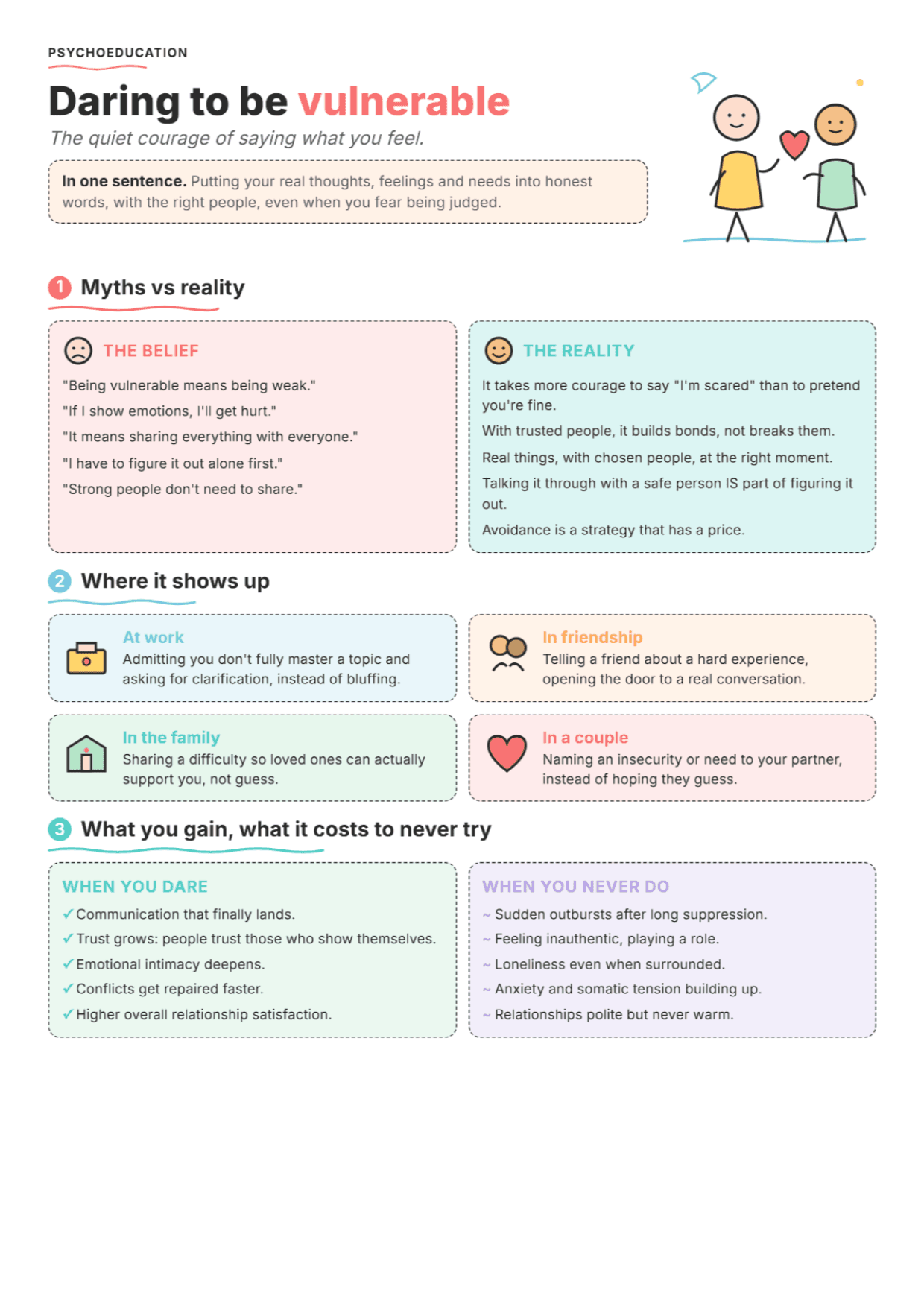
Handout
Expressing Vulnerability in Relationships: PDF Worksheet, Tools and Exercises
A visual PDF worksheet, practical tools, and ready-to-use exercises to help patients put vulnerability into words, overcome relational avoidance, and build genuine emotional intimacy.
Self & identityRelationships
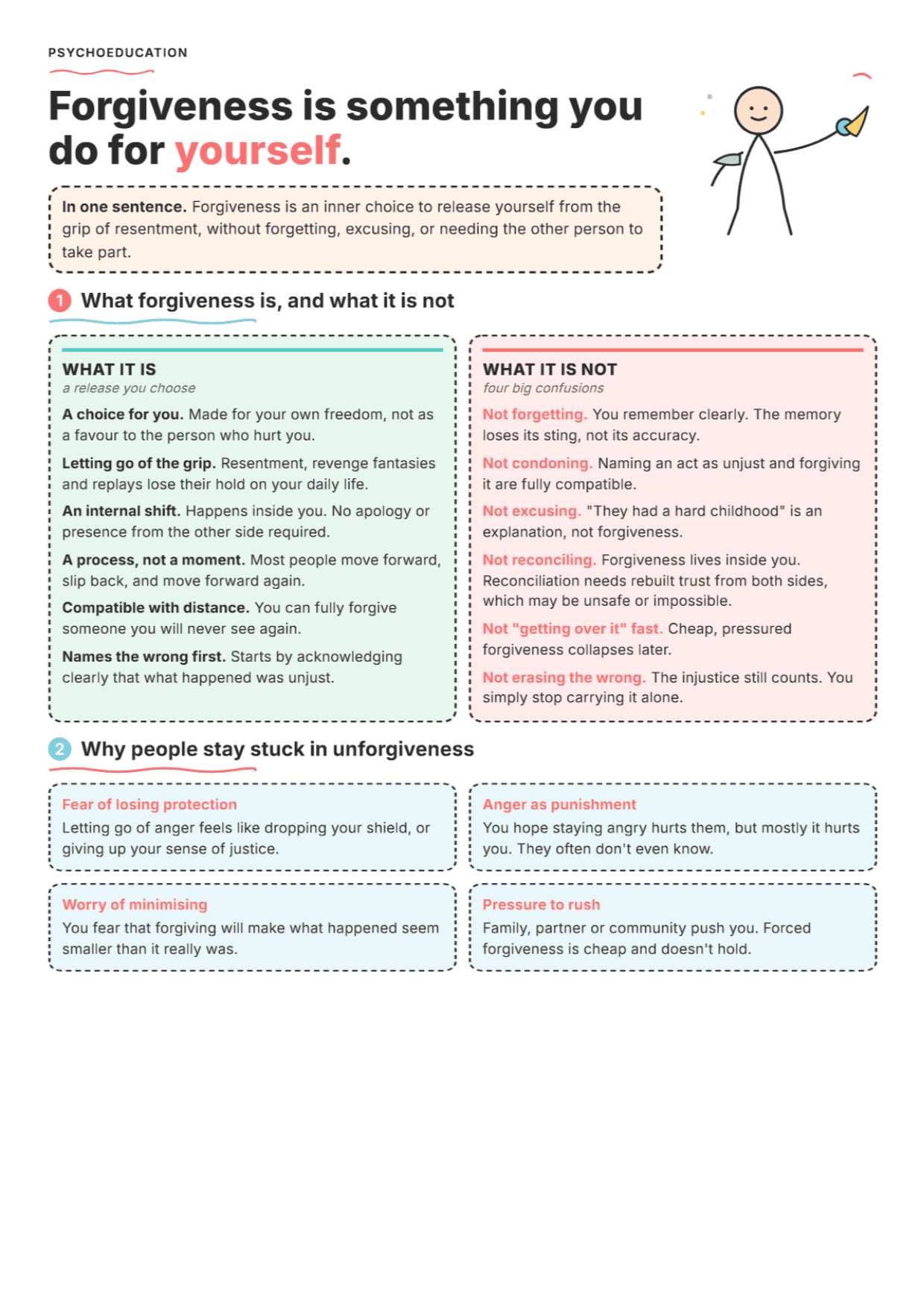
Handout
Forgiveness in Therapy: PDF Worksheet, Tools and Exercises
A printable PDF fiche to support psychoeducation on forgiveness in session: key distinctions, clinical frameworks, and practical tools to help patients stop carrying resentment.
Emotions & stressRelationships
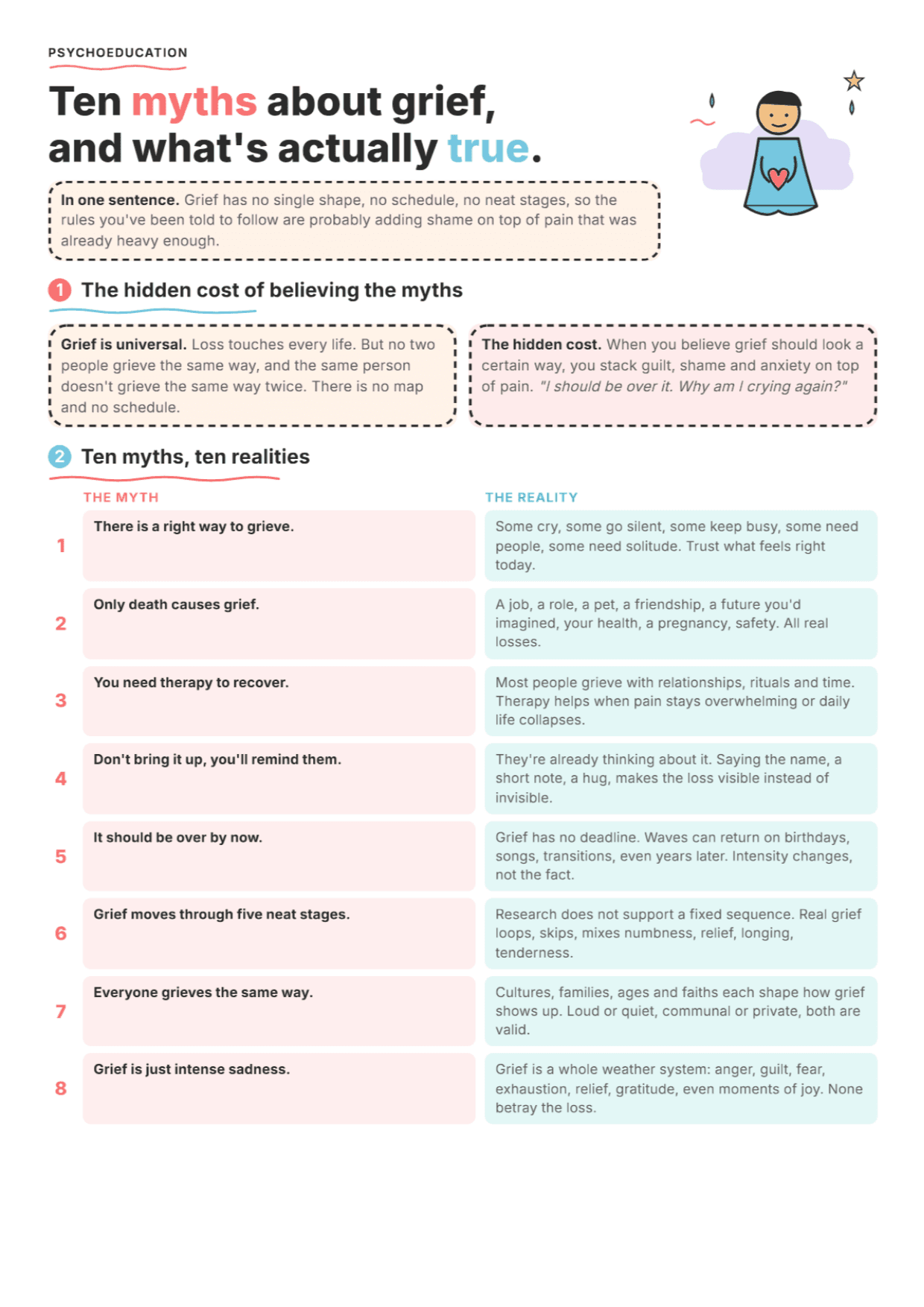
Handout
Grief Myths: PDF Worksheet, Tools and Exercises for Clinical Practice
A visual psychoeducation sheet helping clinicians dismantle the beliefs that compound bereavement with shame, and make space for each patient's own grief process in session.
Mood & depression
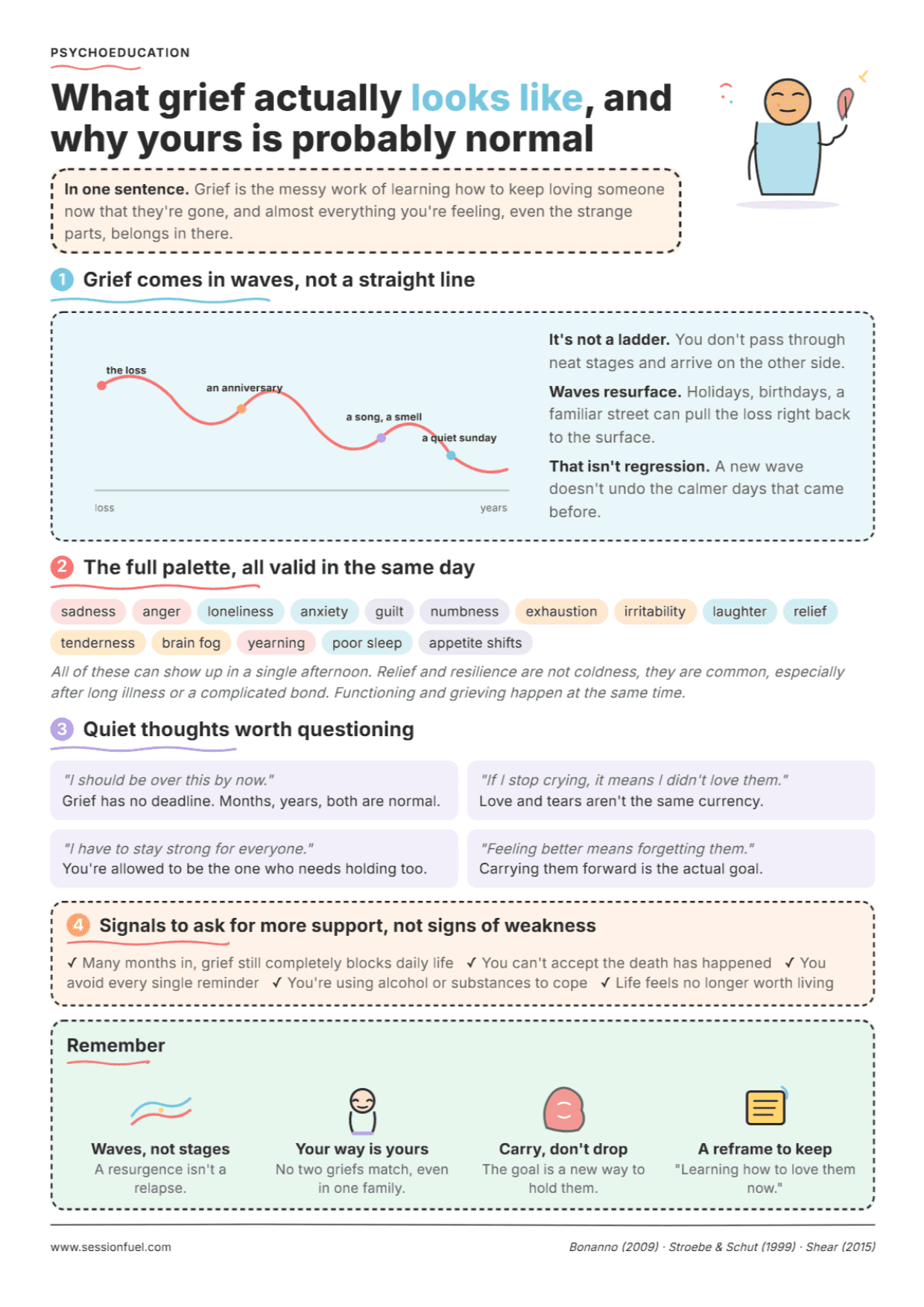
Handout
Grief: PDF Fact Sheet, Tools and Exercises for Clinical Practice
A printable grief fact sheet, clinical tools, and exercises to explain bereavement's non-linear course, normalize its full emotional range, and support patients through loss.
Mood & depression

Handout
Healthy Boundaries: PDF Worksheet, Tools and Exercises for Clinical Practice
A visual PDF worksheet with six concrete tips, ready-to-use scripts, and psychoeducation tools to help clinicians explain healthy boundaries clearly in session.
Self & identityRelationships
Handout
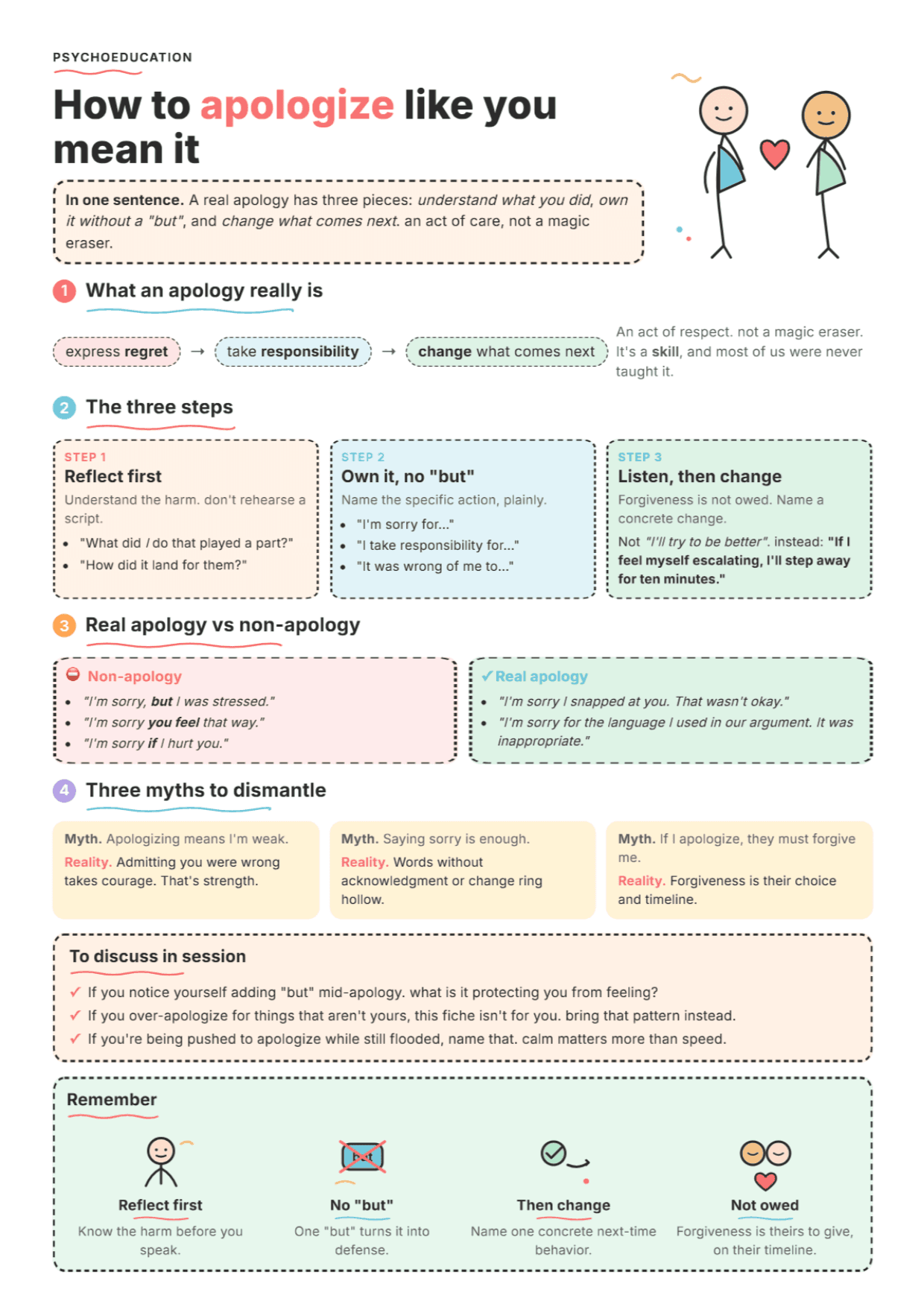
How to Apologize: PDF Worksheet, Tools and Exercises for Clinical Practice
A structured PDF worksheet, clinical tools, and exercises to help patients grasp what genuine apology requires, and stop confusing it with the non-apology patterns that quietly damage relationships.
RelationshipsSelf & identity
Handout
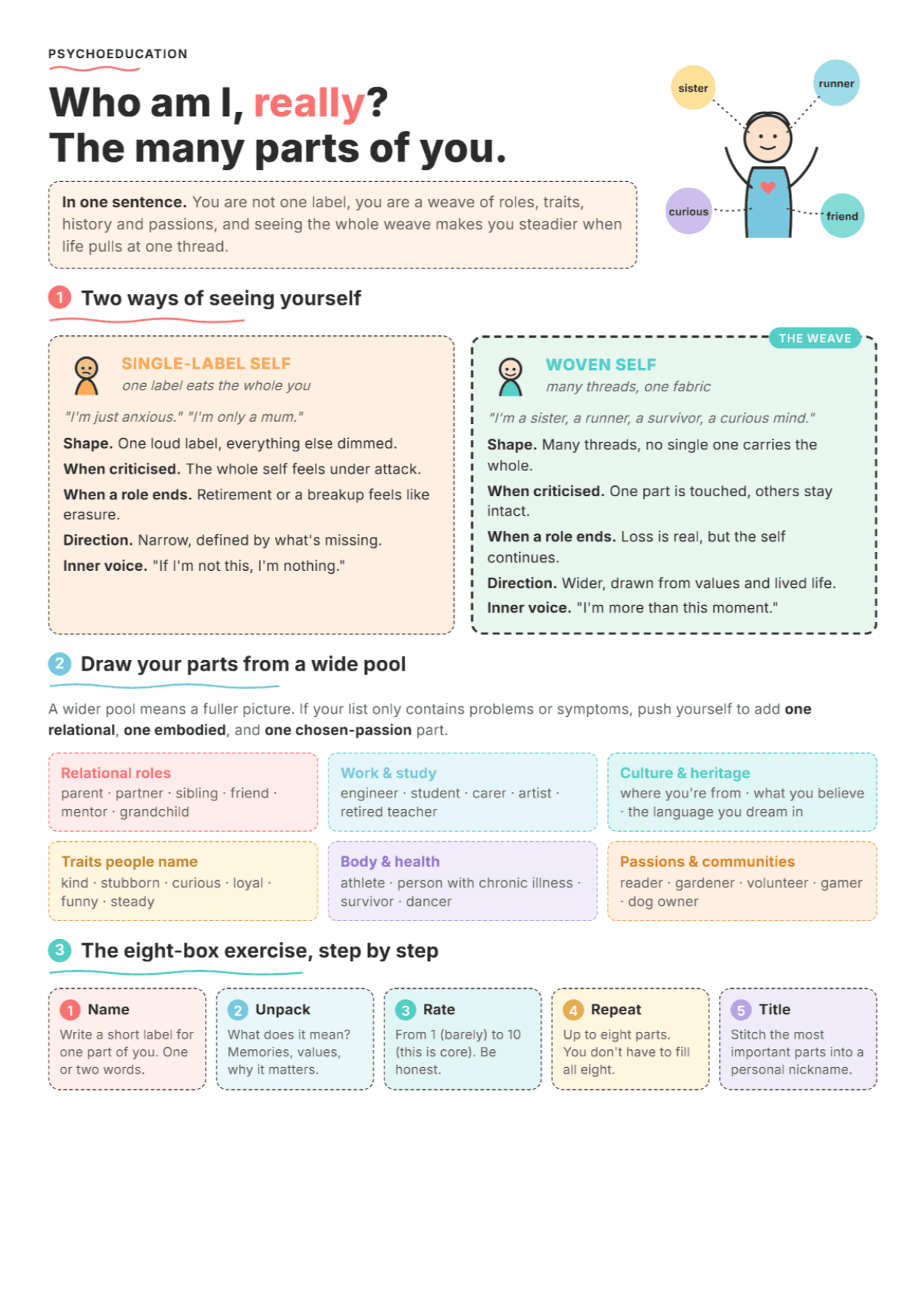
Identity Exploration: PDF Worksheet, Tools and Exercises for Clinical Practice
A printable PDF tool with a side-by-side identity comparison, a structured eight-box exercise, and reflection prompts clinicians can use in session to help patients build a richer, more resilient self-concept.
Self & identity
Handout
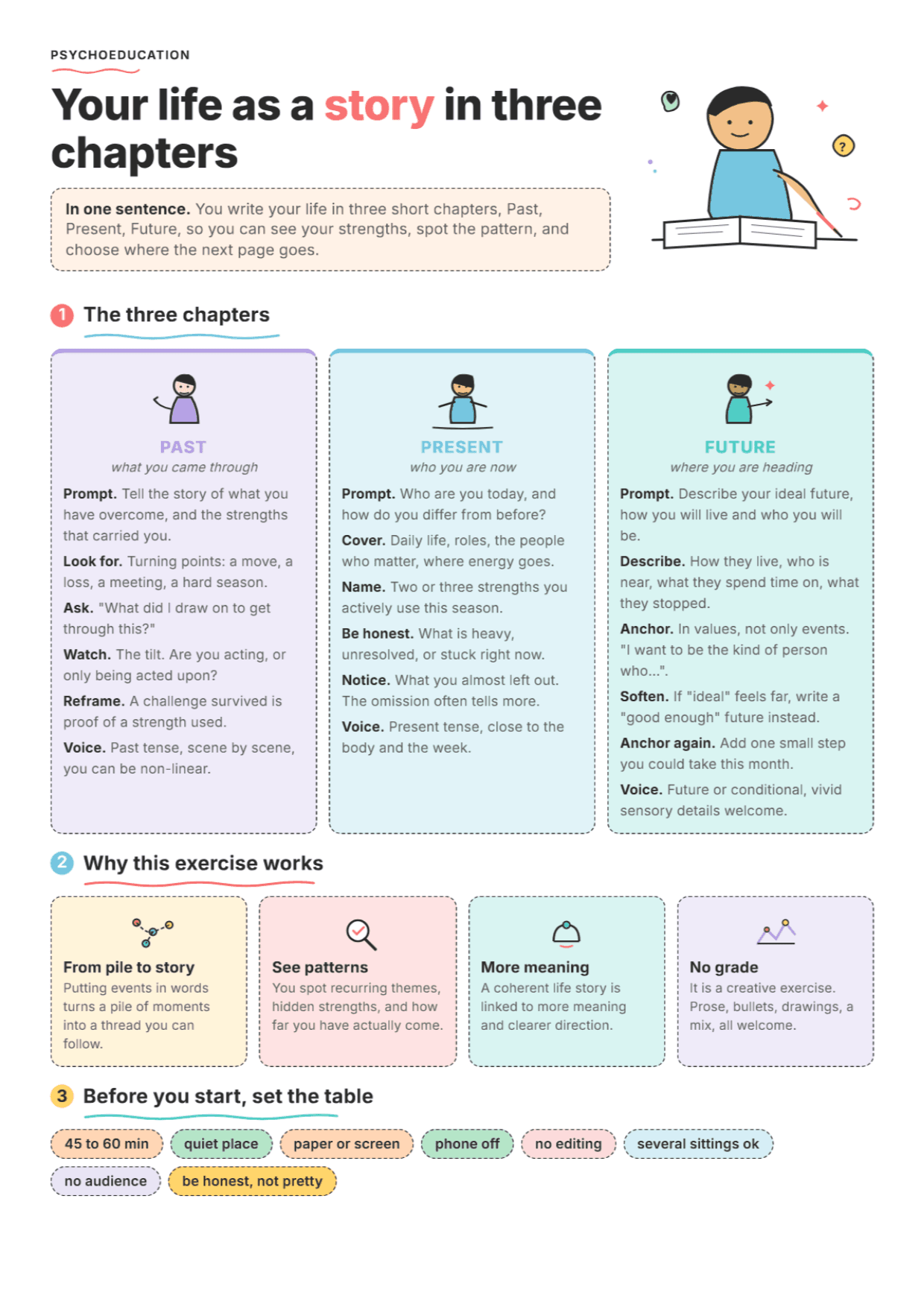
Life Story: Past, Present, Future: PDF Worksheet, Tools and Exercises
A printable PDF worksheet, clinical tools and guided exercises to help patients build a coherent life narrative across past, present, and future chapters.
Self & identityLife transitions
Handout
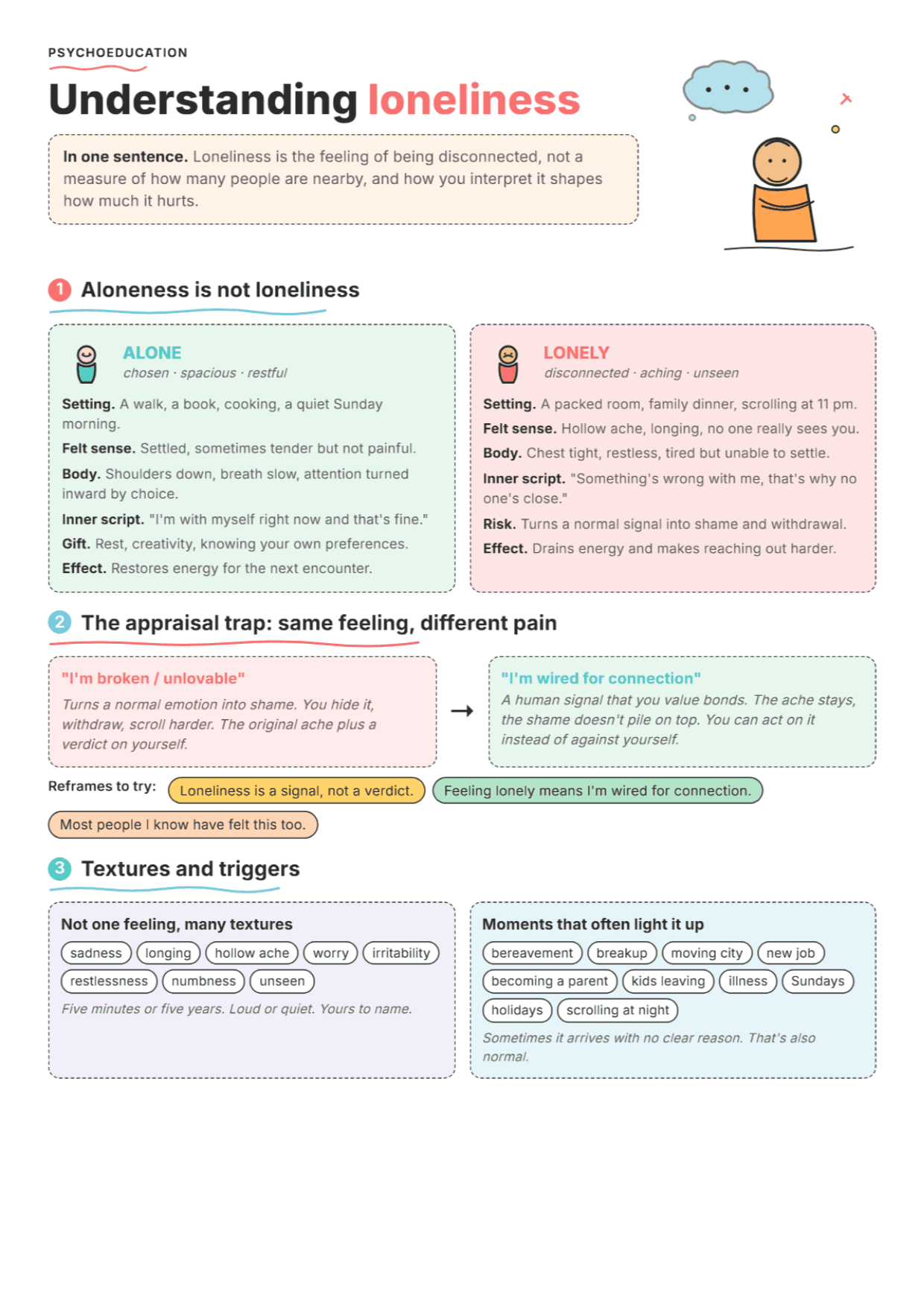
Loneliness: PDF Worksheet, Tools and Exercises for Clinical Practice
A visual psychoeducation tool clinicians can use in session to distinguish loneliness from aloneness, reframe appraisal traps, and give patients a concrete starting point for connection.
RelationshipsMood & depression