
Emotion Regulation: Clinical Worksheets and Tools for Therapists
Emotion regulation, broadly understood as the set of processes by which individuals influence the type, intensity, timing, and expression of their affective states, sits at the heart of most presentations a clinician encounters in outpatient or inpatient practice. Synonymous constructs such as self-regulation, affect modulation, and emotional control span diagnostic categories and theoretical orientations, making this one of the most cross-cutting themes in contemporary clinical psychology. This page gathers printable worksheets, psychoeducation sheets, and structured exercises designed to support regulation-focused assessment and intervention across the lifespan. Whether your frame is cognitive-behavioural, acceptance-based, or integrative, the resources collected here are ready to move directly into your clinical sessions.

What Self-Regulation Actually Means in Practice
Emotion regulation is not a single mechanism but a family of processes: situation selection and modification, attentional deployment, cognitive reappraisal, and response modulation. Gross's process model remains the most cited heuristic, but clinicians must hold it loosely, given that most patients do not deploy strategies in a tidy sequential order. What matters practically is whether a patient's habitual repertoire is flexible or rigid, conscious or automatic, and whether it fits the demands of their current context.
Disregulation rarely presents as a pure deficit; more often it reflects the overuse of a narrow set of strategies (suppression, rumination, avoidance) that worked well enough under earlier life conditions. Framing dysregulation in those terms, rather than as a character flaw or a symptom list, immediately opens a collaborative therapeutic stance. It also helps patients tolerate the psychoeducation phase without shame.
From Appraisal to Behavioural Output
The chain from event appraisal to behavioural response is where most intervention points live. Cognitive appraisal shapes the emotional label assigned to an event; that label then gates physiological arousal and the impulse toward a particular action tendency. Any worksheet or exercise targeting this chain, whether it uses a CBT, REBT, or ACT rationale, is working on regulation even when it does not use that word explicitly. The ABC Model (REBT): PDF Worksheet, Tools and Exercises for Clinical Practice operationalises this chain in a format patients can complete between sessions, turning abstract theory into something traceable on paper.
Identifying Dysregulation in the Consultation Room
Clinical Signs Across Presentations
Dysregulation presents along several dimensions simultaneously: affective lability, poor frustration tolerance, emotional numbing or restricted affect, and impulsive behaviour driven by unmodulated arousal. In adults, you may notice rapid shifts in session tone, over-apologising followed by irritability, or a marked discrepancy between stated emotion and physiological signs (flushing, voice tremor, postural withdrawal). None of these signs is pathognomonic; they are data points requiring triangulation.
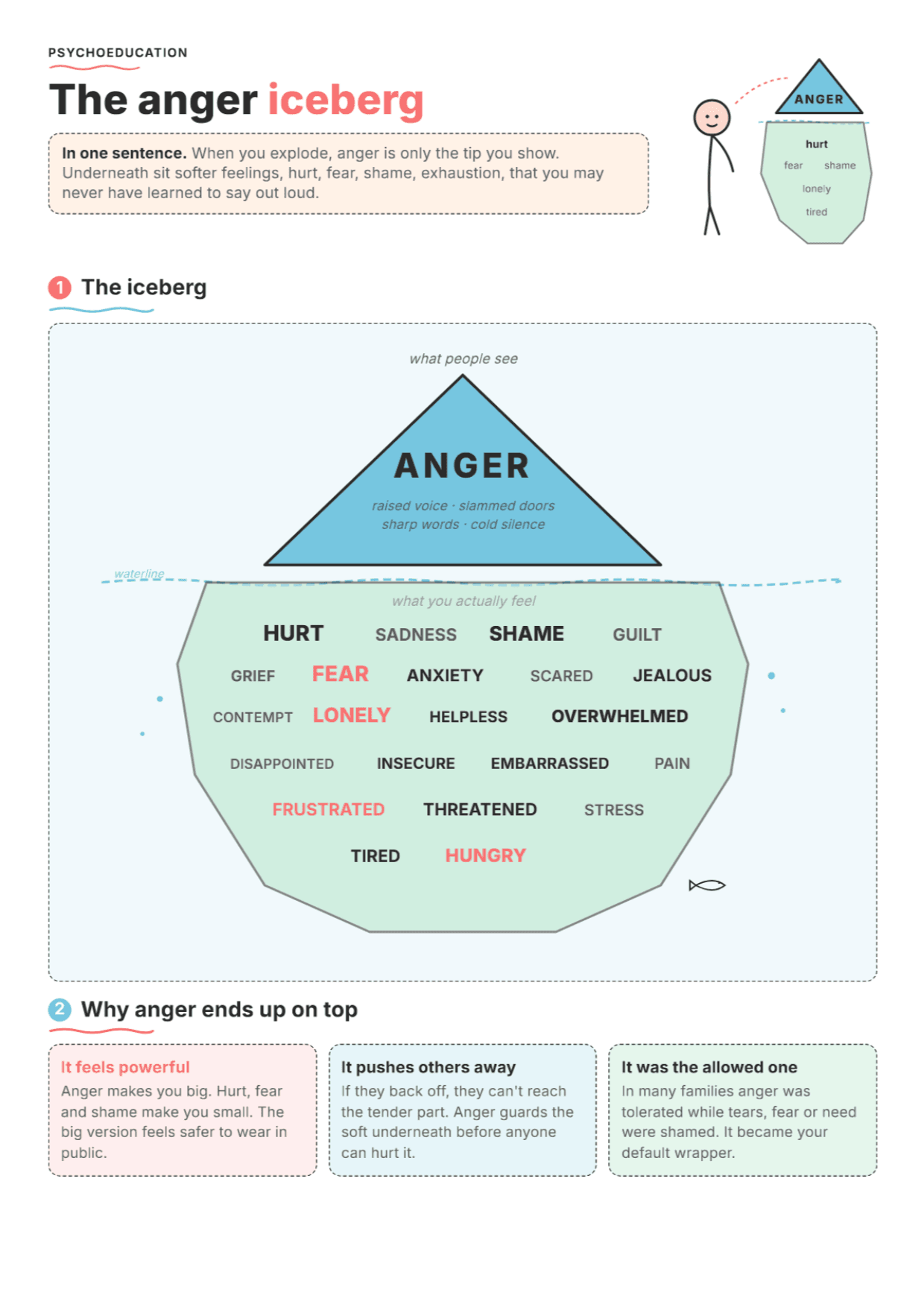
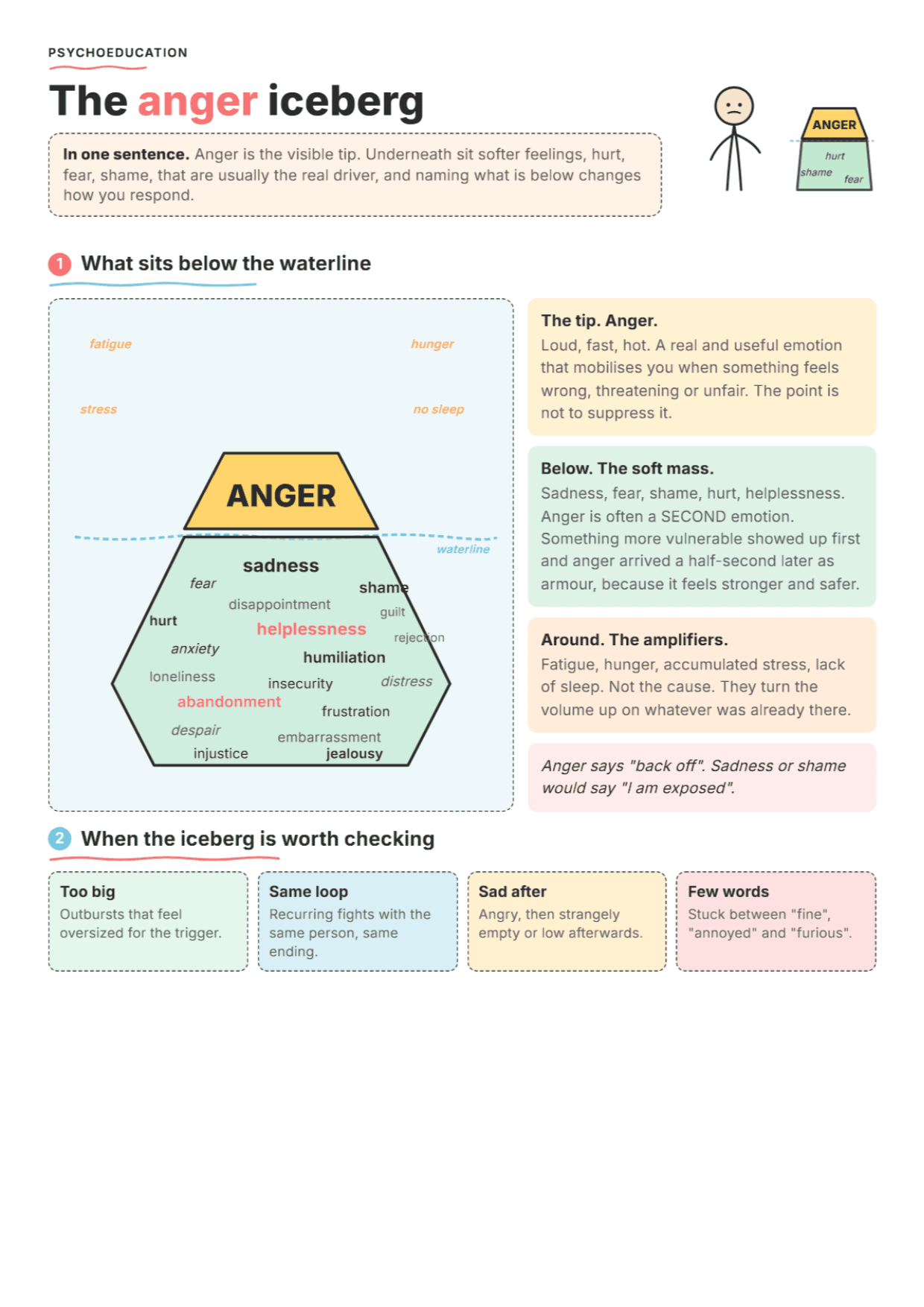
A particularly useful entry point is anger, because it is often the surface emotion that masks a far more vulnerable internal state. The Anger Iceberg: PDF Worksheet, Tools and Exercises for Clinical Practice offers a structured visual metaphor to introduce this idea without triggering defensiveness. Once a patient grasps that anger is frequently secondary to shame, fear, or grief, the therapeutic alliance usually deepens substantially. For earlier psychoeducation on physical and behavioural precursors, the Anger Warning Signs: PDF Worksheet, Tools and Exercises for Clinical Practice helps patients build somatic awareness before they are flooded.
Developmental Considerations in Children and Adolescents
Regulatory capacity is neurobiologically immature well into young adulthood; the prefrontal modulation of limbic reactivity is not structurally consolidated until the mid-twenties. In children and adolescents, this means that what looks like a characterological problem is often a developmental lag that is responsive to skills-based intervention. Assessing the child's current coping repertoire, and explicitly mapping which strategies are adaptive versus which perpetuate distress, is a logical starting point. The 50 Coping Strategies for Children and Adolescents: PDF Worksheet, Tools and Exercises gives both clinician and young patient a tangible inventory to work from, supporting collaborative goal-setting rather than prescriptive instruction.
Developmental history also matters. Early attachment disruptions, chronic stress, or trauma can shift a child's regulatory baseline downward in a lasting way. In those cases, pure skills training is necessary but insufficient; the relational context of the intervention carries as much therapeutic weight as the technique itself.
Comorbidities and Differential Diagnosis
When Dysregulation Overlaps with Mood and Anxiety Disorders
Emotional dysregulation is a transdiagnostic feature rather than a category-specific one. It appears prominently in borderline personality disorder and bipolar spectrum conditions, but it is equally present in major depressive disorder (where regulation fails in the direction of blunting or rumination), generalised anxiety disorder (where it manifests as intolerance of uncertainty and sustained worry), and PTSD (where arousal dysregulation is virtually universal). Identifying which regulatory mechanisms are most impaired in a given patient guides treatment selection more precisely than the DSM label alone.
Comorbid substance use almost always includes a regulation function: the substance is doing the regulatory work that the patient's own repertoire cannot. Any intervention that removes the substance without building an alternative regulation system is setting the patient up for relapse. The Adaptive vs Maladaptive Coping: PDF Worksheet, Tools and Exercises makes this distinction explicit in a non-shaming, functionally oriented framework that transfers well to substance-use presentations.
Distinguishing Trait-Level Patterns from Situational Reactivity
A key diagnostic question is whether dysregulation is pervasive and ego-syntonic (suggesting a characterological substrate) or situationally bound and ego-dystonic (suggesting a state-level response to current stressors). Chronicity, age of onset, and cross-contextual consistency are the primary discriminators. When rigidly fixed schemas and modes underlie the regulatory failure, a schema-informed lens adds considerable explanatory power, and the 12 ACT Schemas and Modes of Thinking: PDF Worksheet, Tools and Exercises can assist in mapping which schema-level patterns are driving avoidance and reactivity.
Therapeutic Frameworks Targeting Emotion Regulation
Cognitive-Behavioural and REBT Approaches
Cognitive restructuring targets regulation at the appraisal stage: disputing irrational beliefs (in the REBT tradition) or examining automatic thoughts (in standard CBT) reduces the emotional intensity generated by a given trigger. These approaches are particularly effective when the patient has sufficient metacognitive capacity to observe their own thought processes, which itself is a regulatory skill worth cultivating explicitly.
The REBT framework, with its A-B-C chain, is one of the most pedagogically clear tools available for this work. Patients who have struggled with vaguer explanations of emotion often respond well to its directness. The ABC Model (REBT): PDF Worksheet, Tools and Exercises for Clinical Practice supports session-by-session consolidation of this framework and doubles as a homework format.
ACT-Based Pathways to Psychological Flexibility
Acceptance and Commitment Therapy reframes regulation entirely: rather than reducing emotional intensity, the goal is to change the patient's relationship to internal experience so that emotional content, however uncomfortable, no longer dictates behaviour. Psychological flexibility, the capacity to contact the present moment, defuse from difficult cognitions, and act in line with values even in the presence of distress, is the ACT analogue of adaptive regulation.
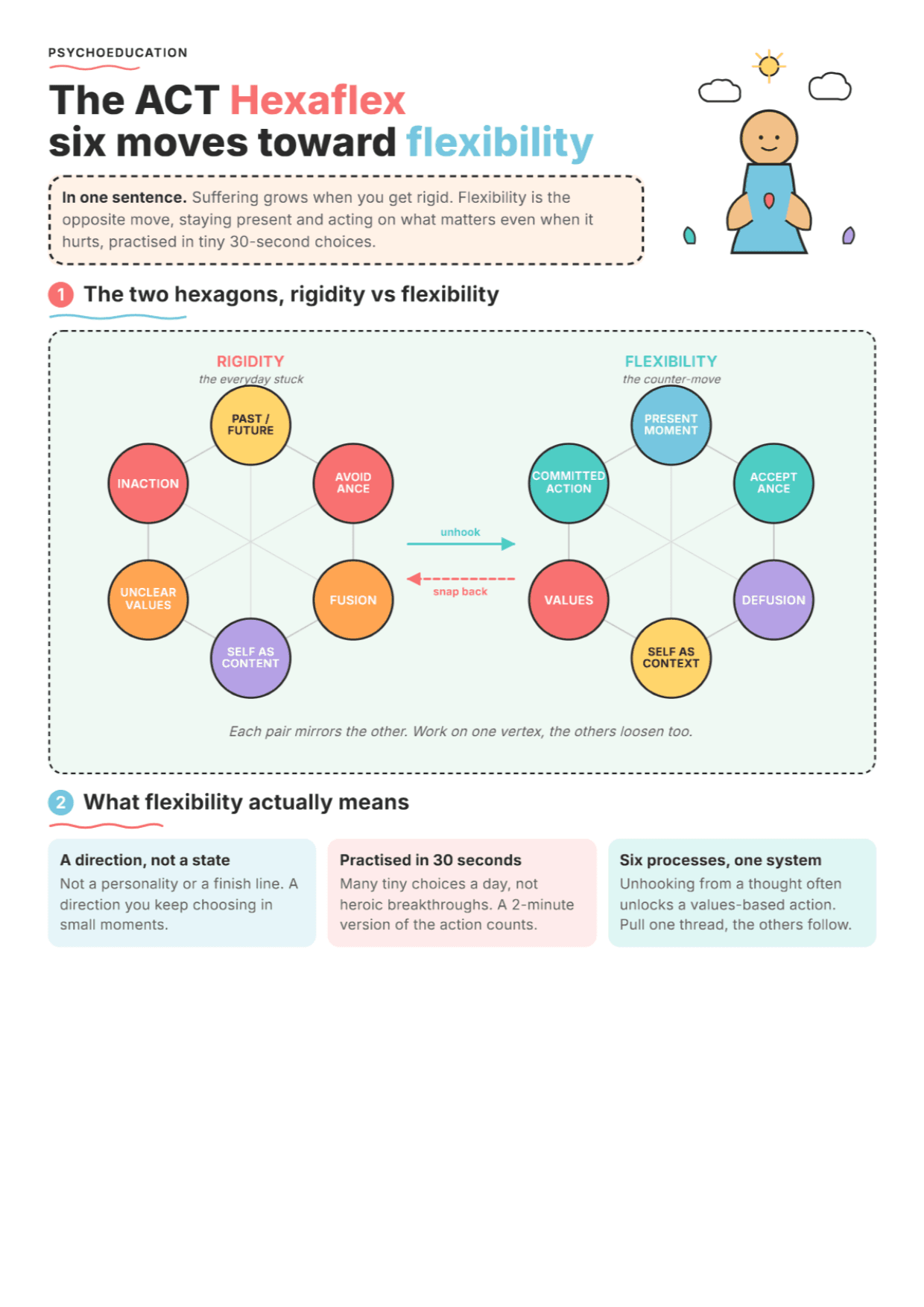
The ACT Hexaflex: PDF Worksheet, Tools and Exercises for Clinical Practice provides the complete theoretical map of this flexibility model, useful for both clinician case conceptualisation and patient psychoeducation. When the primary regulatory problem is cognitive fusion, where patients are fused with their thoughts as literal truths, the ACT Cognitive Defusion: PDF Worksheet, Tools and Exercises for Clinical Practice offers concrete techniques to loosen that grip without requiring the patient to challenge the content of the thought. For moments of heightened conflict or behavioural choice, The Choice Point: PDF Worksheet, Tools and Exercises for ACT Practice maps the decision architecture between triggering context and value-consistent action.
More broadly, Psychological Flexibility: PDF Worksheet, Tools and Exercises for ACT Practice consolidates ACT-based regulation work into a coherent framework clinicians can use across several sessions, scaffolding progress from psychoeducation through to behavioural experimentation.
Using These Printable Resources in Session
Sequencing the Intervention
Regulation work follows a broadly consistent arc, regardless of orientation:
- Assessment and psychoeducation: Establish a shared model of how the patient's emotional system is currently functioning. Identify which strategies are in current use, and their functional consequences.
- Awareness and monitoring: Build capacity to notice regulatory failure earlier in the cycle, through somatic tracking, thought monitoring, or behavioural chain analysis.
- Repertoire expansion: Introduce new strategies, rehearse them in session, and assign structured practice. Tools like the coping inventories and defusion exercises belong here.
- Values clarification and committed action: Anchor regulation goals to what genuinely matters to the patient, so skill use is motivated by meaning rather than anxiety reduction alone.
- Consolidation and relapse prevention: Review which strategies have generalised, identify future high-risk contexts, and build a personalised crisis plan.
The worksheets in this category map onto different points of this arc. Selecting the right resource at the right phase is more important than exhaustive coverage.
A Brief Clinical Vignette
> A 34-year-old patient with recurrent depression and a history of impulsive anger episodes arrives for the fourth session. She reports a conflict with her manager that left her feeling "out of control." Rather than moving immediately into event processing, the clinician introduces the Anger Iceberg worksheet. The patient identifies humiliation and fear of being seen as incompetent beneath the surface anger. From there, the session shifts naturally to the ABC chain, tracing how her appraisal of the manager's comment as a global threat to her competence generated disproportionate arousal. Two printable tools, one psychoeducational and one cognitive, worked in sequence to contain and productively process what had initially looked like a crisis presentation.
Integrating Regulation Work into the Broader Care Plan
Coordination with Other Intervention Targets
Regulation work rarely stands alone. In a patient with trauma, stabilisation and regulation skills typically precede trauma processing; in eating disorders, regulation of emotional triggers for binge or restrict cycles is central to the maintenance model. The resources in this category are modular by design: they slot into an existing care plan rather than requiring a standalone protocol.
When working with children, parents and teachers are usually part of the intervention system. A worksheet the child completes in session can also become a co-regulation tool at home if parents understand its logic. Building that bridge explicitly, by reviewing the tool with caregivers, often determines whether skills generalise outside the consulting room.
Tracking Regulatory Change Over Time
Outcome monitoring in regulation-focused work benefits from tracking both symptom severity and process variables: frequency of strategy use, flexibility of repertoire, and degree of behavioural impact of emotional episodes. Revisiting completed worksheets at intervals provides a qualitative record of change that standardised questionnaires alone cannot capture. Patients often find this concrete archive of their own progress more motivating than a score on a scale.
Points of Vigilance and Clinical Limits
Regulation-focused work carries specific risks that deserve attention. Psychoeducation about emotion can, in patients with high alexithymia or intellectualising defences, reinforce cognitive distance from emotional experience rather than genuine integration. Monitoring for this pattern, where the patient discusses emotions fluently but without affective contact, is essential.
Some patients present with dissociative regulation: emotional content is managed by departing the present moment entirely. Standard worksheets are poorly suited to this population unless grounding and stabilisation have already been established. Similarly, high-risk patients (active suicidality, severe self-harm) require safety planning as the primary intervention before any skills-building worksheet is appropriate.
Finally, framing the goal as emotion elimination rather than regulation flexibility is a common therapeutic error, both clinician-side and patient-side. Every resource in this collection should be introduced with explicit messaging that the aim is a broader, more responsive repertoire, not the removal of difficult internal states.
Tools in this category

Handout
Surfing the Wave: PDF Worksheet, Tools and Exercises for Distress Tolerance
A visual PDF worksheet, tools and exercises to explain urge surfing in session and help patients ride the wave of intense emotion without acting from the peak.
AnxietyEmotions & stress
Handout
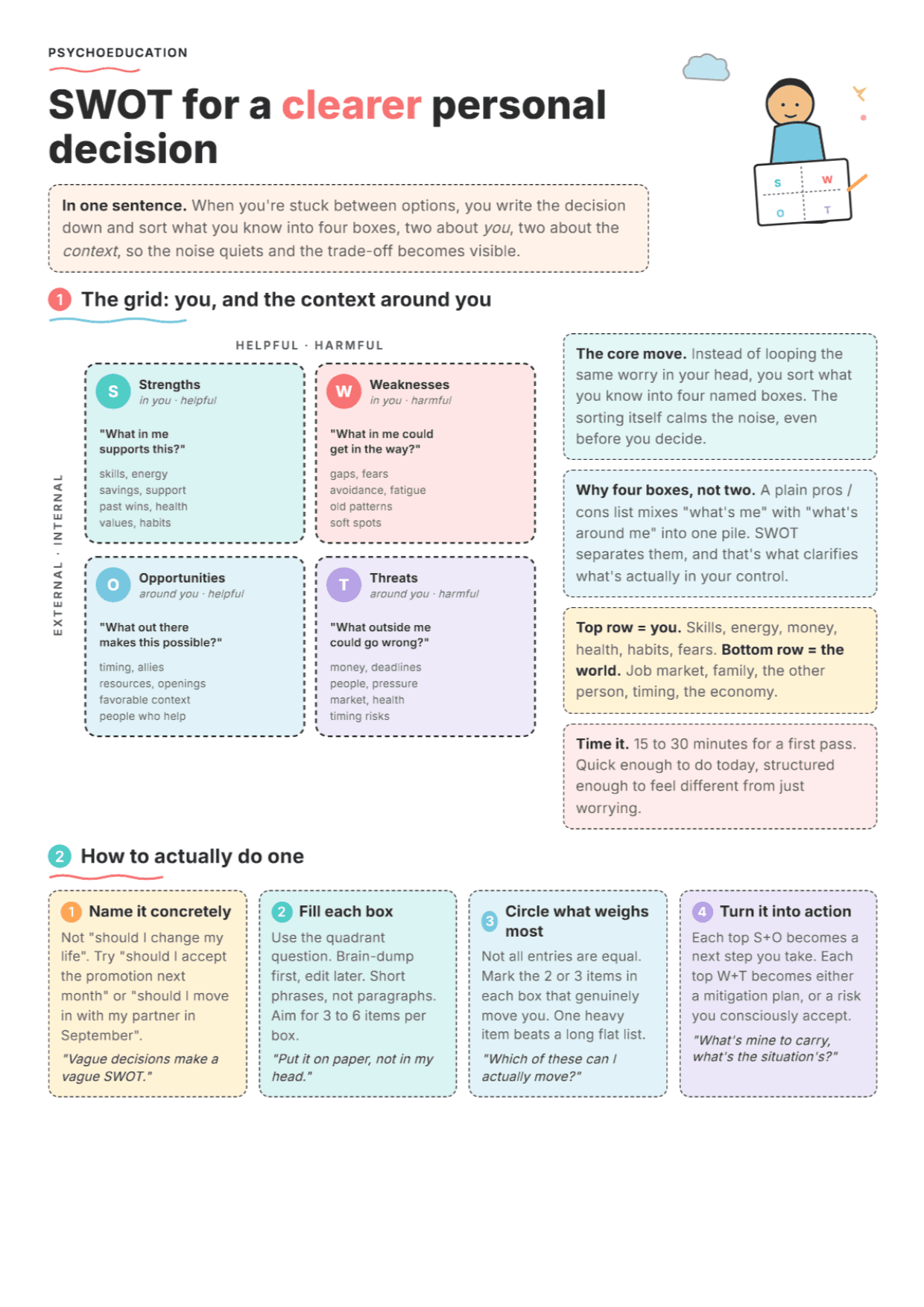
SWOT Analysis: PDF Worksheet, Tools and Exercises for Clinical Practice
A structured visual PDF worksheet helping clinicians externalise complex decisions with patients, separate internal from contextual factors, and turn looping deliberation into a concrete action plan.
Life transitionsEmotions & stress
Handout
The ACT Hexaflex: PDF Worksheet, Tools and Exercises for Clinical Practice
A printable visual support mapping all six ACT processes in one structured fiche, to explain psychological flexibility clearly, in session, with any patient.
Self & identityEmotions & stress
Handout
The Anger Iceberg: PDF Worksheet, Tools and Exercises
A visual psychoeducation worksheet clinicians can use in session to help patients identify the secondary emotions beneath anger and shift toward more precise emotional expression.
Emotions & stressSelf & identity
Handout
The Anger Iceberg: PDF Worksheet, Tools and Exercises for Clinical Practice
A visual PDF worksheet and practical tools to help clinicians explain the secondary-emotion structure of anger and map the softer feelings underneath in session.
Emotions & stressSelf & identity

Handout
The CBT Cognitive Model: PDF Worksheet, Tools and Exercises
A visual psychoeducation fiche that maps the S-T-E-B chain, names six automatic thought patterns, and gives patients a four-question self-monitoring tool to use between sessions.
Thoughts & cognitionMood & depression

Handout
The Choice Point: PDF Worksheet, Tools and Exercises for ACT Practice
A visual PDF worksheet built on the ACT Choice Point model, with structured tools and exercises to make values-based action concrete and discussable in session.
AnxietyEmotions & stress
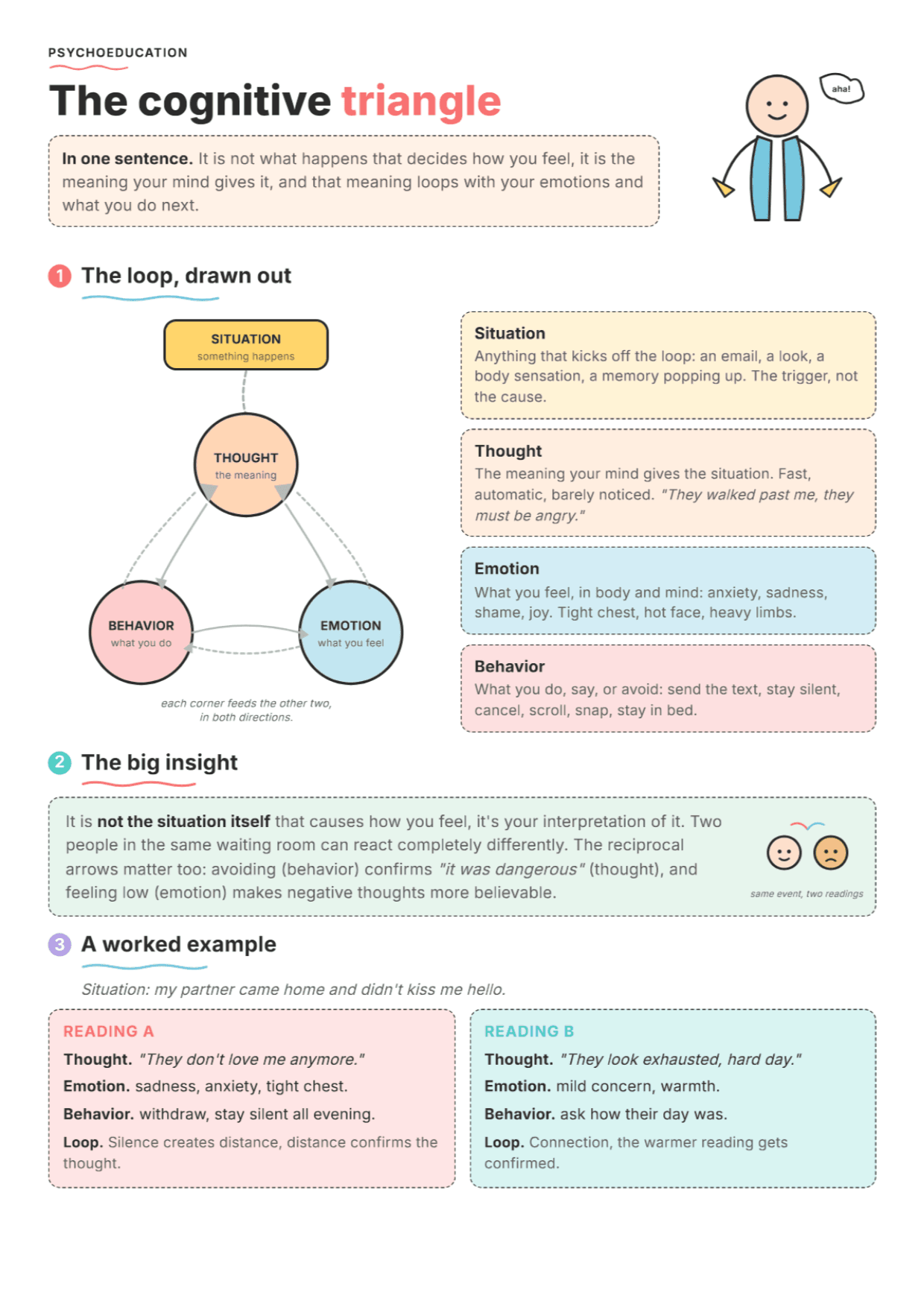
Handout
The Cognitive Triangle: PDF Worksheet, Tools and Exercises
A printable visual support clinicians use in session to explain the thought-emotion-behavior loop concretely, build shared vocabulary, and give patients a reference they can return to between appointments.
AnxietyMood & depression
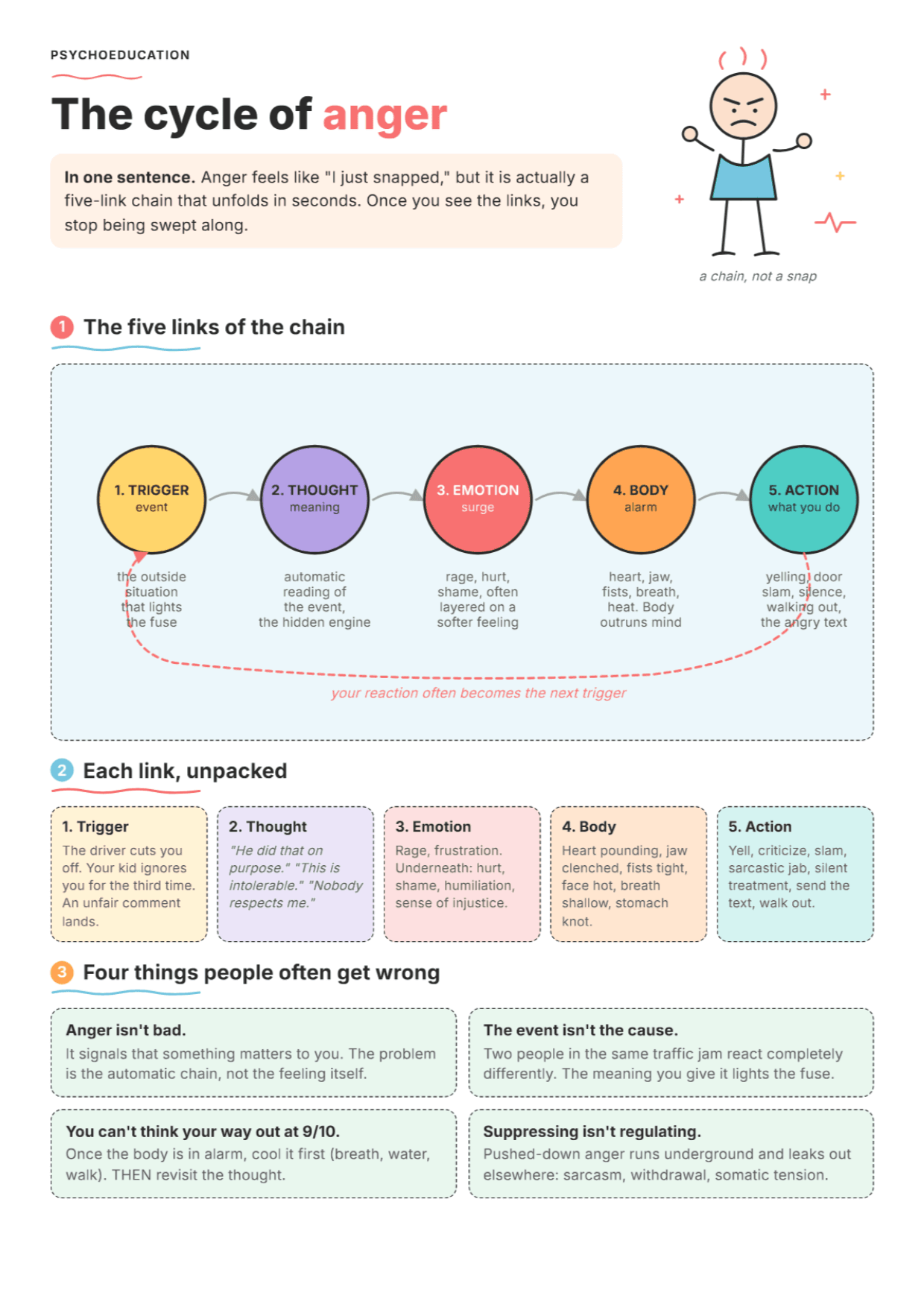
Handout
The Cycle of Anger: PDF Worksheet, Tools and Exercises
A printable CBT handout clinicians can use in session to make the five-link anger chain visible, name each intervention point, and build a durable shared vocabulary with patients.
Emotions & stress