
Emotion-Focused Therapy: Clinical Resources for Practitioners
Emotion-focused therapy (EFT), also referred to as emotion-focused treatment or affect-centered therapy, is a humanistic-experiential model that positions emotional processing as the primary driver of therapeutic change. This page is intended for clinicians who integrate EFT principles into individual or couples work and are looking for structured, printable resources to support that practice. The materials gathered here span psychoeducation programs, guided exercises, and clinical worksheets, each grounded in the core assumption that transformation occurs through accessing, tolerating, and restructuring emotional experience. Whether you are deepening an existing EFT practice or introducing affect-focused techniques into a broader treatment framework, you will find resources here mapped to the key tasks and phases of this approach.

The Primacy of Emotion as a Change Agent
Emotion-focused therapy, developed by Leslie Greenberg and colleagues, holds that maladaptive emotional schemes rather than cognitive distortions or behavioral deficits are the primary source of psychological suffering. These schemes are implicit, embodied memory structures that organize how a person perceives, interprets, and responds to their world. When a client enters a session unable to name why they feel chronically empty, reactive, or shut down, EFT provides a coherent framework for understanding that experience as the product of old, unresolved emotional learning.
The therapeutic mechanism is not insight alone. EFT posits that new emotional experience must occur within the session for lasting change to take root. The therapist's role is to facilitate access to primary adaptive emotions (such as grief or protective anger) that have been blocked or overridden by secondary, reactive states. This distinction between primary adaptive, primary maladaptive, secondary, and instrumental emotions is foundational to clinical decision-making in EFT and directly informs when and how to use the resources on this page.
Emotion Regulation, Dysregulation, and the Therapeutic Window
A working knowledge of emotion regulation is indispensable here. EFT does not aim for the elimination of negative affect; it aims for emotional flexibility and the capacity to use emotion as information. Clients who chronically over-regulate (suppressing, intellectualizing) and those who chronically under-regulate (flooding, dissociating) both fall within the EFT frame, but they require different interventions at different moments. The concept of the therapeutic window (staying within a range of tolerable activation) guides pacing throughout treatment.
Identifying EFT-Relevant Clinical Presentations
Signs in the Consulting Room
Recognizing a client who will benefit from an explicitly emotion-focused approach requires attention to process as much as content. Clinically relevant signs include: difficulty labeling or differentiating emotional states (alexithymia), a predominance of secondary emotions masking underlying vulnerability, a history of relational trauma or attachment disruption, and a pattern of presenting intellectually while the body communicates distress. Flat affect in the context of chronic depression is particularly salient, as these clients have often learned to suppress emotional signaling altogether.
Anger is one of the most clinically layered presentations in EFT. What appears as rage or irritability at the surface frequently conceals primary adaptive emotions such as hurt, fear of abandonment, or grief. The The Anger Iceberg: PDF Worksheet, Tools and Exercises for Clinical Practice is directly useful here: it externalizes the EFT distinction between visible secondary anger and submerged primary states, making the concept accessible for psychoeducation early in treatment.
EFT Across Formats: Individual, Couples, and Group
EFT has well-validated applications in both individual therapy (particularly for depression and trauma) and emotionally focused couples therapy (EFT-C), the latter developed by Sue Johnson. While the attachment theory underpinning is more explicit in the couples model, both formats share the same attention to emotional cycles, interactional patterns, and the need for corrective emotional experience. The resources on this page span both formats, and several are specifically designed for couples work, where emotional disconnection and negative interaction cycles are the primary clinical targets.
Comorbidities, Differential Diagnosis, and Clinical Boundaries
When EFT Intersects with Other Diagnostic Presentations
Depression is one of the most studied areas of EFT application. Greenberg's research consistently shows that clients with major depressive disorder who engage in emotion-focused processing show more durable remission than those treated with purely cognitive interventions alone. The Emotions in Depression: A 4-Session Psychoeducation Program is designed precisely for this population: it systematically introduces the role of emotion in depressive cycles across four structured sessions, building the client's emotional literacy before more intensive processing work begins.
Anxiety disorders, complex PTSD, grief, and relationship distress all fall within EFT's scope. Differential diagnosis matters insofar as it informs pacing: a client with significant dissociation or a fragile self-structure requires careful titration of emotional activation before any deep processing tasks. EFT is not contraindicated in personality pathology, but the stabilization phase must be extended and emotion coaching given priority over emotion evocation.
Distinguishing EFT from Adjacent Approaches
Clinicians sometimes conflate EFT with DBT (dialectical behavior therapy) or ACT (acceptance and commitment therapy) given their shared interest in emotion. The distinction is meaningful. DBT targets emotion regulation skills didactically; ACT targets experiential avoidance through defusion. EFT is more explicitly process-directive within sessions: the therapist actively guides the client toward, into, and through emotional experience using specific tasks such as two-chair work, empty-chair dialogue, and evocative unfolding. The printable resources here complement in-session work; they are not standalone protocols.
Using EFT Exercises and Worksheets in Session
Working with Primary and Secondary Emotions
The sequencing of EFT-informed exercises matters. Before asking a client to access vulnerable primary emotion, they need sufficient psychoeducation about the emotion model being used, some capacity for self-observation, and a solid therapeutic alliance. Worksheets that map emotional layers or identify secondary reactions serve a containing and orienting function in early and middle phases. They create shared language, which is itself a relational resource.
For clients where anger is the presenting affect, introducing the iceberg metaphor early normalizes the therapeutic focus on what lies beneath the surface presentation. This reframe is crucial: it invites curiosity rather than shame, and shifts the clinical conversation from behavioral management toward emotional understanding.
Couples-Focused EFT Resources
In EFT-C, the central clinical task is interrupting negative interaction cycles and facilitating attachment bids that are accessible and responsive. Several resources here target this work directly. The Loss of Trust in a Partner: A Guided Clinical Exercise supports couples navigating attachment injuries, a specific EFT construct referring to moments of perceived abandonment or betrayal that become lodged in the relational system. This exercise can be used between sessions to sustain processing work begun in the room.
When partners are misaligned in their emotional needs or relational goals, structured exercises support the EFT task of cycle de-escalation. The Couple Misalignment: a Guided Clinical Exercise is suited to the early-to-middle phase of EFT-C, helping both partners externalize the cycle rather than blame each other. The Weekly Relationship Review: A Guided Couples Exercise can then be introduced to consolidate gains in the consolidation phase, building a shared reflective practice between sessions.
Integrating EFT Resources into the Care Plan
Sequencing Across the Three Phases of EFT-C
EFT-C is typically organized across three broad phases: cycle de-escalation, restructuring of attachment interactions, and consolidation. The distribution of resources across a care plan should reflect this arc:
- De-escalation phase: Introduce psychoeducation about emotion and the couple's negative cycle. The Emotions in Depression: A 4-Session Psychoeducation Program offers a structured psychoeducation scaffold adaptable to couples where one partner carries a depressive presentation.
- Restructuring phase: Facilitate deeper emotional disclosure and responsive engagement between partners. Use the Loss of Trust in a Partner: A Guided Clinical Exercise when attachment injuries surface and require structured processing outside the session.
- Consolidation phase: Support the couple in maintaining gains and negotiating ongoing differences. The Compromise in Couples Therapy: A Psychoeducation Program fits here, reframing compromise not as loss but as a relational skill grounded in mutual emotional recognition.
Building Positive Emotional Registers
EFT attends not only to pain and rupture but also to positive emotional bonding. Research on positive affect in couples consistently shows that shared positive experience is protective against relational deterioration. The Cultivating Gratitude and Appreciation in Couples Therapy draws on this evidence base, offering a structured exercise to amplify positive sentiment override within the couple system. This is particularly valuable in consolidation, where the risk is that therapy has focused heavily on the negative cycle without building the couple's capacity for joyful connection.
> A couple in their eighth session had successfully de-escalated their primary cycle: his withdrawal, her pursuit. The emotional disclosures had been significant. But the therapist noted that the sessions had remained heavy, and the couple rarely referenced anything positive between them. Introducing the gratitude and appreciation exercise shifted the relational temperature noticeably, and the partners began to describe each other with warmth again, something neither had expected to recover.
Points of Vigilance and Clinical Limits
What Printable Resources Cannot Do
Printable exercises and programs support EFT; they do not deliver it. The relational container of the therapeutic relationship, the therapist's empathic attunement, and the moment-to-moment tracking of the client's emotional process are irreplaceable. A worksheet given without clinical framing risks becoming an intellectualization tool, precisely the defense EFT seeks to soften. Always anchor written materials to what has already emerged affectively in the room.
Trauma-Informed Pacing and Contraindications
Clients with dissociative presentations, active psychosis, or severe personality disorganization require careful assessment before emotion-evocative work. The goal in these cases is not avoidance of affect but graded, titrated contact. Psychoeducation programs such as Emotions in Depression: A 4-Session Psychoeducation Program can serve as a gentle entry point, building a cognitive and linguistic scaffold before deeper experiential work is introduced. When in doubt, prioritize stabilization over processing, and use exercises primarily as grounding and orienting tools in the early phases.
Tools in this category

Handout
The Anger Iceberg: PDF Worksheet, Tools and Exercises
A visual psychoeducation worksheet clinicians can use in session to help patients identify the secondary emotions beneath anger and shift toward more precise emotional expression.
Emotions & stressSelf & identity

Handout
The Anger Iceberg: PDF Worksheet, Tools and Exercises for Clinical Practice
A visual PDF worksheet and practical tools to help clinicians explain the secondary-emotion structure of anger and map the softer feelings underneath in session.
Emotions & stressSelf & identity
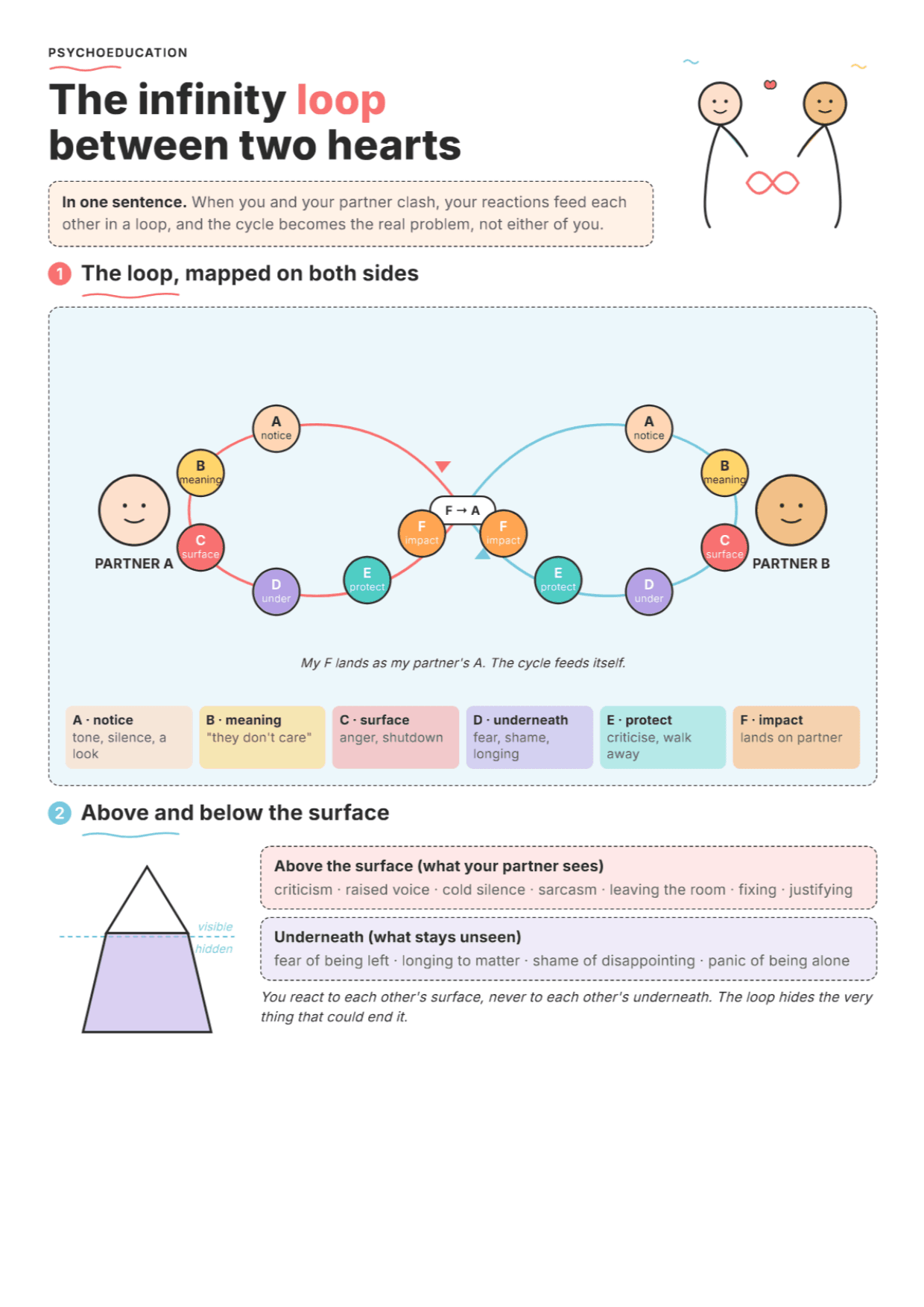
Handout
The EFT Infinity Loop: PDF Worksheet, Tools and Exercises for Couples Therapy
A visual PDF worksheet to map the negative interaction cycle in EFT couples work, with tools and exercises for session use.
Relationships
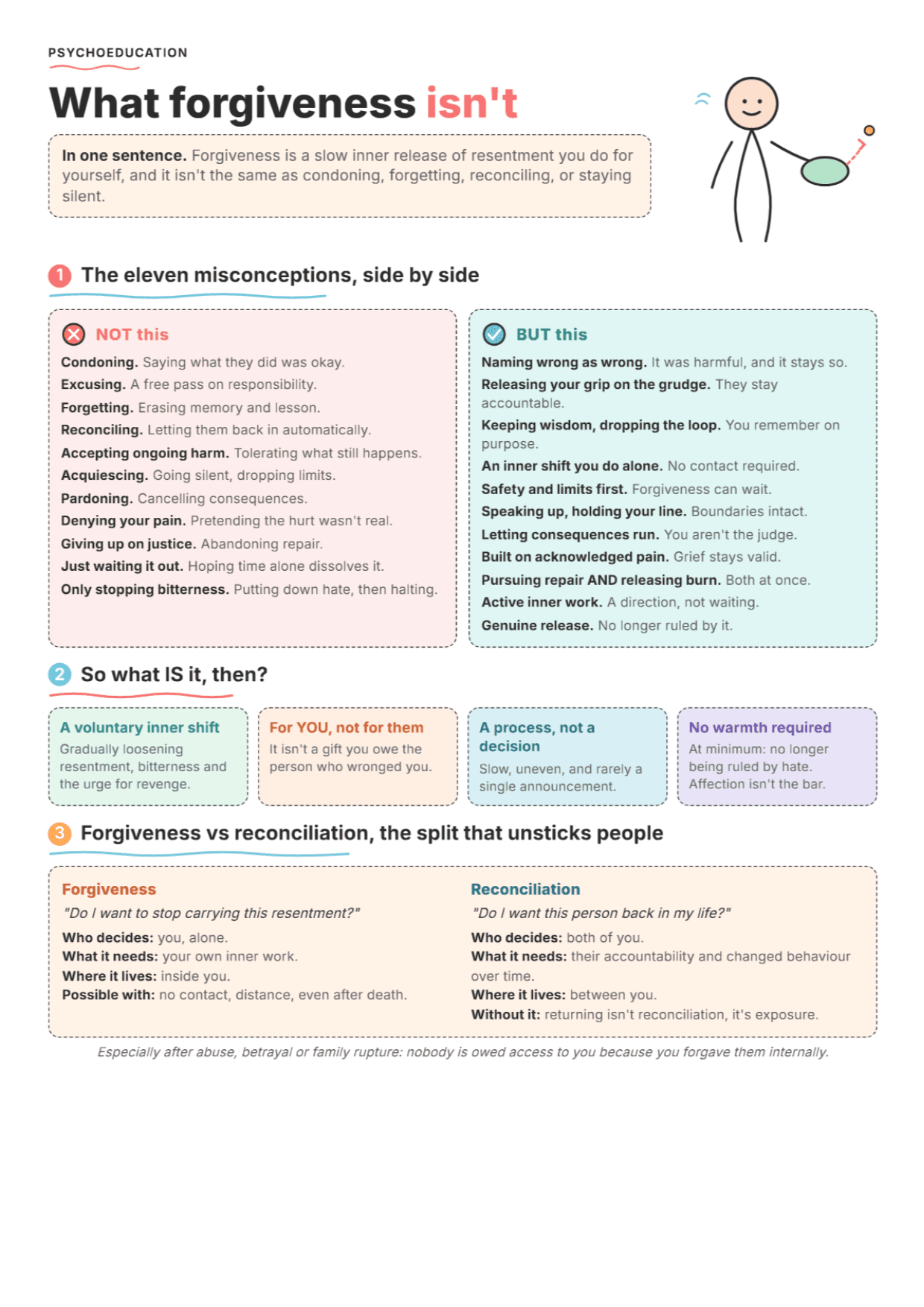
Handout
What Forgiveness Is Not: PDF Worksheet, Tools and Exercises
A visual psychoeducation worksheet helping clinicians clarify the eleven most common forgiveness misconceptions and separate forgiveness from reconciliation in session.
RelationshipsEmotions & stress