
Schema Therapy: Clinical Resources for Practitioners
Schema therapy, also referred to as schema-focused cognitive therapy or schema-focused therapy, is a structured, integrative psychotherapy model designed for clinicians working with personality pathology, chronic Axis I disorders, and deeply entrenched relational patterns. This page brings together printable worksheets, structured exercises, and multi-session psychoeducation programs developed specifically for use within a schema therapy framework. Whether you are introducing the model to a new patient or deepening belief-change work mid-treatment, the resources here map onto the core intervention sequences of the approach.

Early Maladaptive Schemas: the Core Construct
Early maladaptive schemas (EMS) are the organizing concept of the model developed by Jeffrey Young. These are stable, pervasive cognitive-affective structures formed in childhood and adolescence in response to unmet core emotional needs, particularly needs for secure attachment, autonomy, realistic limits, and free expression of affect. Unlike surface-level automatic thoughts, EMS are constitutive: they shape how a patient perceives, interprets, and responds across relational and situational domains.
Eighteen EMS have been identified and grouped into five schema domains: Disconnection and Rejection, Impaired Autonomy and Performance, Impaired Limits, Other-Directedness, and Overvigilance and Inhibition. Each domain corresponds to a cluster of unmet developmental needs. Knowing which domain is most active in a given patient orients your choice of intervention targets and the emotional depth at which you pitch early sessions.
Schema Modes and the Therapeutic Relationship
Schema modes represent the moment-to-moment emotional states and coping responses that EMS activate. The mode framework is particularly useful with patients who present with rapid affective shifts, dissociative episodes, or relational volatility, as it allows clinician and patient to name and track state changes without pathologizing them. Four broad mode categories are recognized: child modes (Vulnerable Child, Angry Child, Impulsive Child), dysfunctional coping modes (Detached Protector, Compliant Surrender, Overcompensation), dysfunctional parent modes (Punitive Parent, Demanding Parent), and the Healthy Adult mode, which is the target of therapeutic development.
The therapeutic relationship in schema therapy is explicitly reparative. Limited reparenting is not simply a technical stance: it is the primary vehicle through which schema change occurs at the experiential level. This distinguishes schema therapy from classical CBT and from most short-term interventions, and it has direct implications for how you pace the work and frame written exercises for the patient.
Identifying Early Maladaptive Schemas in Clinical Assessment
Eliciting Core Beliefs and Their Origins
Assessment in schema therapy goes beyond symptom inventories. The clinician is listening for core beliefs, the propositional content of an EMS, and tracing their developmental origins. Asking patients when they first felt a particular way, and who was present, typically surfaces the relational matrix in which the schema formed. The exercise Mapping the Relational Origins of Core Beliefs in Therapy is designed precisely for this reconstruction work, guiding patients through a structured retrospective that can be completed between sessions and then processed in the room.
Complementing this, the exercise Exploring Core Beliefs About Self, Others, and the World provides a systematic elicitation framework across three referential domains. Using it early in treatment helps you map the patient's belief landscape before selecting specific EMS as primary targets. The exercise Clarifying Core Beliefs: A Structured Clinical Exercise is well-suited to the phase when a patient has identified a belief but still holds it in vague or fluctuating terms, consolidating it into a workable clinical formulation.
Schema Domains in Clinical Presentation
Each domain produces recognizable clinical signatures. The Disconnection and Rejection domain, for instance, typically presents with chronic fear of abandonment, emotional deprivation beliefs, or deep mistrust. The worksheet The Abandonment Schema: PDF Worksheet, Tools and Exercises for Clinical Practice provides both psychoeducation and structured exercises targeted at this schema, including affect regulation prompts and behavioral tracking. Similarly, attachment history is a primary developmental pathway for many EMS: the resource Attachment Styles in Romantic Relationships: PDF Worksheet, Tools and Exercises helps patients connect present relational patterns to early attachment configurations, which is a key schema assessment and psychoeducation move.
Comorbidities and Differential Considerations in Schema-Focused Work
When Schema Therapy Is the Right Frame
Schema therapy has the strongest evidence base for borderline personality disorder, but its clinical utility extends to avoidant, narcissistic, and dependent presentations, as well as to chronic depression, generalized anxiety, and eating disorders where trait-level rigidity is prominent. The key indicator for schema-focused work is the presence of recurrent, cross-situational patterns that have proven refractory to standard CBT protocols.
Differential considerations are worth naming explicitly. Not every patient who holds negative beliefs about themselves requires a full schema therapy frame. A straightforward cognitive restructuring approach may suffice in acute Axis I presentations without personality comorbidity. Where you observe that surface-level belief work repeatedly fails, schemas are likely maintaining the problem. The exercise Tracking the Origin of a Negative Thought to Its Core Belief can serve as a diagnostic probe: if the patient's downward arrow consistently reaches the same early childhood relational context, an EMS formulation is warranted.
Anxiety, Depression, and Schema Maintenance
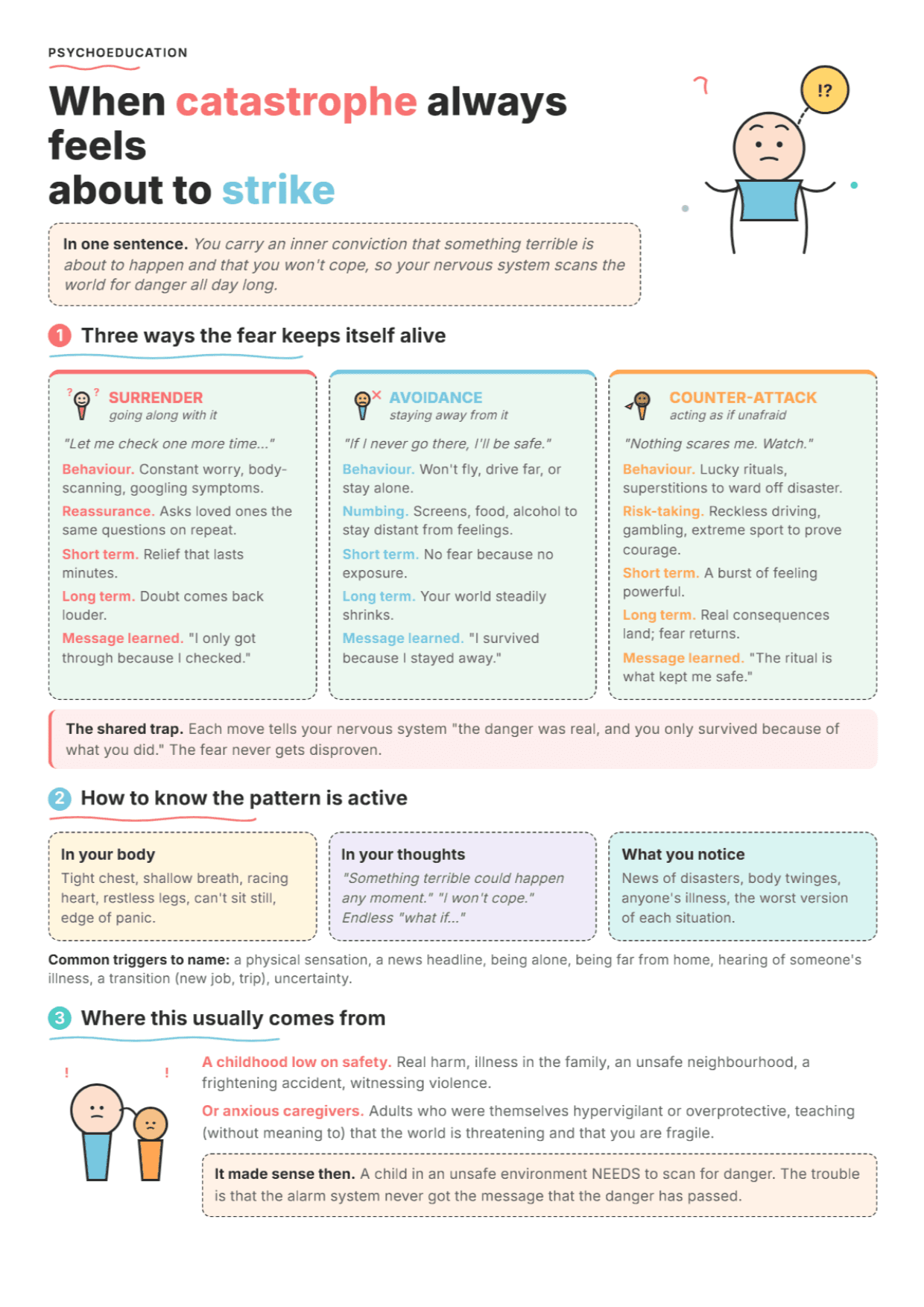
Schema perpetuation operates through three coping styles: surrender, avoidance, and overcompensation. Clinicians working with anxious or depressed patients will often encounter avoidance as the dominant coping style, which complicates engagement with experiential techniques. The multi-session Anxiety and Limiting Beliefs: A Multi-Session Psychoeducation Program offers a structured entry point that normalizes the connection between limiting beliefs and anxiety maintenance before moving to belief-change work proper. A parallel program, Depression and Limiting Beliefs: A Psychoeducation Program, addresses the same relationship for patients in a depressive presentation, with pacing adapted to lower motivational and cognitive resources.
Schema Change Techniques: Cognitive, Experiential, and Behavioral
Cognitive Restructuring Within a Schema Framework
In schema therapy, cognitive restructuring is necessary but not sufficient. It targets the propositional content of a schema while experiential work targets its emotional weight, and behavioral work tests it in real-world conditions. The sequence matters. Beginning with cognitive tools is appropriate when the patient has limited affect tolerance or is in an early phase of treatment.
The exercise Replacing a Negative Belief: A Structured Clinical Exercise operationalizes the construction of a counter-belief, moving the patient from identifying what they currently believe to formulating a more adaptive alternative with empirical support drawn from their own experience. Once the alternative belief is identified, Reinforcing a New Core Belief: A Guided Clinical Exercise provides a structured reinforcement protocol, consolidating the new belief through repeated activation and evidence accumulation, which is the cognitive analogue of the experiential reparenting process.
Targeting Overcompensation Modes
Overcompensation modes are among the most clinically complex because the underlying vulnerability is concealed by behavior that looks, superficially, like competence or confidence. Three exercises in this collection address specific overcompensation presentations directly.
The exercise Patients Who Put Others Down: a Guided Clinical Exercise is designed for patients whose interpersonal style involves devaluation of others as a defense against an underlying defectiveness or shame schema. The exercise Ego, Pride, and Competition: A Guided Clinical Exercise targets grandiosity and competitive overcompensation, tracing their protective function. Both exercises work well as between-session tasks following a mode-mapping conversation in session.
Approval-seeking, a surrender coping style common in the Self-Sacrifice and Approval-Seeking schemas, is addressed in Approval-Seeking in Therapy: A Guided Clinical Exercise, which focuses specifically on how the schema contaminates decision-making. The exercise Perfectionism in Therapy: A Guided Clinical Exercise is relevant to the Unrelenting Standards schema and the Demanding Parent mode, targeting the cognitive and behavioral features of perfectionism that maintain depressive and anxious symptoms.
Using These Resources Across the Schema Therapy Treatment Sequence
A Clinician-Oriented Vignette
> A 38-year-old patient presents with chronic low mood, a long history of unsatisfying romantic relationships, and a tendency to defer to partners even against her own interests. Early sessions reveal a strong Emotional Deprivation schema co-occurring with a Subjugation schema, both rooted in an emotionally unavailable primary caregiver. After mapping the relational origins of these beliefs with a structured exercise, the clinician introduces psychoeducation on limiting beliefs to establish the cognitive model before moving to experiential chair work in session six. Between-session exercises targeting approval-seeking decision patterns are assigned progressively, with reinforcement of the emerging healthy adult belief tracked weekly.
This arc is typical. The resources in this category map onto each phase:
- Assessment and formulation: Use belief-elicitation and origin-mapping exercises to build a shared schema conceptualization.
- Psychoeducation: Introduce multi-session programs to establish the model for the patient and build readiness for deeper work.
- Cognitive restructuring: Assign belief-replacement and belief-reinforcement exercises as structured between-session work.
- Behavioral pattern interruption: Use overcompensation-focused and approval-seeking exercises to address coping modes directly.
- Consolidation: Return to reinforcement exercises as relapse prevention at the end of treatment, integrating healthy adult responses as the default.
Pacing and Sequencing Considerations
Assigning written exercises too early, before the patient has a working understanding of their EMS, typically produces either superficial engagement or avoidance. The psychoeducation programs are deliberately sequenced to build schema literacy before belief-change tasks are introduced. Within a given EMS, the move from exploration to clarification to replacement to reinforcement follows a graduated exposure logic: each step requires slightly more tolerance of the core emotion.
Points of Vigilance and Clinical Limits
Schema Work Is Not a Short-Term Intervention
Schema therapy is an intensive, medium-to-long-term model. Realistic treatment duration for personality pathology is 50 to 100 sessions or more. Framing these resources as tools within a coherent, ongoing treatment is essential; using them in isolation, as standalone psychoeducation in a brief intervention context, will rarely produce schema-level change.
Some clinical cautions are worth keeping in mind:
- Dissociation and trauma history: Imagery rescripting and deep experiential work can activate trauma material. Ensure adequate stabilization before intensifying experiential techniques.
- Therapeutic relationship ruptures: The limited reparenting stance generates strong transference. Ruptures are clinically informative but require explicit repair work, especially in Disconnection and Rejection domain presentations.
- Therapist schema activation: Schema therapy training emphasizes the clinician's own EMS as a supervision and self-care priority. Countertransference in this model is schema-specific and requires reflective practice structures.
- Medication interactions: Where patients are in pharmacological treatment for depression or anxiety, schema change may destabilize symptomatic equilibria temporarily. Coordinate with prescribers in complex presentations.
Cultural and Contextual Adaptation
The unmet core emotional needs framework is theoretically universal, but the relational and cultural contexts in which schemas form vary substantially. Core beliefs about self-sacrifice, approval-seeking, or emotional expression carry different valences across cultural contexts. Bring clinical judgment to the cultural loading of specific schema content, and adapt the framing of exercises accordingly rather than applying them in a culturally decontextualized way.
Tools in this category

Handout
Unrelenting Standards Schema: PDF Handout, Tools and Exercises
A visual psychoeducation handout to help clinicians explain the unrelenting standards schema in session, name its origins, and open the first work toward flexibility.
Self & identityThoughts & cognition

Handout
Unrelenting Standards Schema: PDF Worksheet, Tools and Exercises
A printable visual aid to help clinicians explain the unrelenting standards schema in session, name its three coping modes, and give patients a concrete reference to take home.
Self & identityThoughts & cognition
Handout
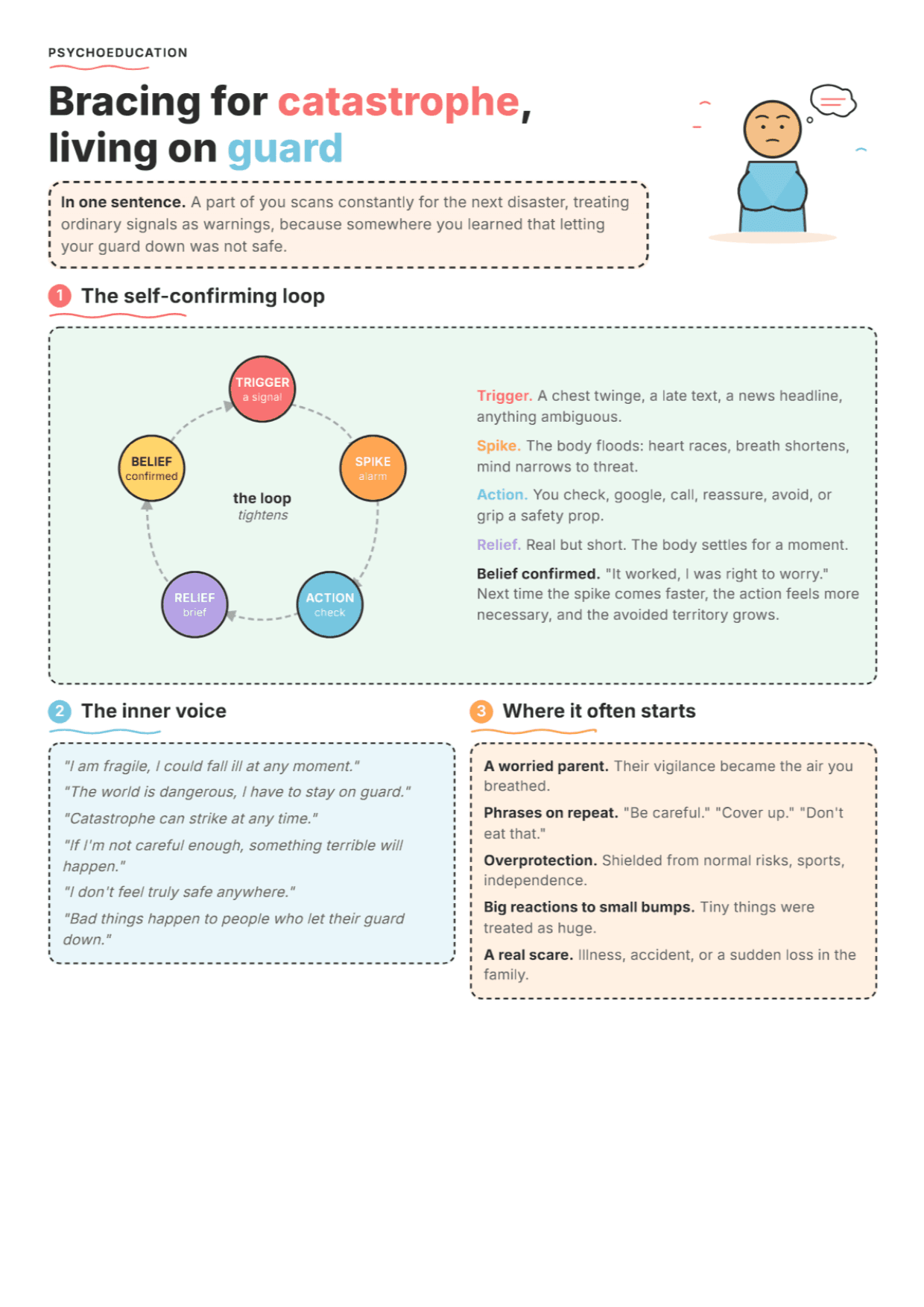
Vulnerability to Harm Schema: PDF Worksheet, Tools and Exercises
A visual PDF worksheet to explain the vulnerability to harm and illness schema in session, with tools and exercises for schema therapy and CBT practice.
AnxietySelf & identity
Handout
Vulnerability to Harm Schema: PDF Worksheet, Tools and Exercises for Clinical Practice
A visual psychoeducation tool helping clinicians explain the Vulnerability to Harm schema in session, its three coping modes, body signals, developmental roots, and pathways to change.
AnxietySelf & identity
Handout
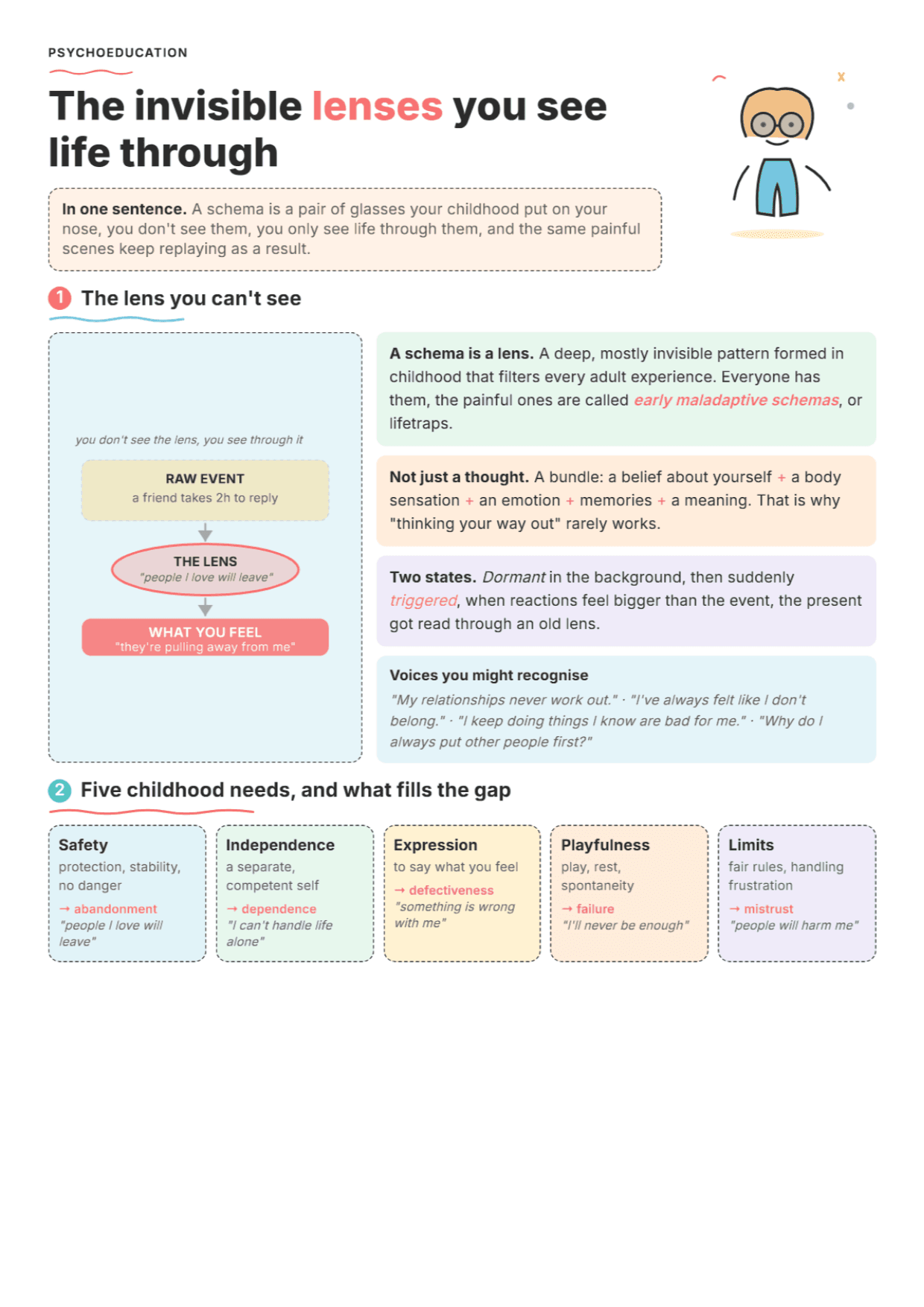
What Are Schemas? PDF Worksheet, Tools and Exercises
A printable psychoeducation fiche, clinical tools and exercises to help patients grasp early maladaptive schemas during session.
Self & identityPersonality
Handout
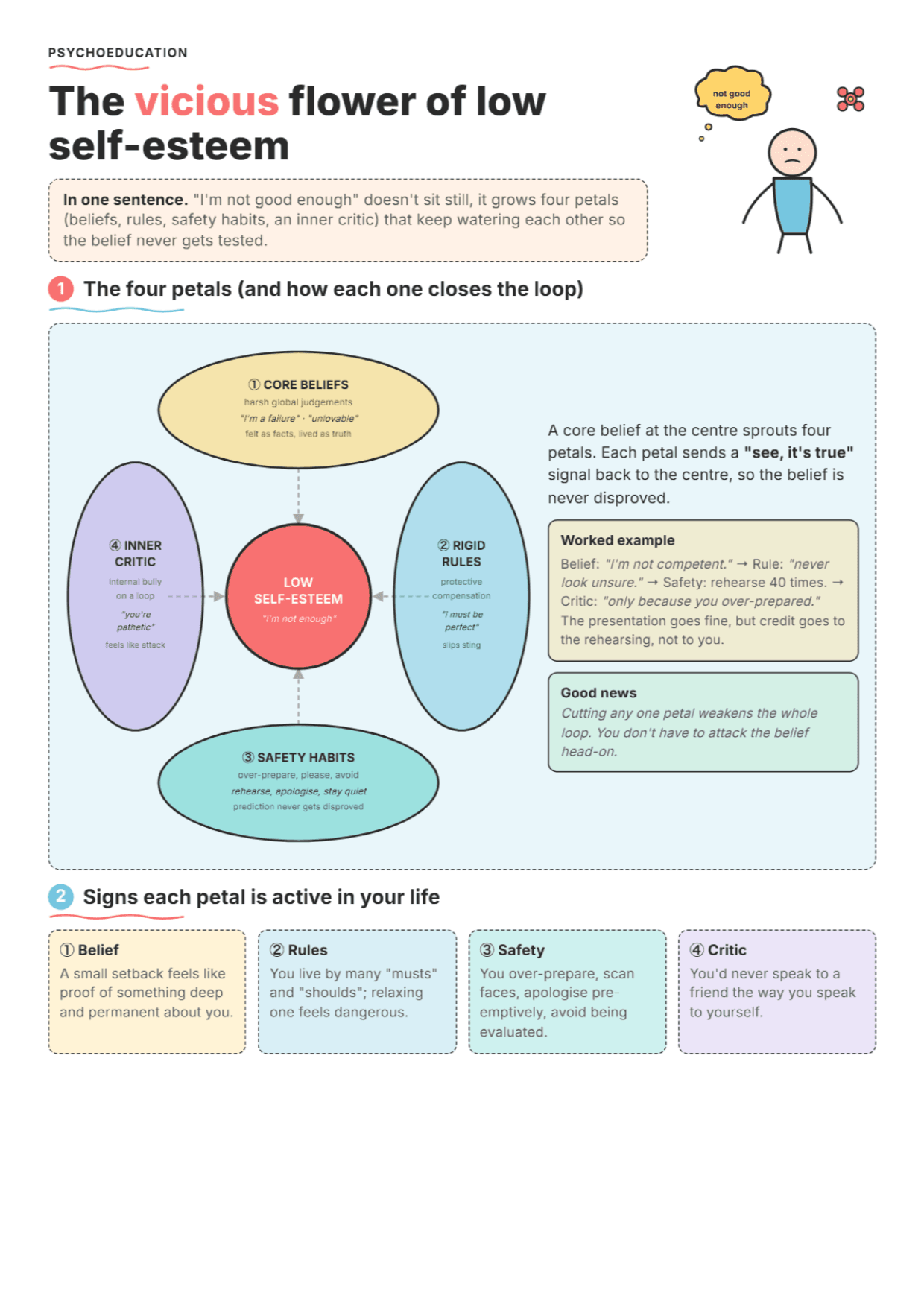
What Keeps Low Self-Esteem Going: PDF Worksheet, Tools and Exercises
A visual psychoeducation tool for clinicians to explain the four-petal maintenance cycle of low self-esteem in session, grounded in Fennell's CBT model.
Self & identity

Handout
Young's 18 Early Maladaptive Schemas: PDF Worksheet, Tools and Exercises
A printable PDF fiche clinicians can use in session to map all 18 schemas, their domains, and the three coping styles that keep them alive.
Self & identityPersonality

Handout
Young's 18 Early Maladaptive Schemas: PDF Worksheet, Tools and Exercises
A visual reference covering all 5 domains, the three coping styles, and first softening steps, a practical psychoeducation tool for schema therapy work.
PersonalitySelf & identity