
Anxiety Disorders: Clinical Resources for Assessment and Treatment
Anxiety disorders, encompassing generalised anxiety disorder, panic disorder, social anxiety disorder, specific phobias, OCD-spectrum presentations, and related conditions, represent the most prevalent diagnostic category seen in outpatient psychological practice. This page is designed for clinicians seeking structured, printable resources to support assessment, psychoeducation, and intervention across the full anxiety spectrum. The worksheets, exercises, and psychoeducation sheets gathered here are organised to accompany evidence-based protocols, from initial case formulation through to relapse prevention. Whether you work within a CBT, ACT, or integrative framework, you will find tools calibrated to different clinical moments and patient profiles.

The Fear-Anxiety Continuum
Anxiety disorders share a common architecture: a hyperactive threat-detection system that generates alarm responses disproportionate to actual danger. The distinction between adaptive fear (time-limited, cue-specific, motivating) and pathological anxiety (pervasive, anticipatory, functionally impairing) is the first clinical hinge. Most patients do not present with this distinction already made; they experience distress as undifferentiated and chronic.
The cognitive model emphasises threat overestimation and tolerance underestimation. The inhibitory learning model (Craske et al.) adds that avoidance prevents the brain from updating threat predictions, making it the central maintenance mechanism across all anxiety presentations. Identifying what the patient is avoiding, both behaviourally and cognitively, is therefore a higher clinical priority than cataloguing symptoms alone.
Neurobiological and Cognitive Underpinnings
The amygdala-prefrontal axis is dysregulated in anxiety disorders: bottom-up threat signals override top-down regulatory processing. This explains the characteristic phenomenology of urgency, cognitive narrowing, and post-episode exhaustion. Psychoeducation that makes this circuitry tangible to the patient is a meaningful early intervention, not a formality.
Cognitive distortions are pervasive across anxiety presentations. Two of the most clinically significant are catastrophising (amplifying probability and catastrophic impact of feared outcomes) and mind reading (assuming negative evaluation by others). The worksheet Decatastrophizing: PDF Worksheet, Tools and Exercises for Clinical Practice gives patients a structured method to challenge probability overestimation, while Mind Reading: PDF Worksheet, Tools and Exercises for Clinical Practice targets the social-evaluative distortion that underlies social anxiety and interpersonal avoidance.
Identifying Anxiety Disorders in Session
Clinical Presentations Across the Spectrum
Anxiety disorders rarely arrive labelled. A patient may present with somatic complaints (tension headaches, gastrointestinal distress, chronic fatigue), with relational difficulties, or with what they call "overthinking." Recognising the anxiety substrate beneath these presentations is a core clinical skill. Screening should cover the three response systems: cognitive (intrusive worry, rumination), physiological (autonomic arousal, sleep disruption), and behavioural (avoidance, reassurance seeking, rituals).
OCD warrants particular care. Its obsessive-compulsive phenomenology can be mistaken for generalised worry or for moral scrupulosity, and psychoeducation must be tailored to the model. The sheet OCD Explained in Session: PDF Worksheet, Tools and Exercises is useful precisely because it externalises the OCD cycle, helping patients recognise compulsive neutralisation as the mechanism that maintains intrusions rather than resolves them.
Screening and Differential Diagnosis
Differential diagnosis in anxiety is genuinely complex. The table below summarises the most common diagnostic overlaps:
- GAD vs. depressive rumination: GAD worry is future-oriented and ego-dystonic; depressive rumination is past-oriented and ego-syntonic.
- Panic disorder vs. cardiac or respiratory pathology: medical clearance is essential before attributing recurrent panic attacks to a purely psychological cause.
- Social anxiety disorder vs. autism spectrum presentations: both involve social avoidance, but the underlying mechanisms and treatment implications differ substantially.
- OCD vs. health anxiety (illness anxiety disorder): the compulsive checking and reassurance-seeking topographies overlap; functional analysis is required.
- PTSD vs. specific phobia: traumatic etiology, re-experiencing symptoms, and hypervigilance distinguish PTSD from a circumscribed phobia.
Comorbidity is the rule, not the exception. Anxiety and major depressive disorder co-occur in roughly 50% of clinical presentations. Substance use disorders frequently develop as secondary avoidance strategies. Attention should also be given to perfectionism and low frustration tolerance, which often perpetuate anxiety cycles without meeting any single diagnostic threshold.
Cognitive and Behavioural Targets in Anxiety Treatment
Modifying Maladaptive Cognitive Patterns
Cognitive restructuring remains a cornerstone of CBT for anxiety. In practice, restructuring is most effective when it is collaborative and Socratic rather than didactic. The clinician's task is to help the patient discover the distortion, not to correct it. The worksheet Decatastrophizing: PDF Worksheet, Tools and Exercises for Clinical Practice operationalises this with probability estimation and best/worst/most-likely scenario columns, making the session tangible and the homework achievable.
For patients who are overly fused with their anxious thoughts, ACT-based defusion techniques offer an alternative to restructuring. Rather than challenging the content of thoughts, defusion alters the patient's relationship to them. The sheet ACT Cognitive Defusion: PDF Worksheet, Tools and Exercises for Clinical Practice provides a range of defusion exercises graded by abstraction, suitable for patients at different stages of psychological flexibility.
Building Coping Repertoire and Behavioural Activation
Anxious patients typically have a narrow and rigid coping repertoire: they rely heavily on avoidance, reassurance, and suppression, all of which are short-term relievers and long-term amplifiers. Expanding this repertoire is a treatment goal in its own right. The resource Adaptive vs Maladaptive Coping: PDF Worksheet, Tools and Exercises helps patients map their existing strategies against a cost-benefit framework, building motivation for change rather than simply prescribing it.
For younger patients, the sheet 50 Coping Strategies for Children and Adolescents: PDF Worksheet, Tools and Exercises provides age-appropriate tools across emotional, somatic, social, and cognitive domains. It is particularly useful in paediatric consultations where abstract psychoeducation lands poorly.
ACT-Oriented Approaches to Anxiety Disorders
Psychological Flexibility as a Treatment Target
Within an Acceptance and Commitment Therapy framework, the therapeutic goal is not anxiety reduction per se but the cultivation of psychological flexibility: the capacity to act in accordance with one's values even in the presence of distress. This reframe is clinically significant because it shifts treatment success from a symptom metric to a functional one. The worksheet Psychological Flexibility: PDF Worksheet, Tools and Exercises for ACT Practice maps the six ACT core processes and can anchor a psychoeducation session on what treatment is actually targeting.
Values clarification and committed action are particularly important when anxiety has resulted in significant life contraction. Patients who have been avoiding for years often need help articulating what they are avoiding towards, not just what they are avoiding from. The The Choice Point: PDF Worksheet, Tools and Exercises for ACT Practice tool is effective here: it makes visible the moment-to-moment choice between away-moves (avoidance, fusion) and towards-moves (values-consistent action), even under conditions of high anxiety.
Growth Orientation and Long-Term Change
A fixed mindset about anxiety ("I am an anxious person, this is who I am") predicts poorer treatment engagement and higher relapse. Introducing a growth-oriented frame early in treatment can improve therapeutic alliance and shift the patient's relationship to setbacks. The sheet Adopting a Growth Mindset: PDF Worksheet, Tools and Exercises for Clinical Practice is well-suited to this purpose, particularly for adolescents and for patients with high shame around their anxiety.
Assertiveness Training in the Context of Anxiety
Why Assertiveness Deficits Perpetuate Anxiety
Assertiveness deficits are highly prevalent among patients with social anxiety disorder, GAD, and health anxiety. The inability to set limits, decline requests, or express needs directly fuels chronic interpersonal stress and reinforces core beliefs about personal inadequacy. Assertiveness training is therefore not an adjunct to anxiety treatment; in many formulations it is central to it.
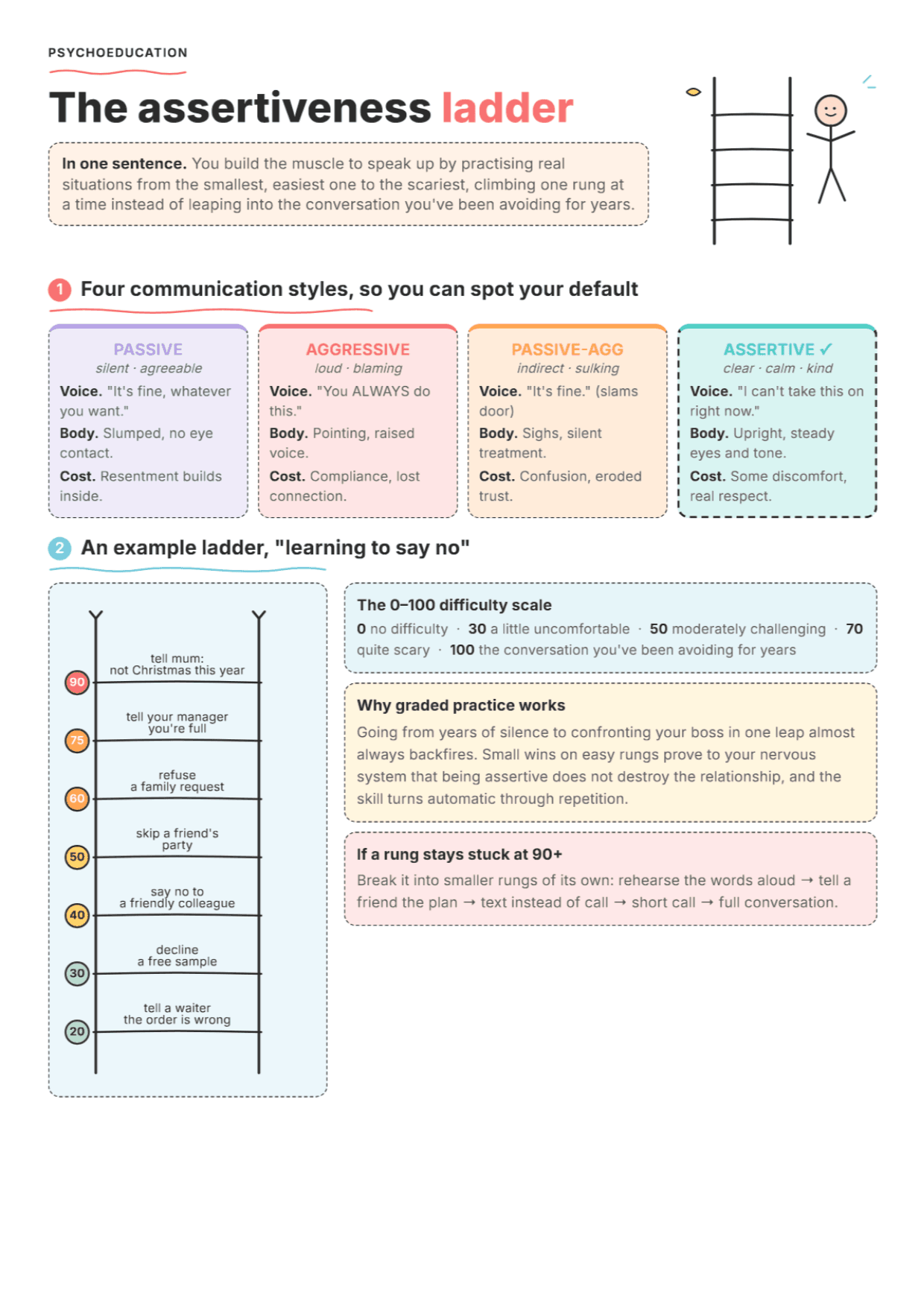
Begin with psychoeducation on rights before introducing skill-building. The sheet Assertive Rights: PDF Worksheet, Tools and Exercises for Clinical Practice provides a grounding in the legitimate entitlements that anxious patients often deny themselves, addressing the cognitive layer before the behavioural one. Once that foundation is in place, the Assertiveness Ladder: PDF Worksheet, Tools and Exercises for Clinical Practice offers a graduated exposure structure: patients identify low-stakes to high-stakes situations and practise assertive responses hierarchically, consistent with the inhibitory learning rationale.
> A patient with longstanding social anxiety had declined every social invitation for two years. In session, the Assertiveness Ladder was used not for classic "saying no" scenarios but for the feared act of initiating a conversation. Starting with a brief exchange at a familiar shop, and grading up to rejoining a professional networking event, she completed five rungs over six weeks. The ladder made the exposure hierarchy visible and allowed her to self-monitor without the clinician present.
Integrating These Resources into the Care Plan
Sequencing Across Treatment Phases
These resources are not interchangeable; sequencing matters. A suggested integration framework:
- Assessment and formulation (sessions 1-3): use psychoeducation sheets to introduce the cognitive-behavioural or ACT model, externalise the anxiety cycle, and build shared language. OCD Explained in Session: PDF Worksheet, Tools and Exercises and the Psychological Flexibility: PDF Worksheet, Tools and Exercises for ACT Practice sheet both serve this function.
- Cognitive intervention (sessions 4-7): introduce cognitive restructuring with Decatastrophizing: PDF Worksheet, Tools and Exercises for Clinical Practice and Mind Reading: PDF Worksheet, Tools and Exercises for Clinical Practice, or shift to defusion with ACT Cognitive Defusion: PDF Worksheet, Tools and Exercises for Clinical Practice if fusion is the primary target.
- Behavioural intervention (sessions 6-12): hierarchy construction with the Assertiveness Ladder: PDF Worksheet, Tools and Exercises for Clinical Practice, values clarification with The Choice Point: PDF Worksheet, Tools and Exercises for ACT Practice.
- Coping consolidation and relapse prevention (sessions 10-16): broaden the repertoire with Adaptive vs Maladaptive Coping: PDF Worksheet, Tools and Exercises and anchor a growth orientation with Adopting a Growth Mindset: PDF Worksheet, Tools and Exercises for Clinical Practice.
Adapting Resources for Specific Populations
Children and adolescents require developmentally calibrated materials. Abstract psychoeducation about the amygdala is rarely effective with a 10-year-old in acute distress. 50 Coping Strategies for Children and Adolescents: PDF Worksheet, Tools and Exercises bridges this gap, providing concrete, somatic, and creative strategies that younger patients can use independently.
For patients with comorbid depression, the energy cost of engagement with worksheets is real. Prioritise shorter, highly structured tools in early sessions. As alliance deepens and activation increases, more demanding reflection exercises become feasible.
Clinical Cautions and Limits
Psychoeducation Is Not Treatment
Worksheets and psychoeducation sheets are adjuncts to, not substitutes for, a formulation-driven treatment. A patient who completes a decatastrophizing worksheet without a therapist processing the outcome is doing exercises, not therapy. The clinical value of these resources lies in how they are introduced, debriefed, and connected to the patient's formulation.
Reassurance seeking is a compulsive behaviour that worksheets can inadvertently reinforce if the clinician is not attentive. Completing a coping sheet may become another safety behaviour if the patient uses it to temporarily reduce anxiety rather than to build tolerance. Monitor for this, particularly with OCD presentations.
When Anxiety Disorders Require Escalation
Several presentations warrant immediate attention beyond the standard outpatient protocol:
- Anxiety with suicidal ideation or self-harm: the anxiety is not the primary treatment target.
- Agoraphobia severe enough to confine the patient to their home: an adapted home-based or digital protocol may be required before standard session-based work is viable.
- Suspected bipolar disorder presenting with anxious agitation: SSRI monotherapy without mood stabilisation carries a switch risk.
- Substance dependence as a primary anxiety management strategy: integrated dual-diagnosis treatment is required.
These tools are designed for use within a clinically supervised framework. Their quality is a function of the clinical relationship and case formulation that surrounds them.
Tools in this category
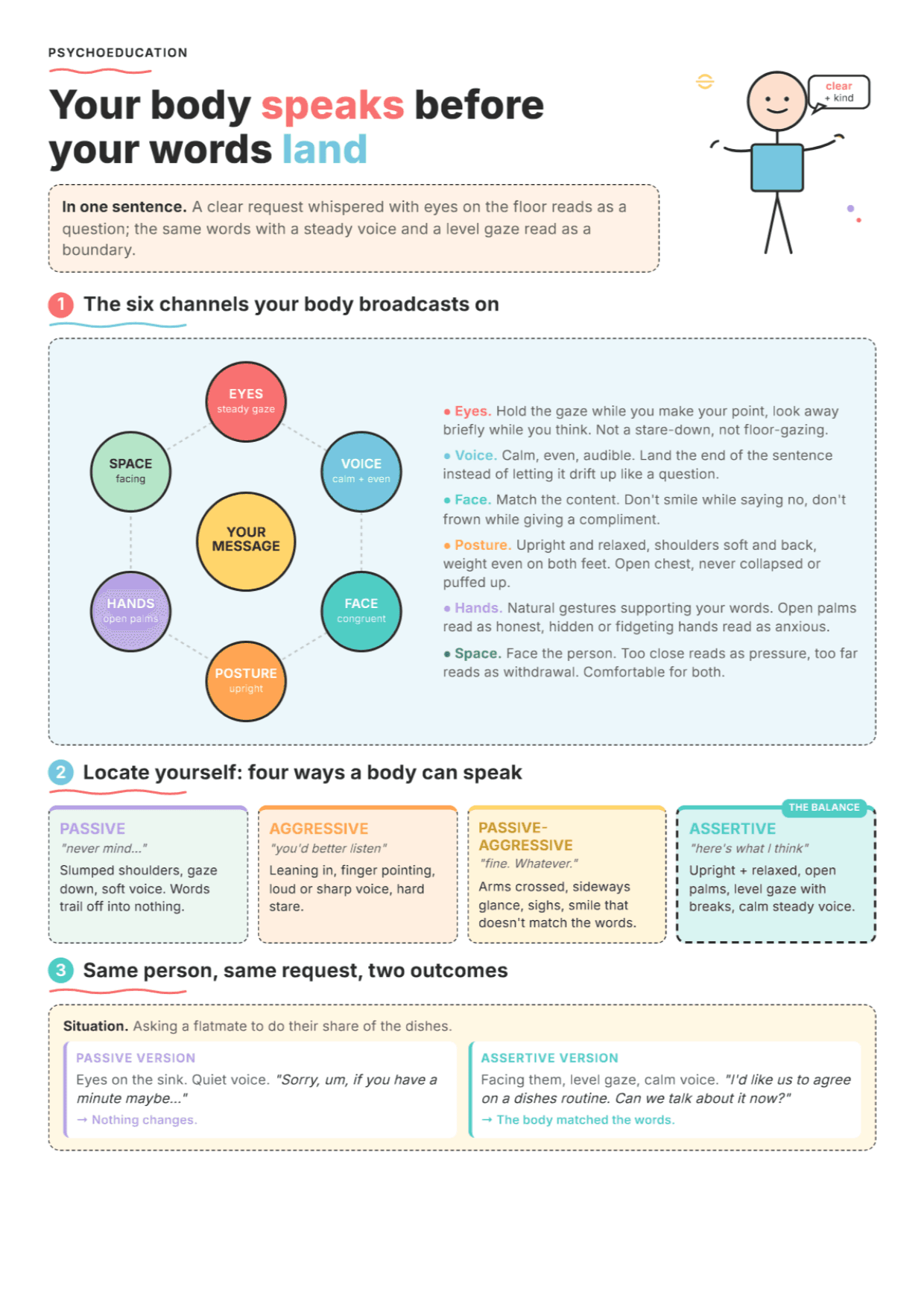
Handout
Assertive Body Language: PDF Worksheet, Tools and Exercises for Clinical Practice
A visual PDF worksheet with exercises and tools to help clinicians explain the six body channels of assertiveness and build concrete practice routines in session.
Self & identityAnxiety
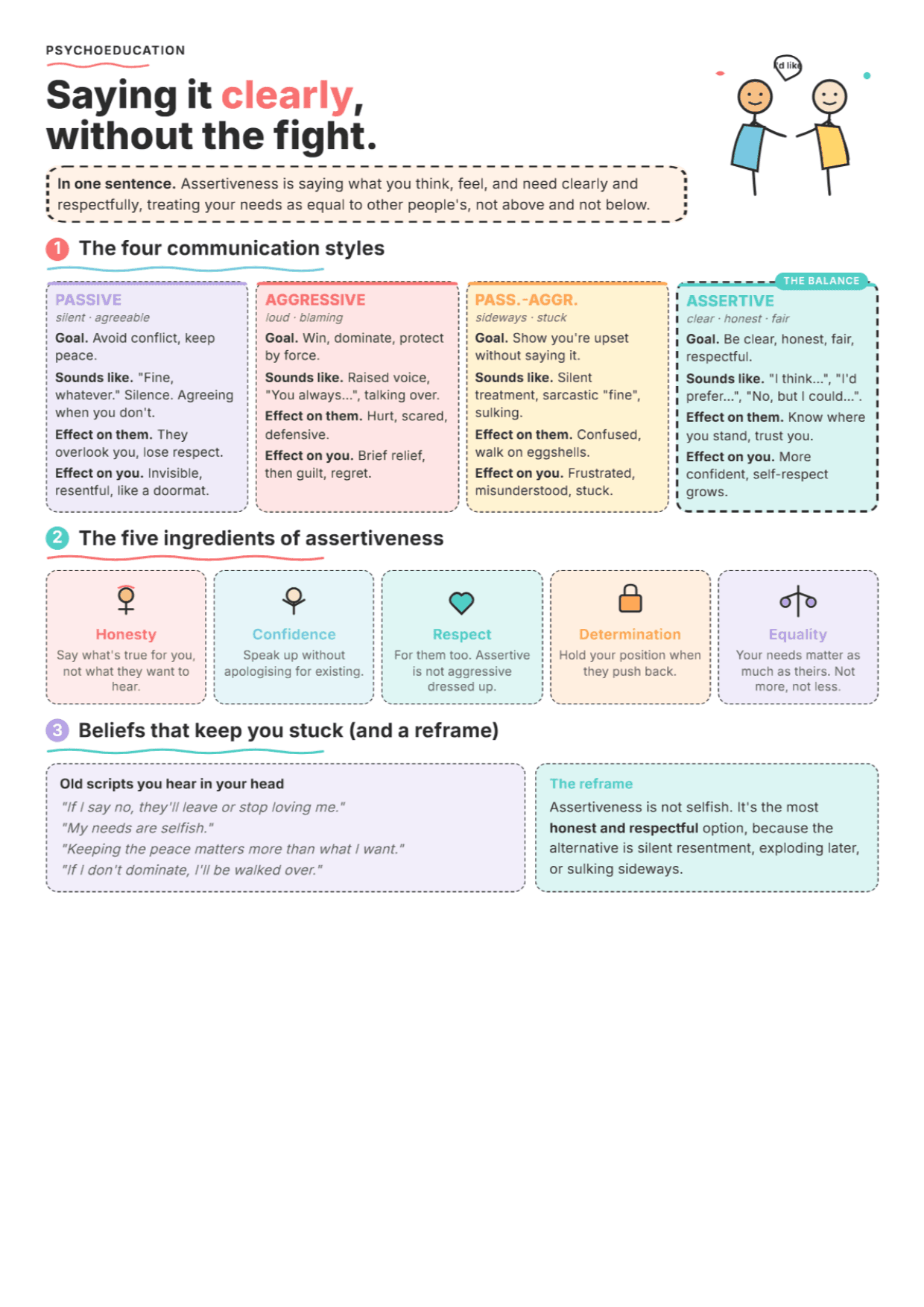
Handout
Assertive Communication: PDF Worksheet, Tools and Exercises
A visual PDF worksheet, practical tools, and ready-to-use exercises to explain assertive communication clearly and build it session by session.
Self & identityRelationships
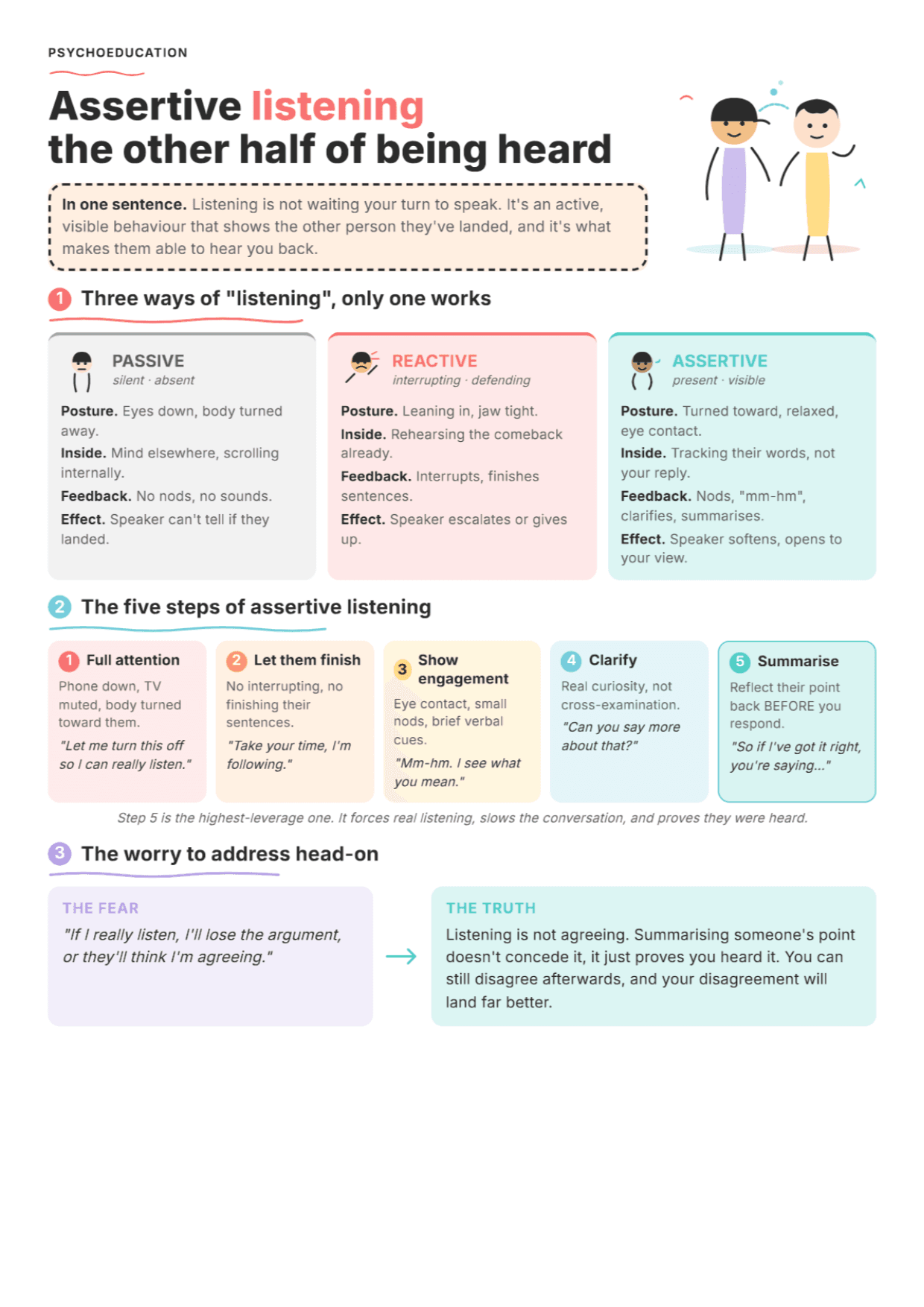
Handout
Assertive Listening: PDF Worksheet, Tools and Exercises for Clinical Practice
A visual PDF worksheet, concrete exercises, and clinical tools to teach assertive listening as a practised behaviour, not a passive stance.
Self & identityRelationships
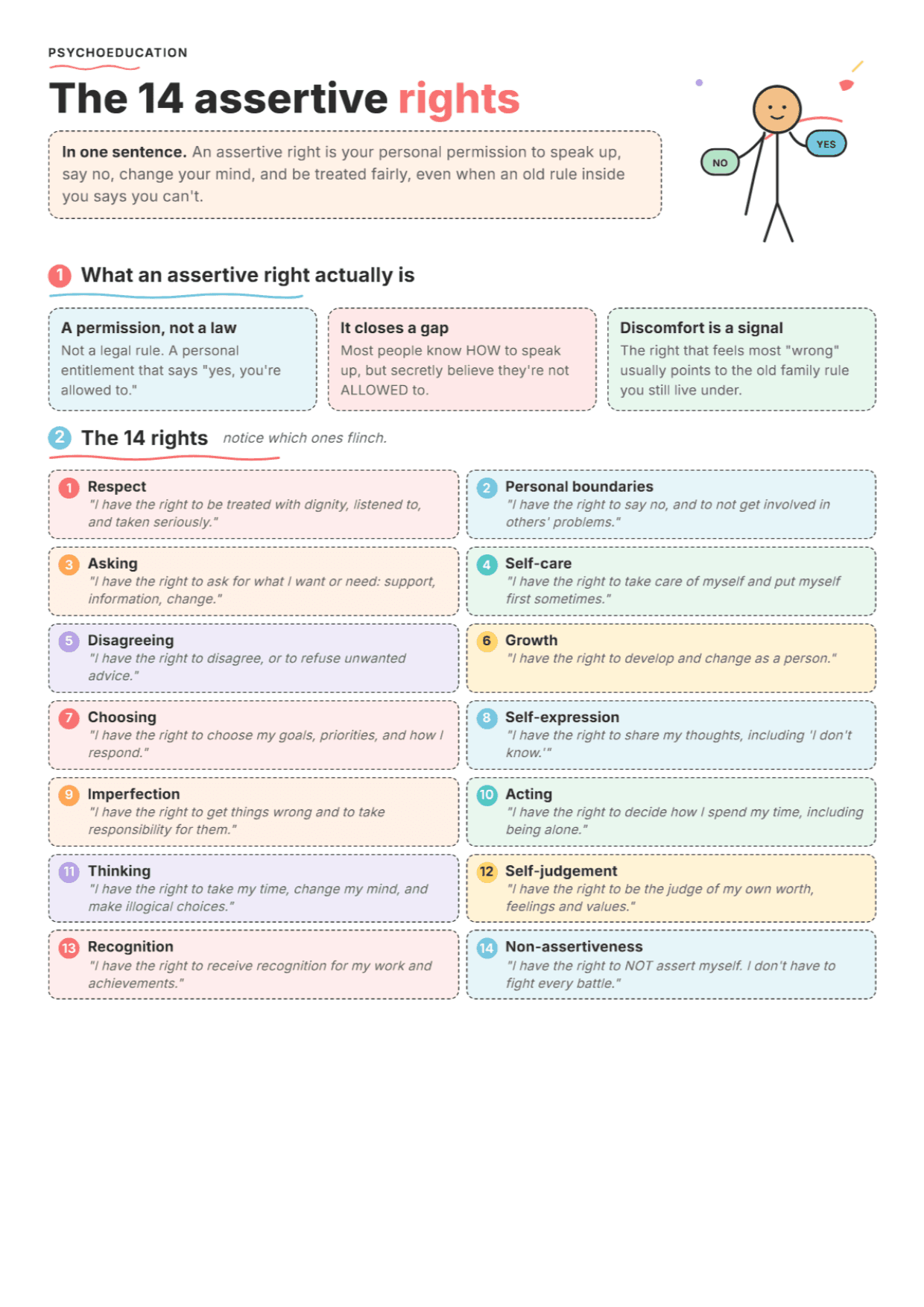
Handout
Assertive Rights: PDF Worksheet, Tools and Exercises for Clinical Practice
A visual PDF worksheet presenting the 14 assertive rights, the hidden rules that block them, and ready-made scripts, a structured psychoeducation tool for assertiveness work in session.
Self & identityAnxiety
Handout
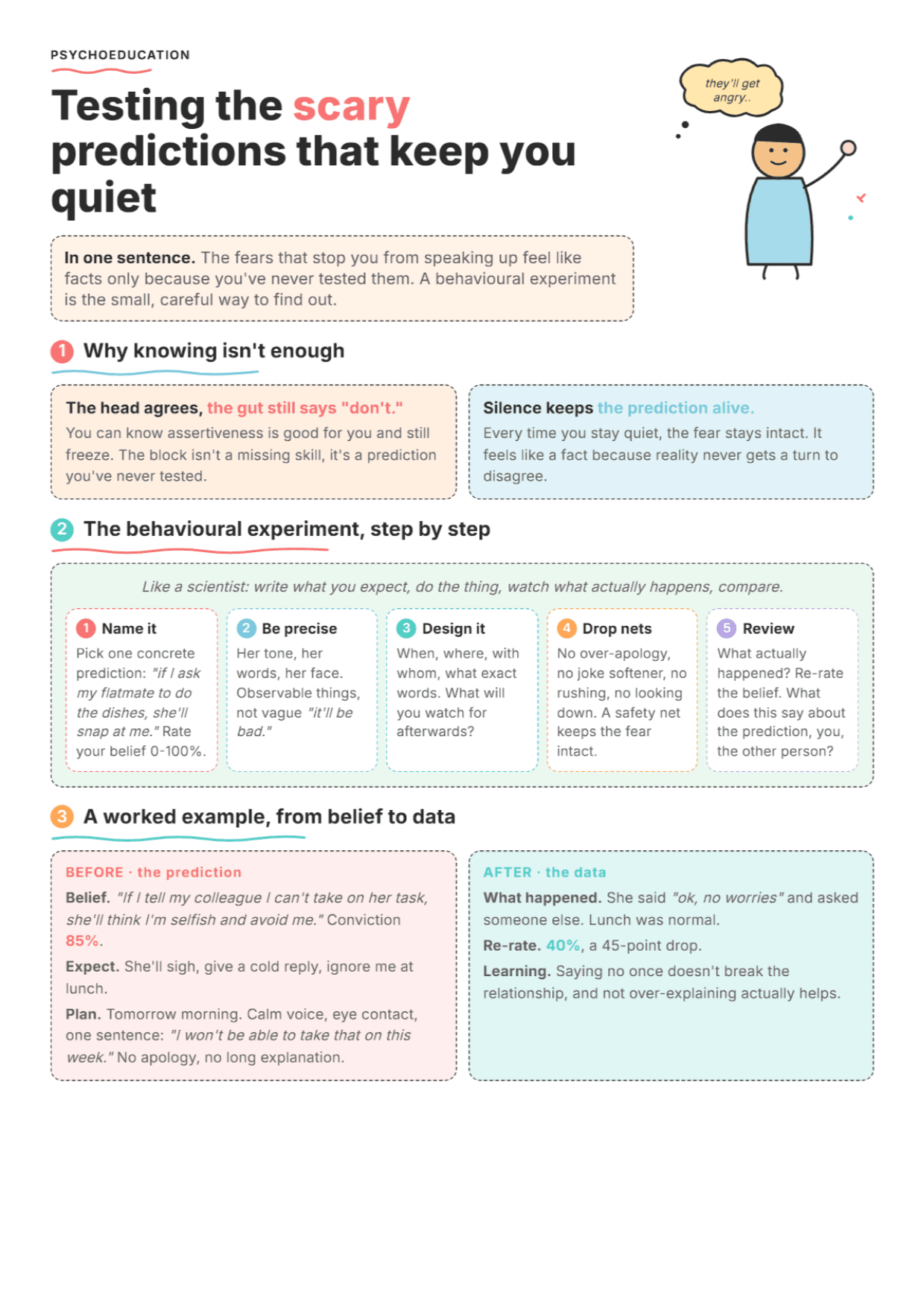
Assertiveness Behavioral Experiment: PDF Worksheet, Tools and Exercises
A visual PDF worksheet clinicians can use in session to help patients design, run, and debrief assertiveness experiments, building real behavioral evidence against fear-driven predictions.
Self & identityAnxiety
Handout
Assertiveness Ladder: PDF Worksheet, Tools and Exercises
A visual PDF worksheet clinicians can use in session to explain graduated assertiveness practice, build a personalized hierarchy, and give patients a concrete reference between appointments.
Self & identityAnxiety
Handout
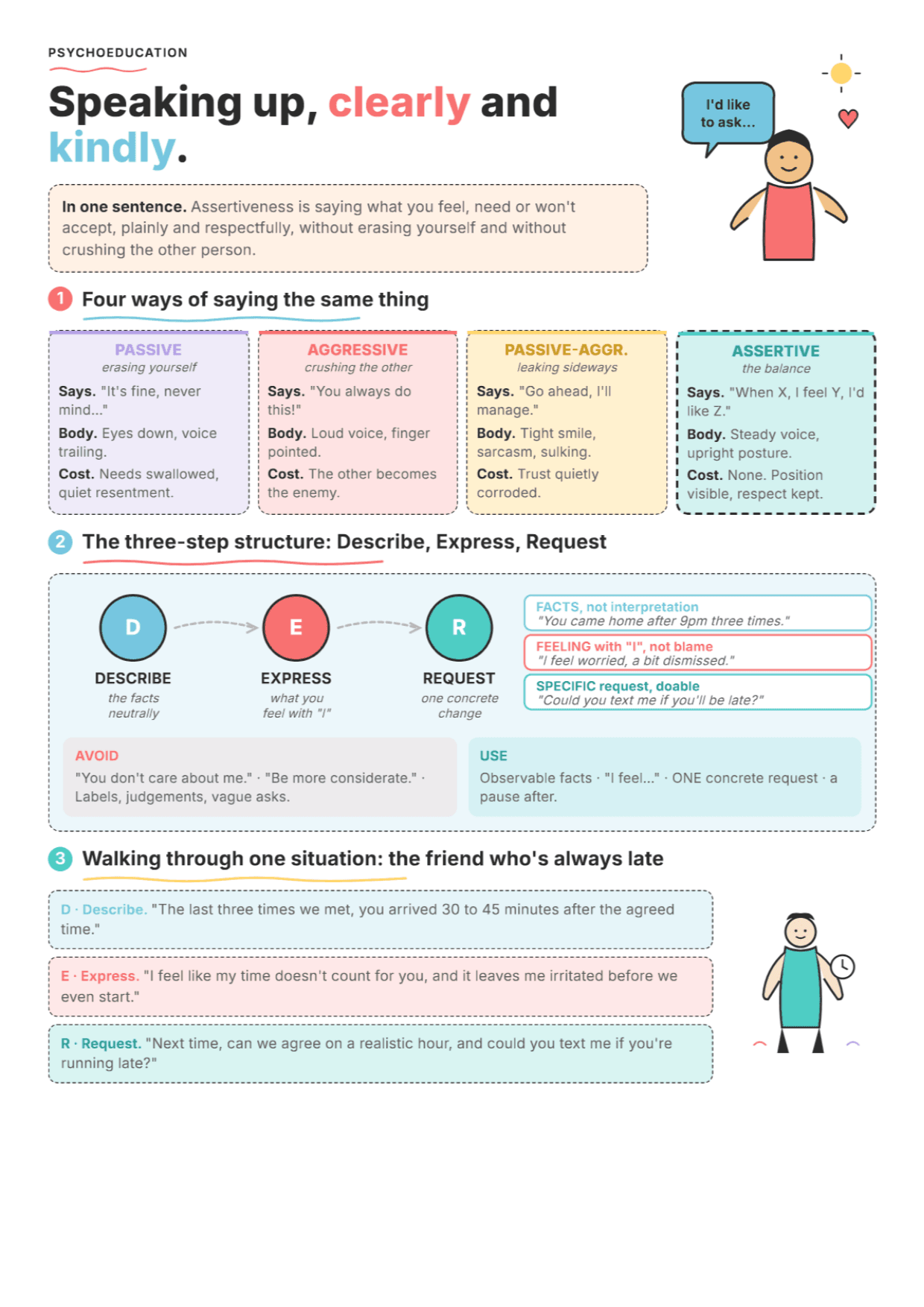
Assertiveness Training: PDF Worksheet, Tools and Exercises for 10 Scenarios
A structured PDF worksheet with four communication styles, the DER framework, and ten rehearsable scenarios to make assertiveness training concrete and fast in session.
Self & identityRelationships
Handout
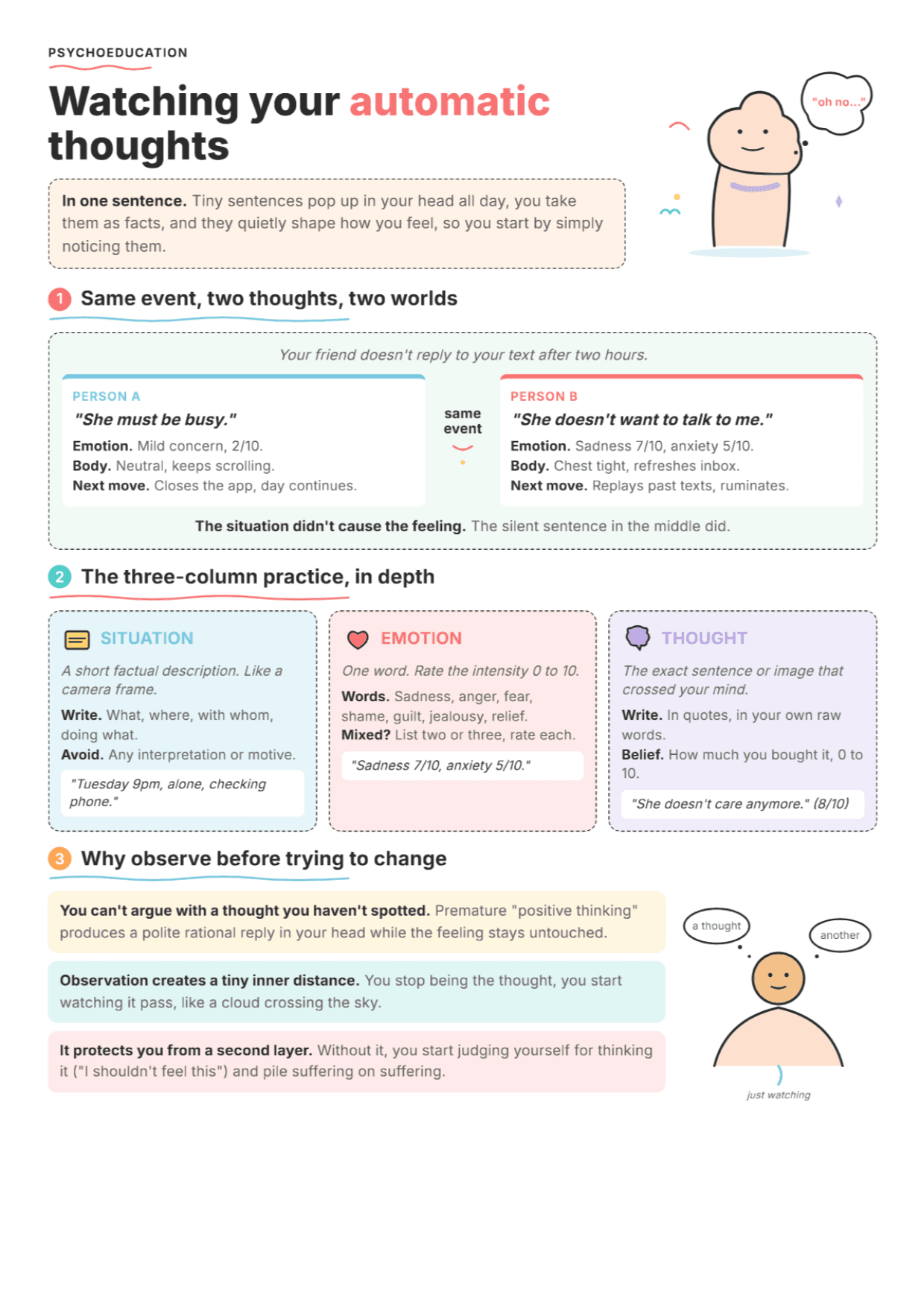
Automatic Thoughts (S-E-T): PDF Worksheet, Tools and Exercises
A visual PDF worksheet, clinical tools, and exercises to help patients observe automatic thoughts in session and carry the S-E-T framework into daily life.
AnxietyMood & depression
Handout
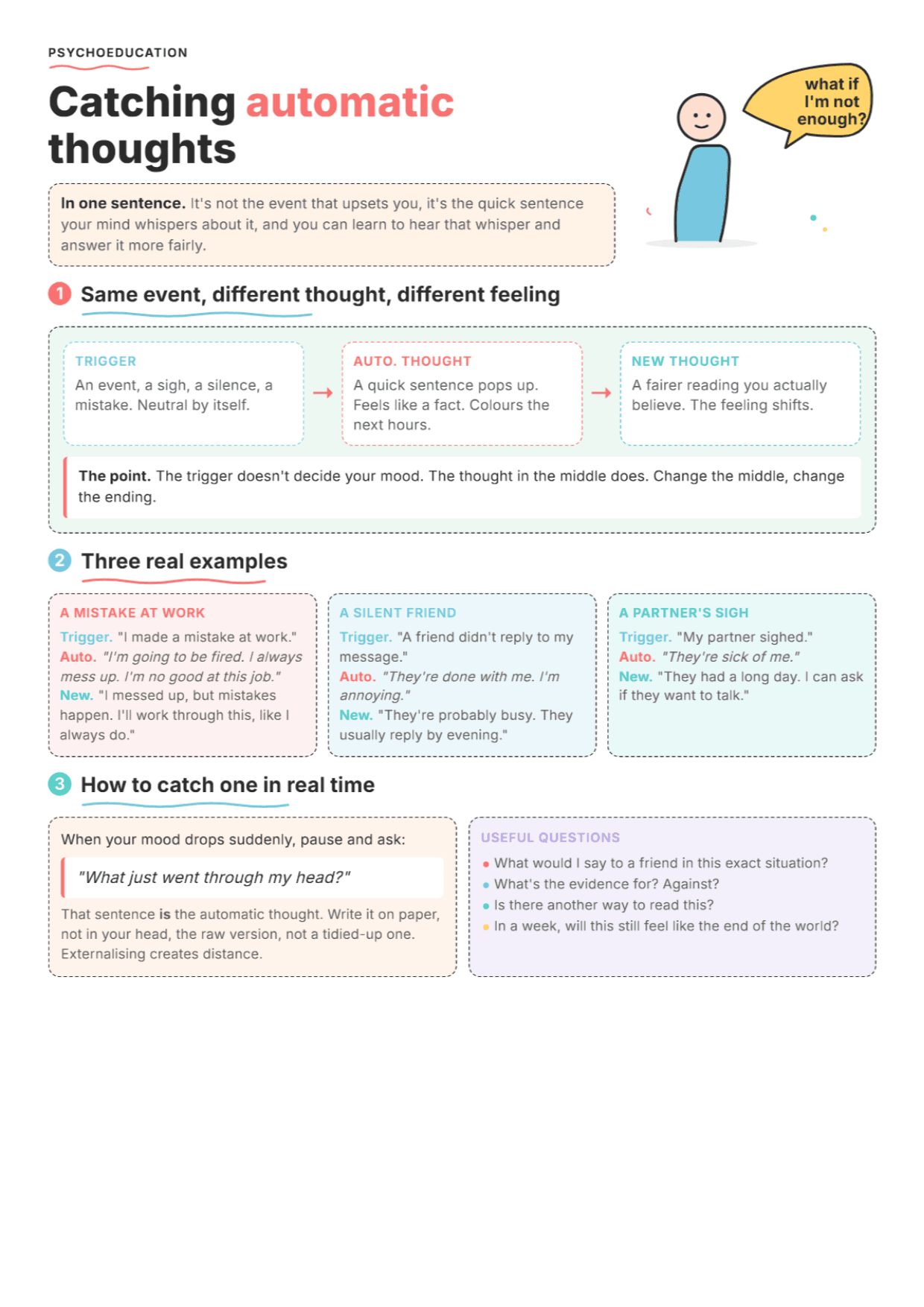
Automatic Thoughts: PDF Worksheet, Tools and Exercises
A printable PDF worksheet, visual tools, and exercises to explain automatic thoughts clearly in session and give patients a concrete between-session reference.
Thoughts & cognitionMood & depression