
Cognitive Restructuring: Clinical Worksheets for Targeted Belief Change
Cognitive restructuring, the systematic process of identifying and modifying maladaptive thought patterns, dysfunctional beliefs, and cognitive distortions, sits at the technical core of most evidence-based psychotherapies. This page is designed for clinicians who want structured, printable tools to support this work across a range of presentations and treatment models. The resources gathered here span psychoeducation, guided self-monitoring, and active disputation exercises, each mapped to a specific mechanism of change. Whether you are working within a strict CBT protocol, integrating REBT principles, or drawing selectively from third-wave approaches, you will find material here that can be embedded directly into session work or assigned as between-session practice.

What the Intervention Actually Targets
Cognitive restructuring is not simply about replacing negative thoughts with positive ones. Its target is the appraisal process: the automatic, often schema-driven interpretation of events that generates emotional and behavioural consequences. The clinician's task is to bring that interpretive layer into awareness, evaluate its accuracy and utility, and support the patient in constructing more adaptive, evidence-consistent alternatives.
The theoretical foundations are plural. Beck's cognitive model foregrounds automatic thoughts, intermediate beliefs, and core schemas. Ellis's REBT emphasises irrational, absolutistic demands (musts, shoulds, awfuls). Both converge on the principle that emotion is primarily a product of appraisal, not of the activating event itself. The ABC Model (REBT): PDF Worksheet, Tools and Exercises for Clinical Practice operationalises this directly, giving patients a structured map from Activating event to Belief to emotional and behavioural Consequence.
Why Structure Matters
Unstructured verbal disputation is often insufficient, particularly early in treatment when patients lack the metacognitive vocabulary to observe their own thinking. Worksheets serve a specific clinical function: they slow the appraisal process down, externalise it onto paper, and create a retrievable record that both clinician and patient can return to. This is not about bureaucratising therapy; it is about creating the conditions under which insight can generalise.
Identifying Restructuring Candidates in Consultation
Presentation Cues That Signal the Technique Is Indicated
Not every patient who presents with distress requires formal cognitive restructuring. The clearest indicators are: recurrent, stereotyped negative appraisals that the patient reports across multiple contexts; emotional responses that appear disproportionate to the objective situation; and a demonstrable gap between the patient's interpretation of events and the evidence they themselves can cite when pressed. Patients who use absolute language habitually ("always", "never", "everyone"), who catastrophise routinely, or who attribute others' behaviour to stable, internal, and global causes are strong candidates.
Cognitive rigidity is another reliable marker. When a patient struggles to generate even one alternative explanation for an ambiguous event, restructuring work is warranted. The fiche All-or-Nothing Thinking: PDF Worksheet, Tools and Exercises for Clinical Practice is particularly useful here: it targets the dichotomous thinking pattern directly and can serve as both an assessment prompt and an introductory psychoeducation tool in the same session.
Assessing Belief Systems Before Beginning
Before diving into session-by-session disputation, a brief mapping of the patient's most entrenched beliefs saves considerable time. Relationship-focused presenting problems, for instance, are often underpinned by a cluster of interpersonal assumptions that are worth surfacing explicitly. The 12 Beliefs That Damage Relationships: PDF Worksheet, Tools and Exercises offers a structured inventory that can be completed collaboratively or assigned prior to the session, giving you a working hypothesis about which belief domains to prioritise.
Core Distortions and Their Clinical Forms
The Distortion Taxonomy as a Clinical Map
The classical taxonomy of cognitive distortions, as described by Beck, Burns, and others, remains clinically useful not because it is exhaustive but because it gives patients a shared vocabulary to name what is happening in their thinking. Naming a distortion is not the intervention itself; it is the precondition for examining it. When a patient can say "I'm doing the mind-reading thing again", they have already created a small but real distance from the thought.
The Mind Reading: PDF Worksheet, Tools and Exercises for Clinical Practice addresses one of the most clinically prevalent distortions: the automatic, untested assumption about others' thoughts and intentions. It pairs well with social anxiety, interpersonal conflict, and certain presentations of depression where the patient's model of how they are perceived by others is central to the maintenance of the problem.
Catastrophising as a Maintenance Factor
Catastrophising, the tendency to treat unlikely worst-case outcomes as probable or unbearable, is a transdiagnostic maintenance factor present across anxiety disorders, chronic pain, health anxiety, and many adjustment reactions. It deserves targeted intervention in its own right. The Decatastrophizing: PDF Worksheet, Tools and Exercises for Clinical Practice guides patients through a structured probability and coping re-evaluation, moving them from "this will be unbearable" toward a calibrated appraisal of both likelihood and their own resilience resources.
Comorbidities, Differential Considerations, and Scope Limits
When Restructuring Is Contraindicated or Needs Adaptation
Cognitive restructuring is not appropriate as a primary intervention when a patient is acutely dissociated, in florid psychosis, or operating below the metacognitive threshold required to observe their own thinking. In early trauma work, challenging a patient's protective cognitions before a sufficient therapeutic alliance and stabilisation phase is in place can be destabilising. The clinician must also be alert to secondary gain from certain beliefs: a patient who holds the belief "I cannot cope alone" may resist restructuring not out of rigidity but because the belief serves an attachment function.
Differential considerations include overvalued ideation (where the patient has some insight but strong conviction) and frank delusions (where the standard Socratic approach is contraindicated). Obsessional rumination can superficially resemble the kind of thought-monitoring used in restructuring but responds poorly to direct disputation; in OCD, the evidence-testing component needs careful framing to avoid reinforcing the compulsive checking cycle.
Rights, Identity, and the Assertiveness Interface
Some dysfunctional beliefs are not primarily about events but about the self as a social agent: beliefs about entitlement, permission, and interpersonal rights. These are particularly relevant in presentations involving chronic submissiveness, passive aggression, or assertiveness deficits. The Assertive Rights: PDF Worksheet, Tools and Exercises for Clinical Practice helps patients examine the often-implicit belief that their own needs, limits, and preferences are less legitimate than those of others, a belief that rarely yields to purely cognitive disputation without explicit values work alongside it.
Using These Worksheets in Session
A Sequenced Approach to Introducing the Tools
The order in which tools are introduced matters. A reasonable sequencing protocol for a new restructuring module:
- Begin with psychoeducation on the cognitive model, using the ABC framework as the conceptual scaffold. The ABC Model (REBT): PDF Worksheet, Tools and Exercises for Clinical Practice is well-suited for this first step.
- Introduce thought monitoring with a focus on one recurrent automatic thought identified collaboratively in session.
- Name and normalise the relevant distortion pattern (all-or-nothing, mind reading, catastrophising) using the appropriate fiche as a reference document.
- Move to active disputation: examine evidence for and against, generate alternatives, re-rate emotional intensity.
- Consolidate gains by linking the restructured belief to a behavioural experiment or a between-session practice task.
> A patient with recurrent relationship conflict consistently interpreted her partner's silence as contempt. After mapping the pattern with the Mind Reading worksheet in session, she was able to identify three alternative explanations she had genuinely not considered. She described the exercise as "the first time I've slowed the thought down enough to look at it." The belief had not disappeared, but its automaticity had been disrupted, which was the clinical goal at that stage.
Assigning Worksheets Between Sessions
Between-session practice is where cognitive restructuring consolidates. Worksheets assigned without adequate in-session preparation tend to be completed superficially or not at all. The clinician should model the exercise with at least one specific example before sending the patient home with it. Reviewing the completed worksheet in the following session, rather than simply asking "how did that go?", signals that the work is taken seriously and generates material for further clinical discussion.
Integrating Cognitive Restructuring Into the Broader Care Plan
Positioning Within a CBT or Integrative Protocol
In a standard CBT protocol, cognitive restructuring typically follows the behavioural activation or exposure component, not precedes it, particularly in depression and anxiety. Changing behaviour first can alter the informational environment in ways that make cognitive change more tractable. That said, in presentations where avoidance is maintained primarily by rigid, explicit beliefs (rather than conditioned fear), restructuring may usefully come first.
Schema-level work is a longer arc. Distortion-level interventions address automatic thoughts; schema change requires sustained work on core beliefs, typically over months. The shift from "I made a mistake" to "I am fundamentally incompetent" illustrates the depth difference. Introducing a growth mindset framework can be a useful transitional step: the Adopting a Growth Mindset: PDF Worksheet, Tools and Exercises for Clinical Practice reframes the patient's relationship to failure and effort in ways that can loosen fixed self-schemas without requiring deep schema therapy.
Cross-Cutting Applications
Cognitive restructuring tools appear across diagnostic categories because the mechanism (appraisal modification) is transdiagnostic. The distortions and belief systems targeted by these resources appear in:
- Depression: global negative self-appraisals, hopelessness cognitions, selective abstraction
- Anxiety disorders: threat overestimation, intolerance of uncertainty, catastrophising about consequences
- Relationship difficulties: interpersonal beliefs, attribution biases, mind reading
- Low self-esteem and assertiveness deficits: beliefs about rights, worth, and social permission
- Adjustment disorders: appraisals of controllability, meaning-making distortions
The breadth of this list is why these resources cluster well as a therapeutic aim category: the technique cuts across presentations even when the content differs substantially.
Clinical Vigilance and Limits of the Approach
The Risk of Intellectualisation
A consistent clinical pitfall with restructuring work is that patients learn to produce "corrected" thoughts at the cognitive level without genuine emotional change. The patient who completes a thought record fluently and re-rates their distress from 80 to 30 but shows no behavioural change and returns the following week with the same automatic thought requires a different intervention strategy. This pattern often signals that the work is occurring in the reflective system while the emotional network remains untouched; experiential techniques, imagery rescripting, or chair-work may be needed to reach the level where belief change is emotionally real.
Validation before disputation is a principle worth keeping in front. Patients who feel their experience is being challenged rather than understood tend to defend rather than examine their beliefs. The Socratic approach works best when the therapeutic alliance is sufficiently robust that the patient experiences the clinician's questions as genuinely curious rather than corrective.
Monitoring Progress and Knowing When to Change Tack
If a patient has worked consistently with restructuring tools across six to eight sessions and the target cognitions remain unchanged in their frequency and emotional charge, the formulation deserves revisiting. The belief may be serving a function that has not yet been addressed, the level of intervention may be mismatched (working on automatic thoughts when the problem is at the schema level), or a comorbidity may be limiting generalisation. These tools are not ends in themselves; they are instruments in the service of a formulation-driven care plan.
Tools in this category
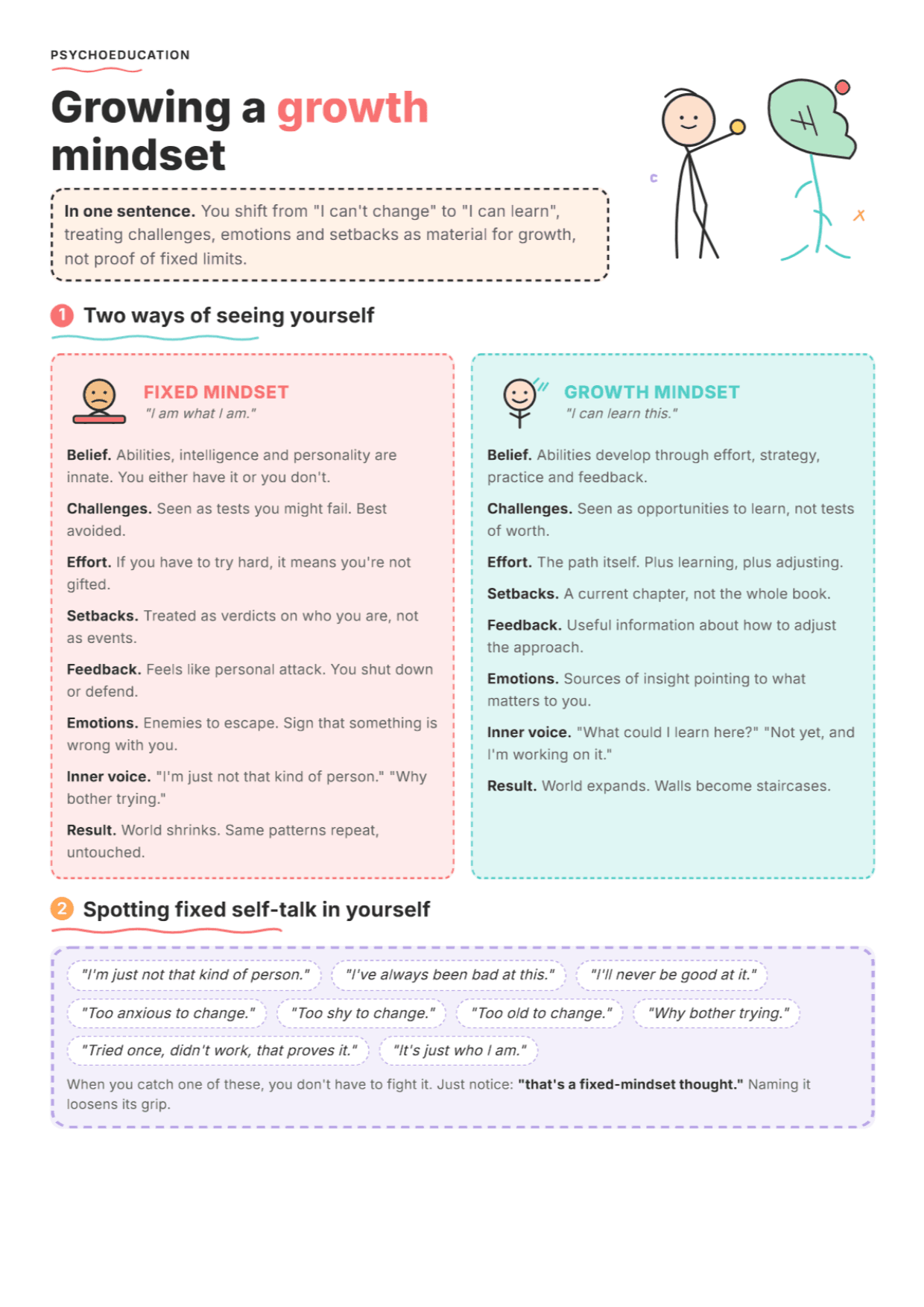
Handout
Developing a Growth Mindset: PDF Worksheet, Tools and Exercises
A visual PDF worksheet, tools and exercises to help clinicians explain the fixed vs. growth mindset distinction clearly in session and leave patients with a concrete reference.
Self & identityMood & depression

Handout
Disqualifying Others: PDF Worksheet, Tools and Exercises for Clinical Practice
A visual PDF worksheet and clinical tools to explain the disqualifying-others filter in session, with concrete exercises for compliment deflection, envy, and low self-esteem work.
Thoughts & cognitionSelf & identity

Handout
Disqualifying the Positive: PDF Worksheet, Tools and Exercises
A printable visual resource with concrete tools and exercises to help clinicians explain and work through the disqualifying-the-positive cognitive distortion in CBT sessions.
Thoughts & cognitionSelf & identity
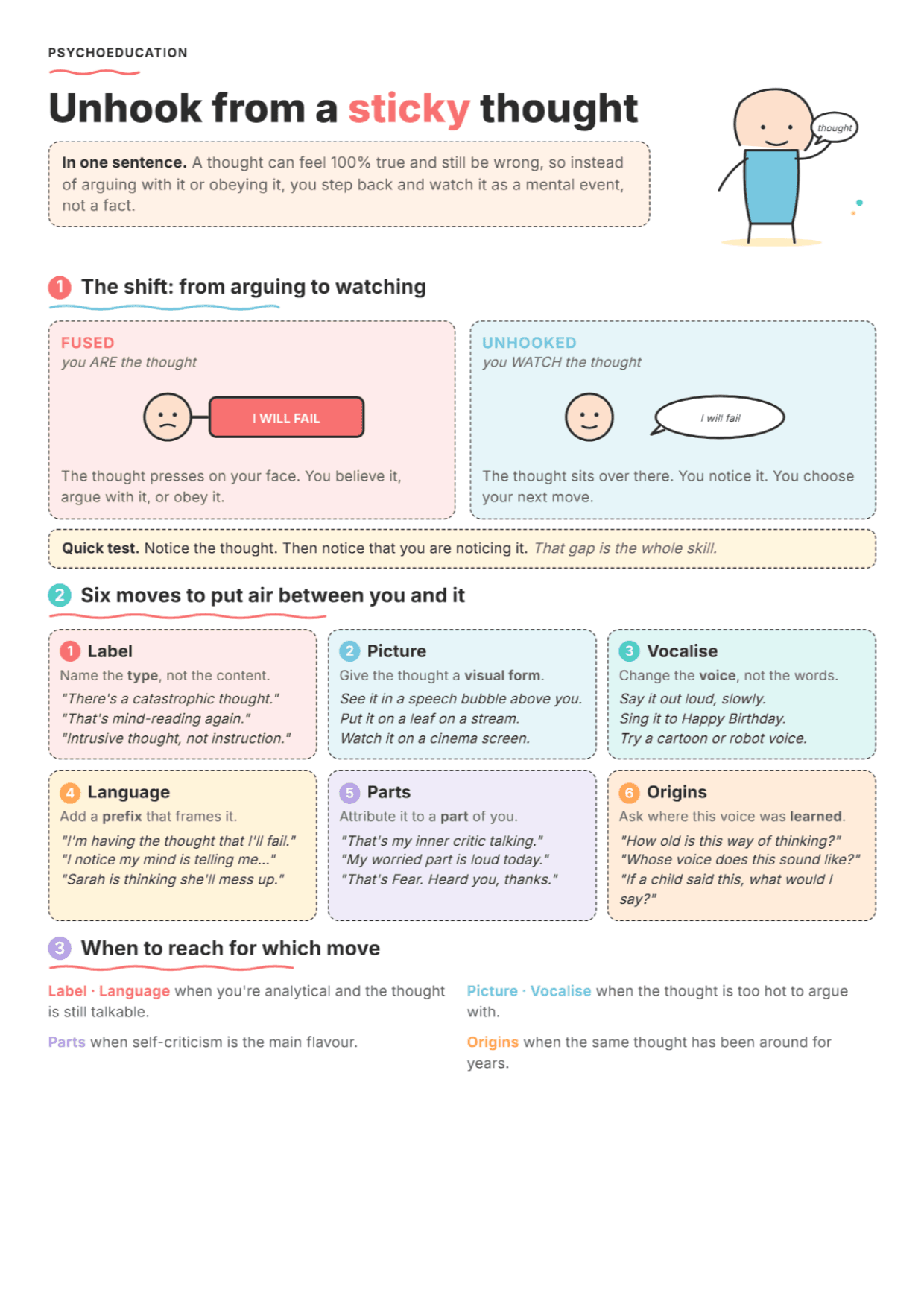
Handout
Distancing and Decentering: PDF Worksheet, Tools and Exercises
A visual PDF worksheet with six concrete defusion moves and exercises to help patients step back from fused thoughts, a practical psychoeducation tool for ACT and CBT clinicians.
AnxietyMood & depression
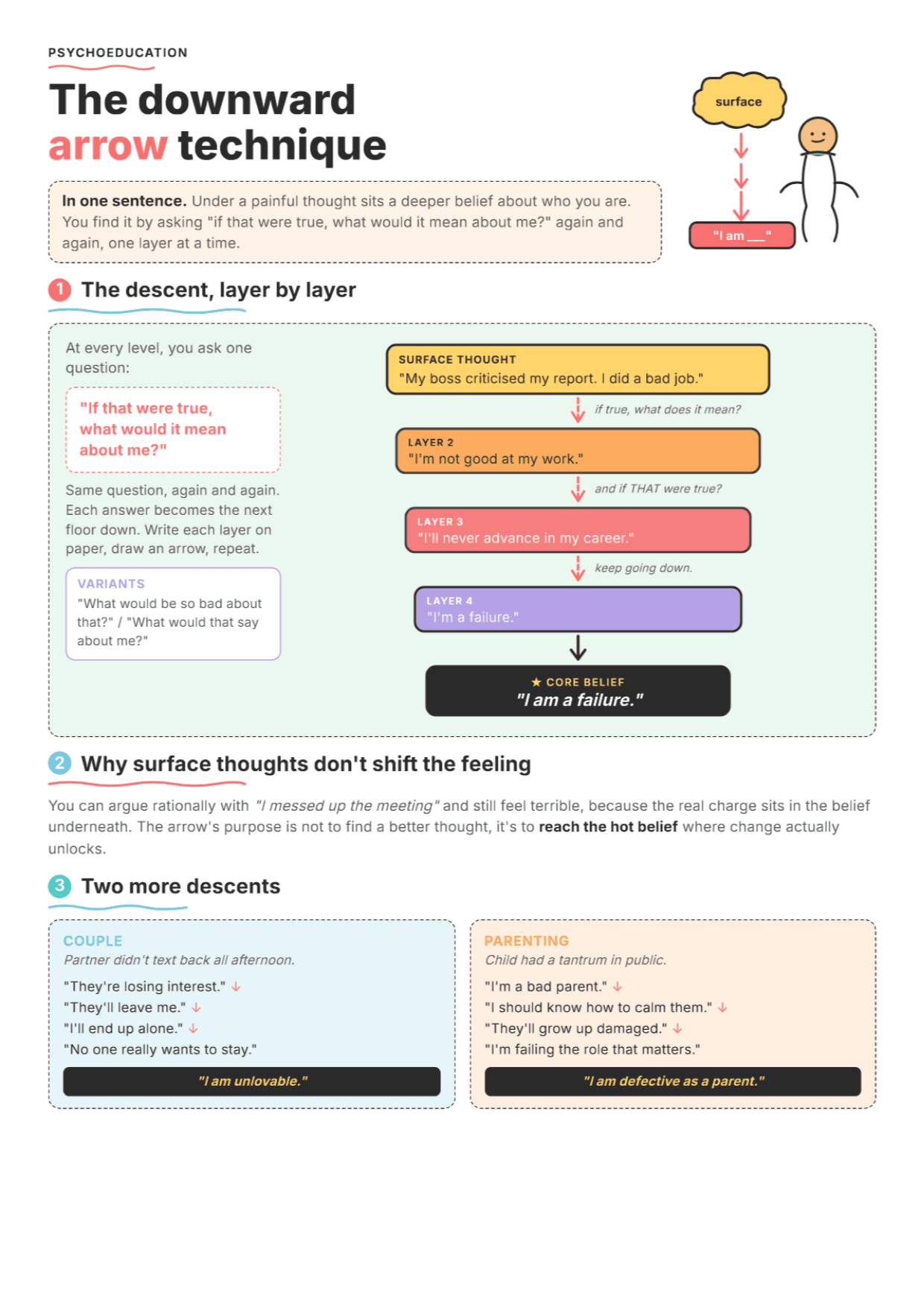
Handout
Downward Arrow Technique: PDF Worksheet, Tools and Exercises
A visual PDF worksheet with tools and exercises to elicit core beliefs in session, layer by layer, turning an oral explanation into a shared clinical map.
Thoughts & cognitionSelf & identity

Handout
Early Maladaptive Schemas: PDF Worksheet, Tools and Exercises
A visual PDF worksheet, clinical tools, and concrete exercises to bring schema therapy concepts to life in session and give patients a lasting psychoeducation anchor.
PersonalityMood & depression
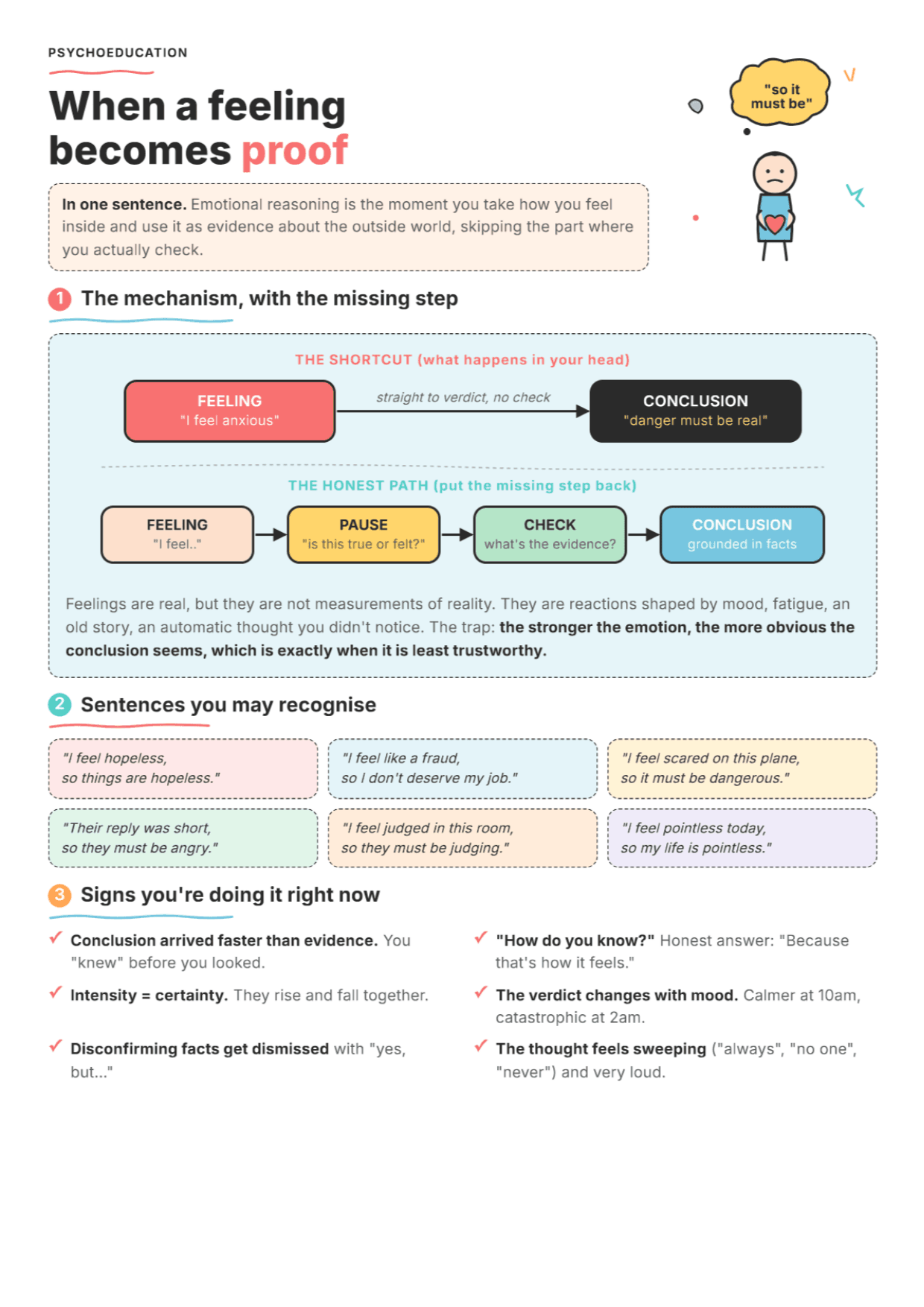
Handout
Emotional Reasoning: PDF Worksheet, Tools and Exercises
A printable PDF worksheet with clinical tools and exercises to make emotional reasoning visible in session and help patients separate feeling from fact.
AnxietyMood & depression
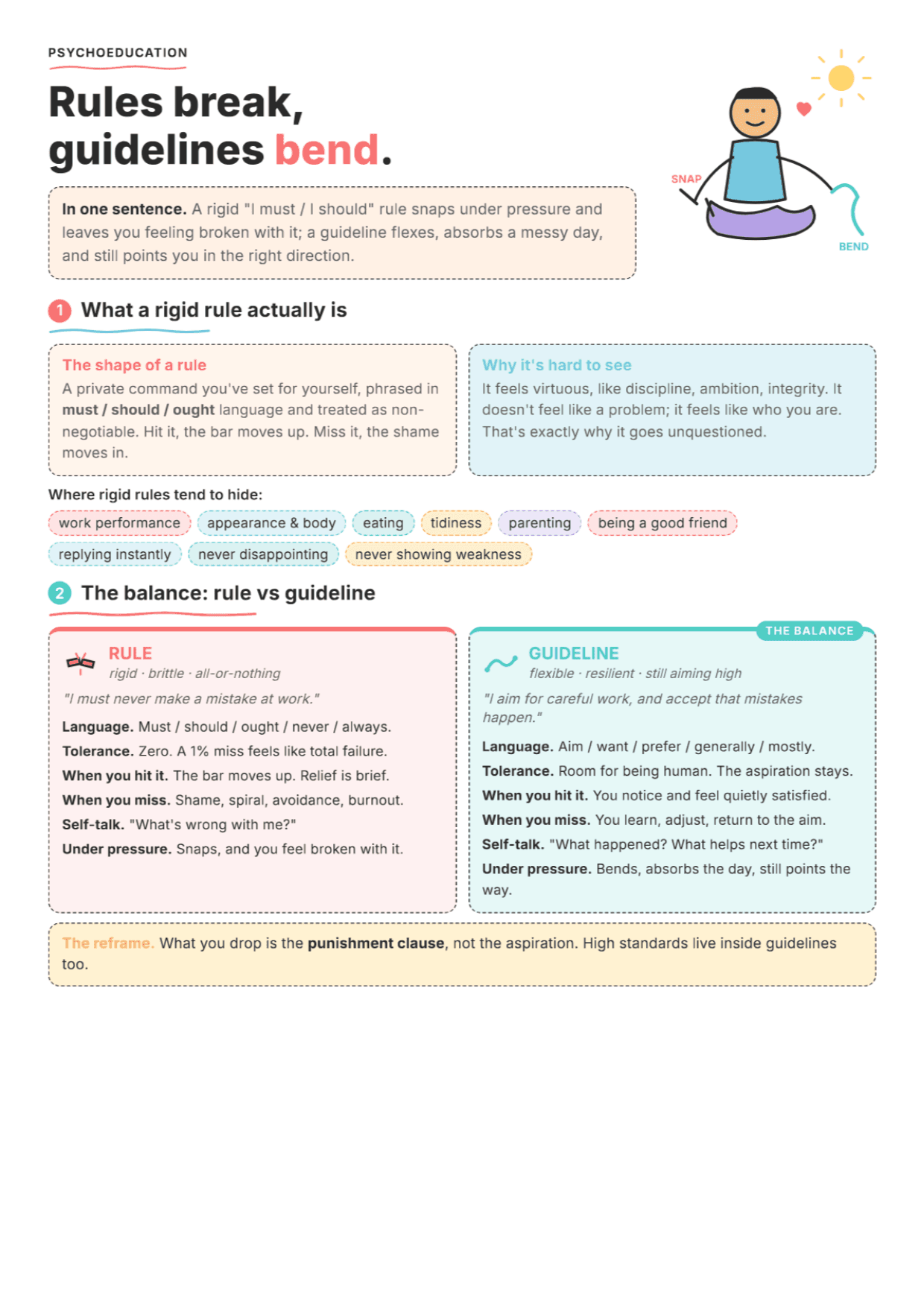
Handout
Evaluating Demanding Standards: PDF Worksheet, Tools and Exercises
A visual PDF worksheet and structured tools to help clinicians explain rigid rules, challenge demanding standards, and guide patients toward flexible guidelines in session.
AnxietyMood & depression

Handout
Examining Negative Thoughts: PDF Worksheet, Tools and Exercises
A structured PDF worksheet with five clinical lenses to help patients slow down, examine harsh thoughts, and write honest, balanced alternatives in session.
AnxietyMood & depression