
Life Transitions: Clinical Tools to Support Psychosocial Adjustment
Life transitions, including major role changes, developmental passages, and unexpected psychosocial ruptures, sit at the intersection of normative psychology and clinical vulnerability, making them a central concern for practitioners across orientations. This page is designed for clinicians who work with adults, adolescents, or families navigating periods of significant change: career shifts, relational endings, bereavement, migration, retirement, parenthood, or any event that disrupts an established sense of self and continuity. The resources grouped here span psychoeducation, structured reflection exercises, and skill-building worksheets that can be integrated across brief and longer-term treatment frames. Together, they address the cognitive, affective, and behavioural dimensions that a well-rounded clinical response to life transitions requires.

What Distinguishes a Transition from Ordinary Stress
Not all stress is transitional stress. A life transition is distinguished by the reorganisation it demands: the individual must revise their self-narrative, renegotiate relational roles, and rebuild a sense of competence in a domain that previously felt stable. This is qualitatively different from acute stressors that resolve without requiring identity-level change. Clinically, the distinction matters because standard stress-management protocols are necessary but insufficient; the work must also address meaning reconstruction and the grieving of a prior self.
William Bridges' classic formulation remains useful at intake: every transition involves an ending, a disorienting neutral zone, and a new beginning. Patients rarely present naming these phases. They present with insomnia, irritability, relational conflict, or a vague sense of purposelessness, and the clinician's task is partly diagnostic: to locate the symptom within a transitional arc rather than immediately pathologising the presentation.
Normative Versus Complicated Adjustment
Adjustment disorder is the most common diagnostic umbrella, but the category obscures important heterogeneity. Normative adjustment involves oscillating distress that reduces as the individual builds competence and meaning in the new configuration. Complicated adjustment is characterised by rumination loops, identity diffusion, or a rigid refusal to relinquish the prior role. The latter warrants closer clinical monitoring and, frequently, a structured intervention targeting cognitive flexibility alongside emotional processing.
Distinguishing the two early prevents under-treatment of complicated presentations and avoids medicalising normative grief. A focused intake conversation about timeline, functional impact, and the patient's own theory of what has changed is often sufficient for this initial triage.
Identifying Transitional Distress in the Consulting Room
Presenting Profiles and Clinical Signatures
Patients in the midst of a major life change rarely self-refer with that framing. They come in with sleep disruption, relational tension, occupational under-performance, or somatic complaints. The clinical signal is a temporal cluster: symptoms emerged around or shortly after a specific change event. Asking directly about recent changes in role, living situation, relationship status, or health status uncovers the transitional substrate in the majority of cases.
Some presentations are less obvious. A patient who appears to be managing a transition well on the surface may be suppressing the emotional processing that healthy adjustment requires. Conversely, patients who present with dramatic distress are not necessarily on a complicated trajectory; the intensity of the initial response is a poor predictor of long-term outcomes.
Common Clinical Forms
Life transitions cluster into several clinical archetypes that practitioners encounter repeatedly:
- Developmental transitions: adolescence to emerging adulthood, entry into parenthood, midlife reconfiguration, retirement
- Relational transitions: separation, divorce, bereavement, new partnership formation, empty nest
- Occupational transitions: job loss, promotion into leadership, career change, burnout-driven exit
- Migratory and cultural transitions: immigration, acculturation stress, displacement
- Health-related transitions: new chronic diagnosis, recovery from acute illness, end-of-life adjustment
Each archetype has its own secondary loss structure, and mapping these losses explicitly with the patient is among the most productive early-session tasks.
Comorbidities and Differential Diagnosis
Distinguishing Transition from Depressive and Anxiety Disorders
The overlap between transitional distress and major depressive disorder or generalised anxiety disorder is clinically significant. Key differentiators include the temporal relationship to the triggering event, the preservation of hedonic capacity in domains unrelated to the transition, and the patient's ability to articulate what specifically feels lost or uncertain. Where these features are unclear, a watchful-waiting approach with structured symptom monitoring over four to six weeks can clarify the picture before committing to a diagnostic formulation.
Post-traumatic presentations also enter the differential when the transition involved an element of threat, helplessness, or horror, as in sudden bereavement, accident-related disability, or forced migration. The presence of intrusion, avoidance, and hyperarousal symptoms shifts both the diagnostic label and the treatment approach substantially.
Personality and Coping Style as Moderators
Attachment style and coping flexibility are among the strongest predictors of transitional adjustment. Anxious-preoccupied patients tend to catastrophise the neutral zone; avoidant patients may deny the significance of the change until decompensation forces the issue. Identifying these patterns early allows the clinician to tailor pacing, degree of emotional exposure, and the type of worksheets most likely to be completed outside the session.
Using Structured Resources During Life Transitions
Cognitive Restructuring and Mindset Work
One of the most consistent barriers to successful transitional adjustment is a fixed mindset about competence: the belief that the skills required in the new life configuration are either innate or permanently absent. Psychoeducation that explicitly frames adaptation as a learnable, incremental process reduces anticipatory avoidance and increases engagement with the practical demands of the new role. The Adopting a Growth Mindset: PDF Worksheet, Tools and Exercises for Clinical Practice operationalises this work through structured reflection prompts and exercises that can be assigned between sessions, helping patients identify and challenge their fixed-ability beliefs in concrete, low-stakes contexts.
This kind of cognitive reframe is not merely motivational; it addresses the attributional distortions that sustain avoidance during the neutral zone. Patients who begin to see transitional difficulty as evidence of learning rather than inherent deficit show measurably better engagement with the practical tasks of adjustment.
Future Self and Motivational Orientation
Anchoring patients to a valued future identity is a well-supported technique in both acceptance and commitment therapy and positive psychology-informed approaches. The neutral zone of a transition is characterised by the absence of the former self without a fully formed replacement; working prospectively with a plausible, valued future self provides motivational scaffolding for the behavioural experiments that consolidate the new role. The Best Possible Self: PDF Worksheet, Tools and Exercises for Clinical Practice guides patients through a structured visualisation and written elaboration exercise that can be revisited across several sessions to track shifts in the patient's sense of possibility and self-efficacy.
This resource is particularly productive with patients who are stuck in the grieving of the prior self. The exercise does not bypass that grief; it introduces a concurrent forward-looking thread that prevents the session from becoming exclusively retrospective.
Communication and Relational Adjustments
Many life transitions fundamentally alter the interpersonal field: new roles require new assertiveness, renegotiated boundaries, and different communicative competencies. A patient moving into a first managerial position, ending a long-term relationship, or entering a caregiving role for an ageing parent may find that their habitual relational style is no longer adaptive. The Assertiveness Ladder: PDF Worksheet, Tools and Exercises for Clinical Practice provides a graduated, skills-based framework for building assertiveness in precisely these high-stakes transitional contexts, moving from lower-intensity situations to more complex ones in a sequenced manner.
Integrating These Resources into the Care Plan
Sequencing Within the Treatment Frame
Structured worksheets are most effective when they are embedded within a coherent treatment logic rather than deployed opportunistically. A suggested sequencing for transitional work is as follows:
- Assessment and externalisation: Map the transition, its secondary losses, and the patient's current coping resources in session, using the intake conversation as a clinical tool.
- Psychoeducation: Normalise the transitional arc, introduce the concept of the neutral zone, and establish realistic expectations about adjustment timelines.
- Cognitive work: Use the Adopting a Growth Mindset: PDF Worksheet, Tools and Exercises for Clinical Practice to address fixed-ability beliefs and increase openness to skill acquisition.
- Prospective anchoring: Introduce the Best Possible Self: PDF Worksheet, Tools and Exercises for Clinical Practice once enough safety has been established; this exercise requires tolerance of positive affect, which can initially feel discordant with grief.
- Interpersonal skill-building: Where the transition involves new relational demands, introduce the Assertiveness Ladder: PDF Worksheet, Tools and Exercises for Clinical Practice as a structured behavioural practice component.
- Consolidation: Review progress, identify remaining avoidance patterns, and plan for anticipated future transitions or relapse triggers.
Adapting Resources to the Patient
Not all worksheets fit all patients. Intellectually avoidant patients may use written exercises as a dissociative strategy; in these cases, completing part of the worksheet collaboratively in session before assigning it independently reduces this risk. Patients with limited literacy or high cognitive load due to acute distress benefit from highly scaffolded, brief tasks rather than open-ended reflection exercises.
> A patient in her mid-forties presented following a voluntary redundancy she had initially framed as a relief. Six sessions in, the clinical picture clarified: she had not grieved the professional identity she had held for eighteen years, and her difficulty imagining a future self was functionally blocking any occupational exploration. The Best Possible Self exercise became the turning point. She returned the following week having written three pages. The shift from avoidance to engagement was the direct subject of that session.
Points of Vigilance and Clinical Limits
When Structured Resources Are Contraindicated
Worksheets and structured exercises presuppose a degree of affect regulation capacity that not all patients in acute transitional distress possess. In the presence of active suicidal ideation, severe dissociation, or acute trauma responses, the priority is stabilisation, not structured reflection. Introducing exercises prematurely in these presentations can be experienced as minimising or coercive.
Similarly, cultural validity of the exercises warrants scrutiny. Concepts such as assertiveness, personal goal-setting, and individual-focused future visualisation carry culturally specific assumptions. With patients from collectivist backgrounds or those navigating migratory transitions, adapt framing accordingly, consulting the patient about how the concepts translate into their relational and cultural context.
The Limits of a Category-Based Approach
Grouping resources under a thematic category like life transitions is clinically useful for navigation, but the category does not constitute a treatment protocol. The resources listed here are adjunct tools: they amplify what happens in the therapeutic relationship, they do not replace the formulation, the alliance, or the clinical judgement that determines which tool is introduced, when, and at what depth. Used with that understanding, they extend the reach of the session into the patient's daily life in ways that accelerate the work considerably.
Tools in this category
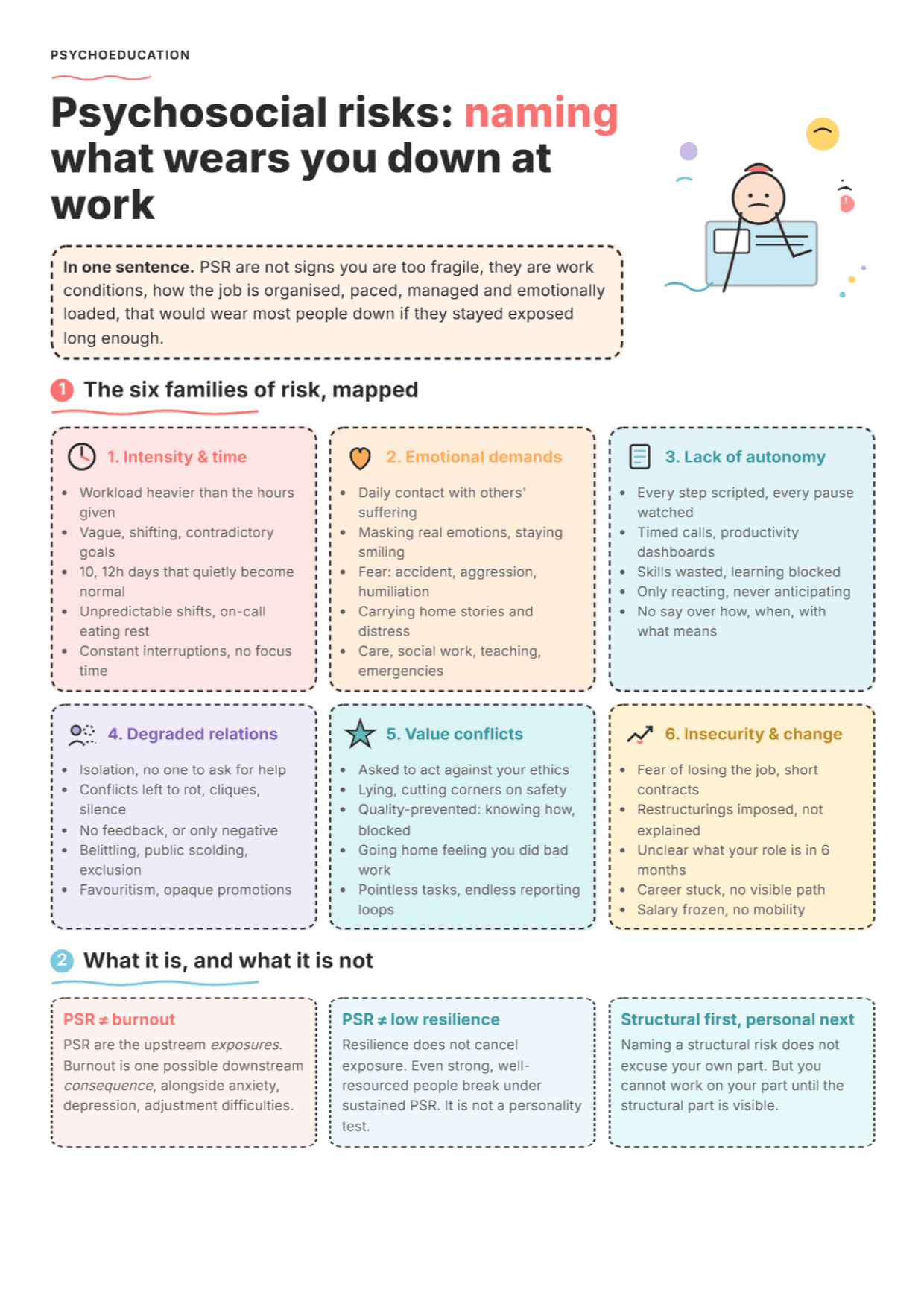
Handout
Psychosocial Risks at Work: PDF Worksheet, Tools and Exercises
A structured visual reference helping clinicians name, map, and work with workplace exposures in session, moving patients from vague exhaustion to concrete clarity.
Life transitionsEmotions & stress
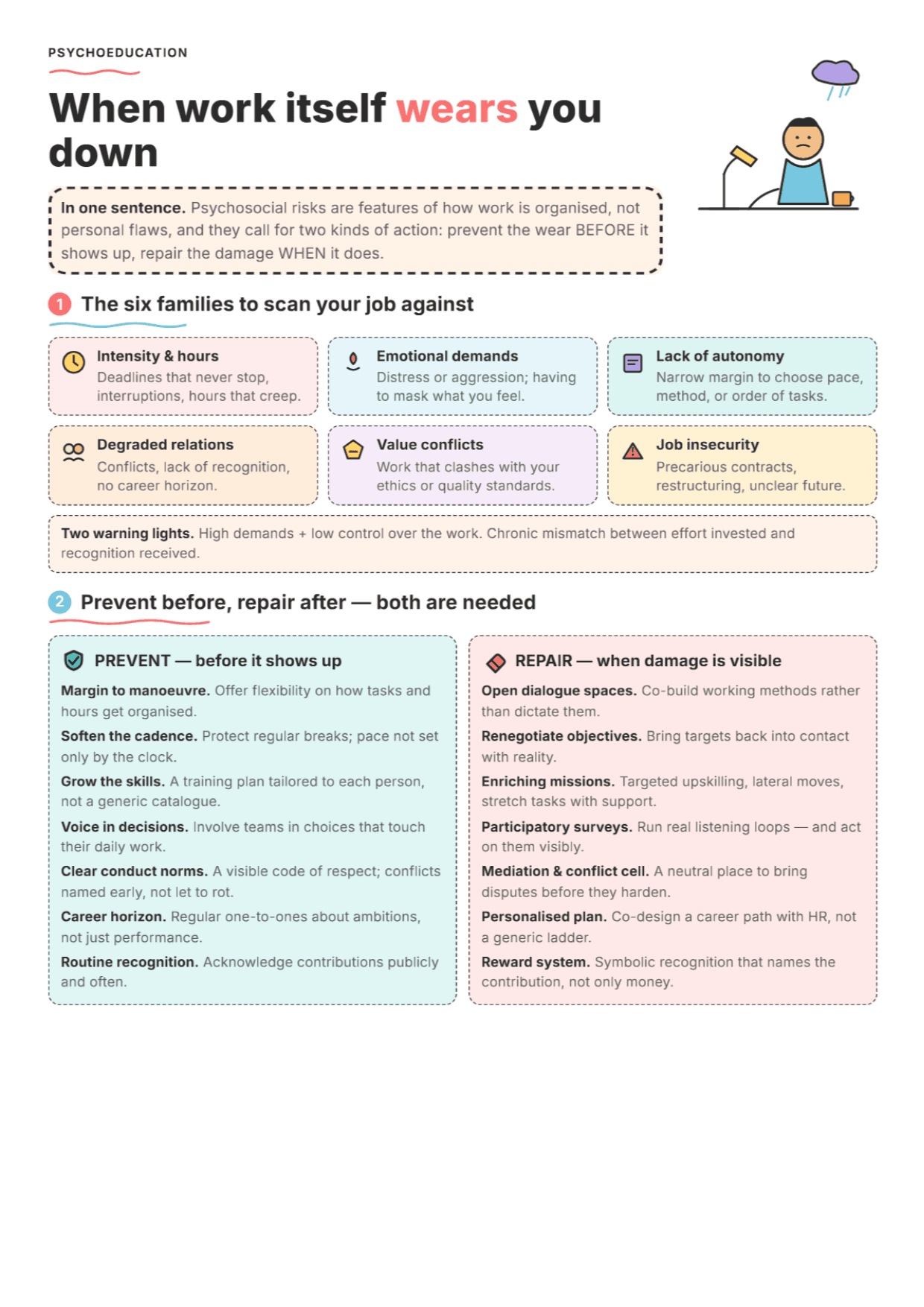
Handout
Psychosocial Risks at Work: PDF Worksheet, Tools and Exercises
A structured PDF worksheet with tools and exercises to explain psychosocial risks at work in session, help patients stop self-blaming, and map concrete prevention and repair levers.
Life transitionsEmotions & stress
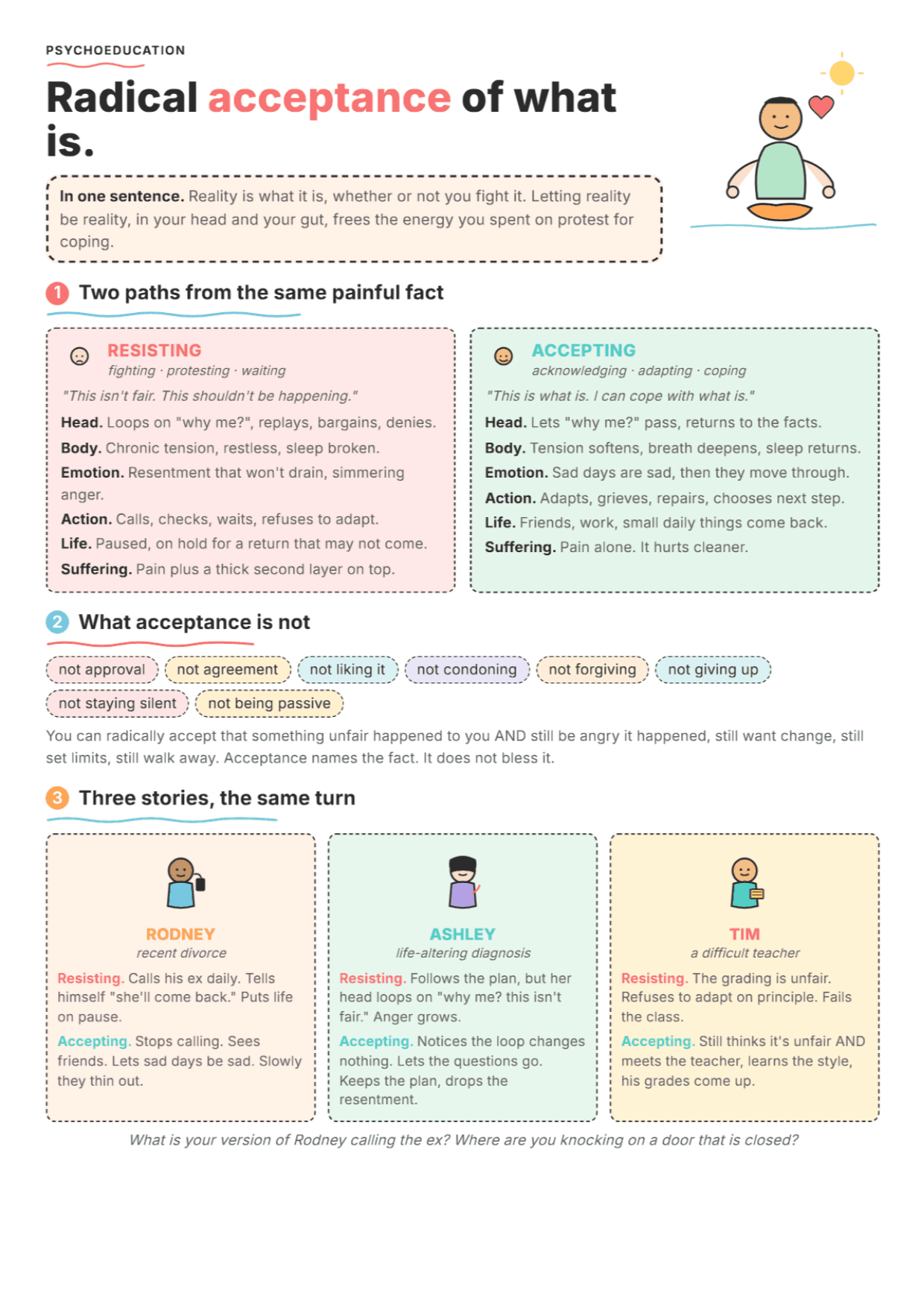
Handout
Radical Acceptance: PDF Worksheet, Tools and Exercises for DBT Practice
A printable DBT fiche PDF covering the resisting/accepting split, the 'turning the mind' practice, and clinical examples, for use as a visual psychoeducation support in session.
Emotions & stressMood & depression

Handout
Self-Care Tips: PDF Worksheet, Tools and Exercises for Clinical Practice
A printable PDF worksheet, practical tools, and concrete exercises to make self-care psychoeducation stick in session and give patients a lasting visual reference.
Emotions & stressLife transitions
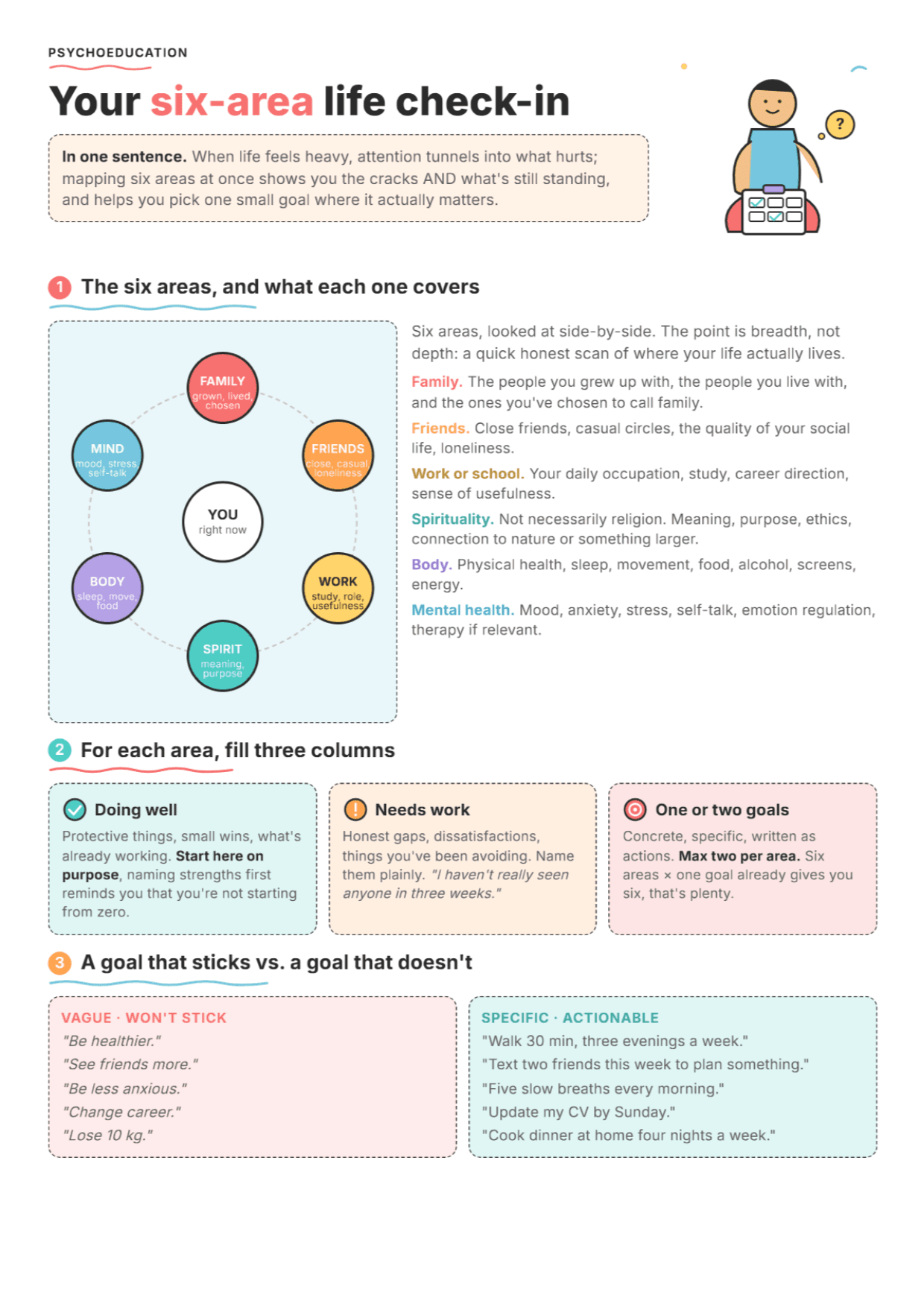
Handout
Setting Life Goals: PDF Worksheet, Tools and Exercises for Clinicians
A structured six-area visual check-in helping patients break attentional tunnel vision, name strengths alongside gaps, and commit to specific, actionable goals in session.
Life transitionsSelf & identity
Handout
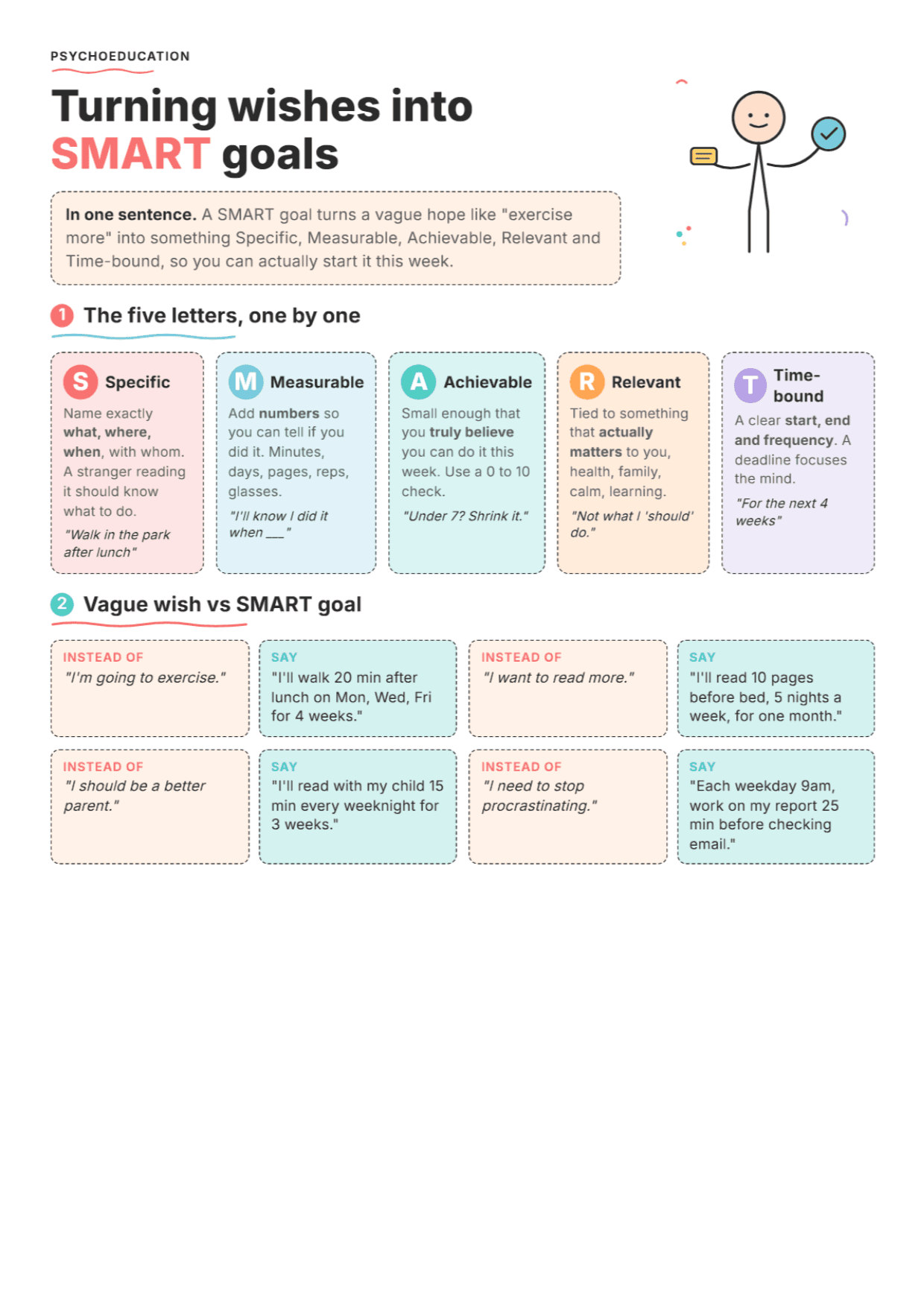
SMART Goals: PDF Worksheet, Tools and Exercises for Clinical Practice
A printable PDF worksheet, clinical tools, and concrete exercises to help patients turn vague intentions into structured, achievable SMART goals in therapy.
Life transitionsMood & depression

Handout
Social Support: PDF Worksheet, Tools and Exercises for Clinical Practice
A structured visual PDF worksheet to help clinicians explain the four types of social support, dismantle help-seeking barriers, and build a workable network with patients in session.
RelationshipsEmotions & stress

Handout
Solution-Focused Brief Therapy: PDF Worksheet, Tools and Exercises
A printable psychoeducation fiche to explain SFBT's core logic visually in session, establish a shared vocabulary, and orient patients toward exceptions and forward-looking goals.
Life transitions

Handout
Sources of Workplace Stress: PDF Worksheet, Tools and Exercises
A visual PDF worksheet and practical tools to help clinicians name the five sources of occupational stress in session, shift self-blame, and map concrete actions with patients.
Emotions & stressLife transitions