
MBSR and MBCT: Mindfulness-Based Protocols for Clinical Practice
MBSR (Mindfulness-Based Stress Reduction) and MBCT (Mindfulness-Based Cognitive Therapy), two of the most empirically supported mindfulness-based interventions in mental health, share a common theoretical architecture centred on present-moment awareness, decentring, and the deliberate cultivation of a non-reactive observational stance. This page is designed for clinicians who integrate mindfulness-based approaches into individual or group care, whether they are certified MBSR or MBCT instructors or practitioners who selectively borrow formal and informal mindfulness practices. Here you will find a curated set of ready-to-use clinical resources, including guided audio meditations, somatic exercises, and structured psychoeducation programmes, each mapped to the core mechanisms these protocols activate.

The Mindfulness Mechanism in Therapeutic Change
Mindfulness-based interventions operate through several partially overlapping mechanisms that current research continues to refine. At the core sits metacognitive awareness: the capacity to observe one's own thoughts and feelings as transient mental events rather than accurate representations of reality. Both MBSR and MBCT train this capacity explicitly, MBSR through a universal stress-reduction lens and MBCT through a relapse-prevention lens targeting depressive rumination and cognitive reactivity.
A second mechanism is attentional regulation. Sustained and flexible deployment of attention, practised repeatedly through formal meditation, generalises over time to everyday cognitive functioning. A third mechanism, increasingly prominent in third-wave literature, is self-compassion: the willingness to meet one's own distress with warmth rather than self-criticism or avoidance.
Understanding these mechanisms matters clinically because it determines which resources you reach for at which phase of treatment. Attentional training tools, somatic anchoring exercises, and compassion-based audio each target a different node in this mechanism map.
MBSR vs. MBCT: Distinguishing the Two Protocols
MBSR, developed by Jon Kabat-Zinn at the University of Massachusetts, is an eight-week group programme originally designed for patients with chronic pain and stress-related conditions. Its scope has since broadened considerably. The programme is transdiagnostic by design and does not presuppose a specific psychiatric diagnosis.
MBCT was developed by Segal, Williams, and Teasdale specifically to reduce recurrence in patients with three or more episodes of major depression. It grafts core elements of cognitive therapy, particularly the identification of negative automatic thoughts and their relationship to mood, onto an MBSR skeleton. The result is a protocol that explicitly targets cognitive reactivity and the ruminative processing style that precedes depressive relapse.
In clinical practice, the boundary between the two is often more permeable than textbook descriptions suggest. Many practitioners apply MBCT skills to anxiety, eating disorders, and chronic pain, and MBSR-derived meditations regularly appear in MBCT programmes.
Clinical Indications and Patient Profiles
Primary Indications for Mindfulness-Based Approaches
The strongest evidence base supports MBSR and MBCT for the following presentations:
- Recurrent unipolar depression (MBCT is a first-line adjunct for three or more episodes)
- Generalised anxiety disorder and health anxiety
- Chronic pain syndromes (fibromyalgia, low back pain, headache disorders)
- Cancer-related distress, fatigue, and sleep disruption
- Burnout and occupational stress
- Eating disorders, particularly as an adjunct to CBT
- Substance use disorders (Mindfulness-Based Relapse Prevention is a direct derivative)
Patients who are excessively fused with their thoughts, who catastrophise, or who display a strong experiential avoidance profile tend to be particularly good candidates. The mindfulness stance offers a direct counter-move to avoidance without requiring the patient to confront feared stimuli head-on, which makes it especially tractable in presentations where exposure is poorly tolerated at intake.
Comorbidities and Differential Considerations
Comorbid anxiety and depression is the most common clinical picture you will encounter. MBCT is well-suited here, as both the ruminative and the anxious worry components respond to decentring. When somatic symptom disorder or medically unexplained symptoms are present alongside mood difficulties, the body-focused components of MBSR (in particular the body scan and mindful movement) can access experiential material that purely verbal interventions miss.
Differential considerations are important. Bipolar disorder warrants caution, particularly during or near hypomanic phases, where the introspective load of extended meditation can amplify rather than dampen activation. Dissociative disorders require modification of standard body-awareness practices. And in patients with a trauma history, standard mindfulness instructions focused on sustained internal attention can paradoxically increase distress before adaptive processing occurs.
Assessment and Case Formulation in Mindfulness-Based Work
Identifying Good Candidates During Assessment
The clinical interview should explore a patient's pre-existing relationship with attention and the body. Patients with marked interoceptive avoidance, those who describe themselves as perpetually "in their head," and those who chronically suppress emotional experience are prime candidates for gradual mindfulness introduction. When a patient describes difficulty staying present, disconnection from bodily signals, or automatic pilot functioning in daily life, these are direct clinical entry points.
It is worth assessing motivation for self-practice explicitly. The home practice component is the mechanism through which in-session work generalises. A patient who cannot or will not practise between sessions will derive limited benefit from the formal protocol, though they may still benefit from in-session mindfulness-informed interventions.
Contraindications and Clinical Vigilance
Points of vigilance include:
- Acute psychotic episodes or recent psychotic decompensation: structured group settings and internal-focus instructions carry significant risk.
- Active suicidal ideation with limited therapeutic alliance: extended body-scan or visualisation work should be deferred.
- Severe depersonalisation or derealisation: prolonged closed-eye practices may exacerbate symptoms rather than ground the patient.
- Untreated or poorly stabilised PTSD: trauma-sensitive adaptations (eyes open, shorter durations, emphasis on external anchors) are mandatory before introducing any sustained interoceptive practice.
- Patients who intellectualise mindfulness as a performance task: early psychoeducation on the non-striving attitude is essential.
For patients who struggle to stay present and somatically anchored, the Grounding Exercise: When Patients Are Stuck in Their Head offers a brief, structured entry point that can be introduced before any formal mindfulness protocol begins.
Using Guided Audio and Formal Practice Resources in Session
Body Scan and Somatic Awareness Practices
The body scan is typically the first formal practice introduced in both MBSR and MBCT. Its function is to restore contact with somatic experience in a non-evaluative way, counteracting the intellectual overmodulation that characterises many patients presenting with anxiety or depression. In-session use allows the clinician to observe the patient's response in real time and debrief it clinically.
For full body scan delivery, the Long Body Scan Audio: Full Somatic Awareness in Session provides a complete guided track suited to a full session. When time is limited or when you are introducing the practice to a new patient, the Short Body Scan Audio: Guided Relaxation for Clinicians offers a condensed alternative without compromising the instructional quality.
Somatic regulation is also central to anger and high-arousal presentations. The Anti-Anger Guided Audio: Somatic Regulation in Session applies body-based mindfulness to affect regulation in a format directly usable mid-session.
Present-Moment Anchoring and Attention Training
Present-moment anchoring exercises operationalise the attentional regulation mechanism described above. They can be used both as formal session-opening rituals and as targeted interventions when a patient is flooded or dissociated. The Present-Moment Anchoring: Long Guided Audio for Clinicians is appropriate for mid-session use or as a home practice assignment, while the Short Guided Audio for Present-Moment Grounding in Therapy fits naturally into brief-contact formats or the closing minutes of a session.
Nature-based visualisation audios extend the repertoire of anchoring tools. The Wave Sounds Guided Visualization Audio for Clinicians, the Birdsong Guided Visualization Audio for Clinical Practice, the River Walk Guided Visualization Audio for Clinicians, and the Gentle Rain Guided Visualization Audio for Clinicians all engage sensory-rich present-moment awareness through a natural environment frame, which many patients find more accessible than abstract attention instructions.
Targeting Rumination, Negative Thoughts, and Emotional Pressure
Mindfulness-Based Approaches to Rumination
Ruminative processing is the primary target of MBCT and a secondary target of MBSR. Clinically, rumination is best understood not as thinking too much but as repetitive, self-referential, and past- or future-oriented thinking that is inflexible and decoupled from effective problem-solving. The mindfulness antidote is not thought-stopping but a shift in relationship to thought: observing without engaging, noticing without following.
The The Rumination Eraser: Guided Meditation Audio for Clinicians targets this directly, using guided instruction to help patients externalise and disengage from ruminative loops. It pairs well with the Anti-Negative Thoughts Bubble: Guided Audio for Clinicians, which employs a visualisation metaphor to cultivate the decentred observer stance.
Emotion Regulation and the Compassion Components
Affect tolerance is a prerequisite for effective mindfulness practice. Patients who are overwhelmed by their emotions cannot observe them; they can only react. The The Emotional Pressure Valve: Guided Meditation Audio offers a structured approach to reducing affective charge before or during deeper mindfulness work, functioning as a regulation primer.
Self-compassion work, central to both MBCT and its derivatives, is addressed directly through the The Self-Compassion Bandage: Guided Audio for Clinicians and the Guided Audio Meditation: Compassion for Emotions in Session. These resources are particularly useful for patients with high self-criticism or shame, populations in whom mindfulness without explicit compassion cultivation can paradoxically increase self-monitoring and distress.
For the less-discussed clinical challenge of boredom tolerance (a significant predictor of dropout from mindfulness programmes), the Boredom Guided Audio: A Clinical Meditation for In-Session Use provides a specific, in-session tool.
Psychoeducation and Structured Programme Resources
Introducing the Mindfulness Framework to Patients
> "A patient referred for recurrent depression asks, 'So I just have to watch my thoughts? That sounds too simple.' I use the first session to co-construct what 'watching' actually means physiologically and cognitively. The psychoeducation module on mental health foundations changes the quality of that conversation entirely."
Before introducing formal mindfulness practices, most patients benefit from a psychoeducational frame that situates stress reactivity, attention, and emotion regulation within an accessible model. The Mental Health Foundations: A 4-Session Psychoeducation Program provides exactly this scaffolding, covering the cognitive-emotional mechanisms that MBSR and MBCT subsequently train.
Working with Judgment as a Therapeutic Target
Self-judgment and the evaluative mind are explicitly addressed in MBCT through the non-judging attitudinal foundation of mindfulness. This is not merely philosophical: habitual self-evaluative cognition is a driver of both depressive relapse and anxiety maintenance. The Working with Judgment in Therapy: A 3-Session Program offers a structured programme for addressing this dimension directly, bridging psychoeducation and experiential mindfulness work across multiple sessions.
Limits and Integration into the Broader Care Plan
When Mindfulness-Based Approaches Are Not Sufficient
MBSR and MBCT are adjuncts, not replacements. Severe, acute, or complex presentations require a broader care plan: pharmacotherapy for moderate-to-severe depression, trauma-focused protocols (EMDR, PE, CPP) when PTSD is the primary diagnosis, and DBT skills training when emotion dysregulation is pervasive. Mindfulness-based resources play a support role in these contexts, facilitating affect tolerance and attentional flexibility without carrying the primary therapeutic load.
It is also worth noting that group-format MBSR and MBCT produce outcomes that individual mindfulness-informed therapy may not replicate. The social learning, normalisation, and group containment are therapeutic factors in their own right. When patients cannot access group programmes, the resources gathered here offer a reasonable approximation of the core experiential components, with the clinician holding the relational and debrief functions that the group normally provides.
Trauma-Sensitive Adaptations and Special Populations
Adapting standard MBSR and MBCT practices for trauma survivors involves several consistent modifications: shorter practice durations, eyes open or softly downcast rather than closed, emphasis on external and distal sensory anchors before internal body focus, and explicit permission to modify or stop at any point. The grounding and nature-based visualisation audios in this collection are particularly well-suited to this population, as their external environmental focus reduces interoceptive demand while still building present-moment awareness.
For adolescent populations and older adults, pacing and metaphor require adaptation, but the core mechanisms remain valid. The clinician's role is to calibrate instruction complexity and practice length to the patient's developmental stage, cognitive profile, and current functional capacity.
Tools in this category

Handout
Nervous System Regulation: PDF Worksheet, Tools and Exercises
A visual PDF fiche, practical tools, and concrete exercises to explain nervous system regulation clearly in session and give patients a lasting somatic reference.
Emotions & stressBody & health
Handout
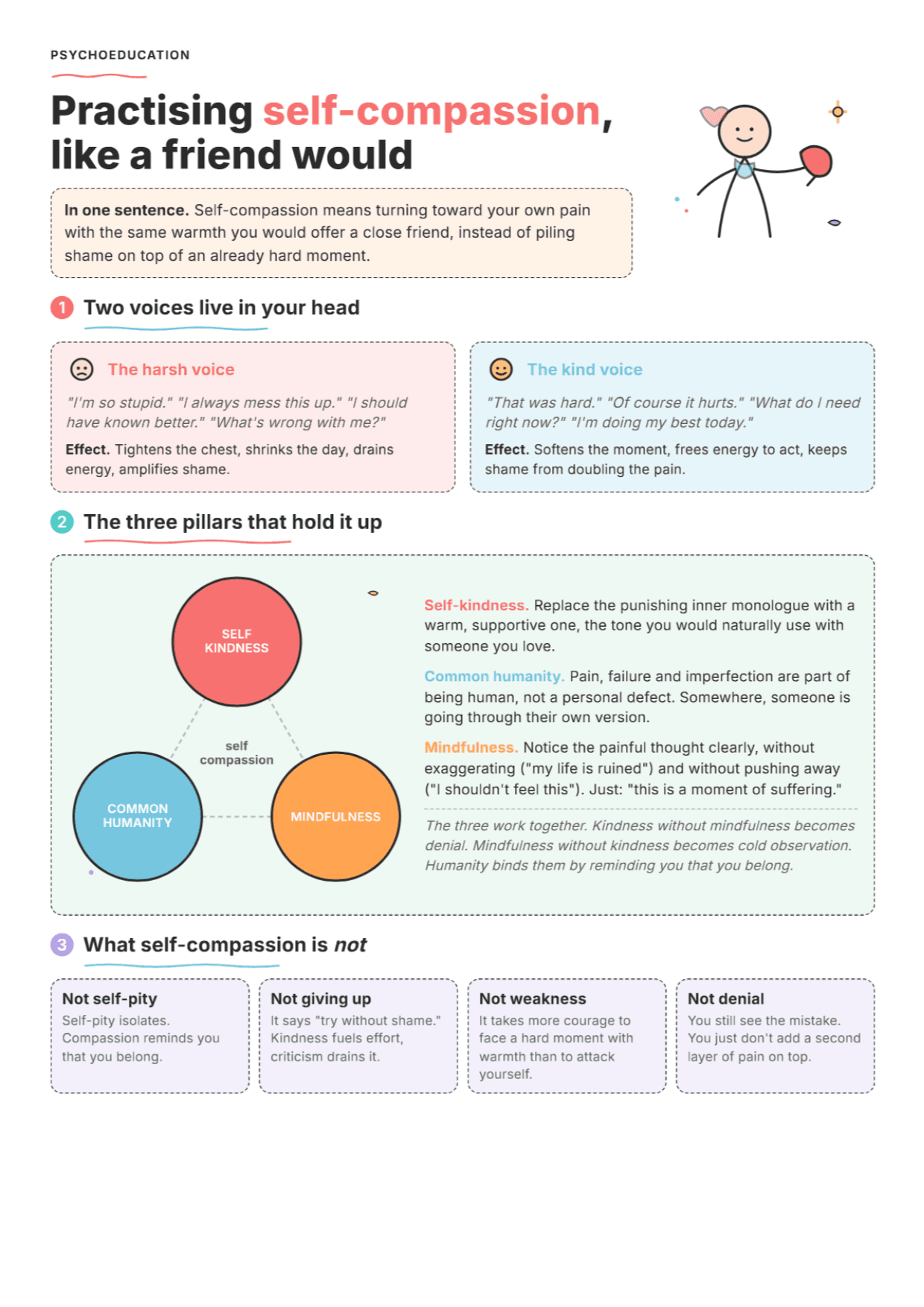
Practicing Self-Compassion: PDF Worksheet, Tools and Exercises
A printable PDF fiche and concrete exercises to help clinicians explain self-compassion clearly in session and give patients a lasting visual reference.
Self & identityMood & depression

Handout
RAIN Mindfulness Technique: PDF Worksheet, Tools and Exercises
A printable PDF worksheet, clinical tools, and exercises to explain the RAIN mindfulness technique in session and give patients a durable self-compassion map.
AnxietyMood & depression

Handout
Somatic Exercises: PDF Worksheet, Tools and Exercises for Clinical Practice
A visual psychoeducation tool to introduce body-based regulation techniques in session, with six grounded exercises patients can use independently.
Trauma & PTSDMood & depression
Handout
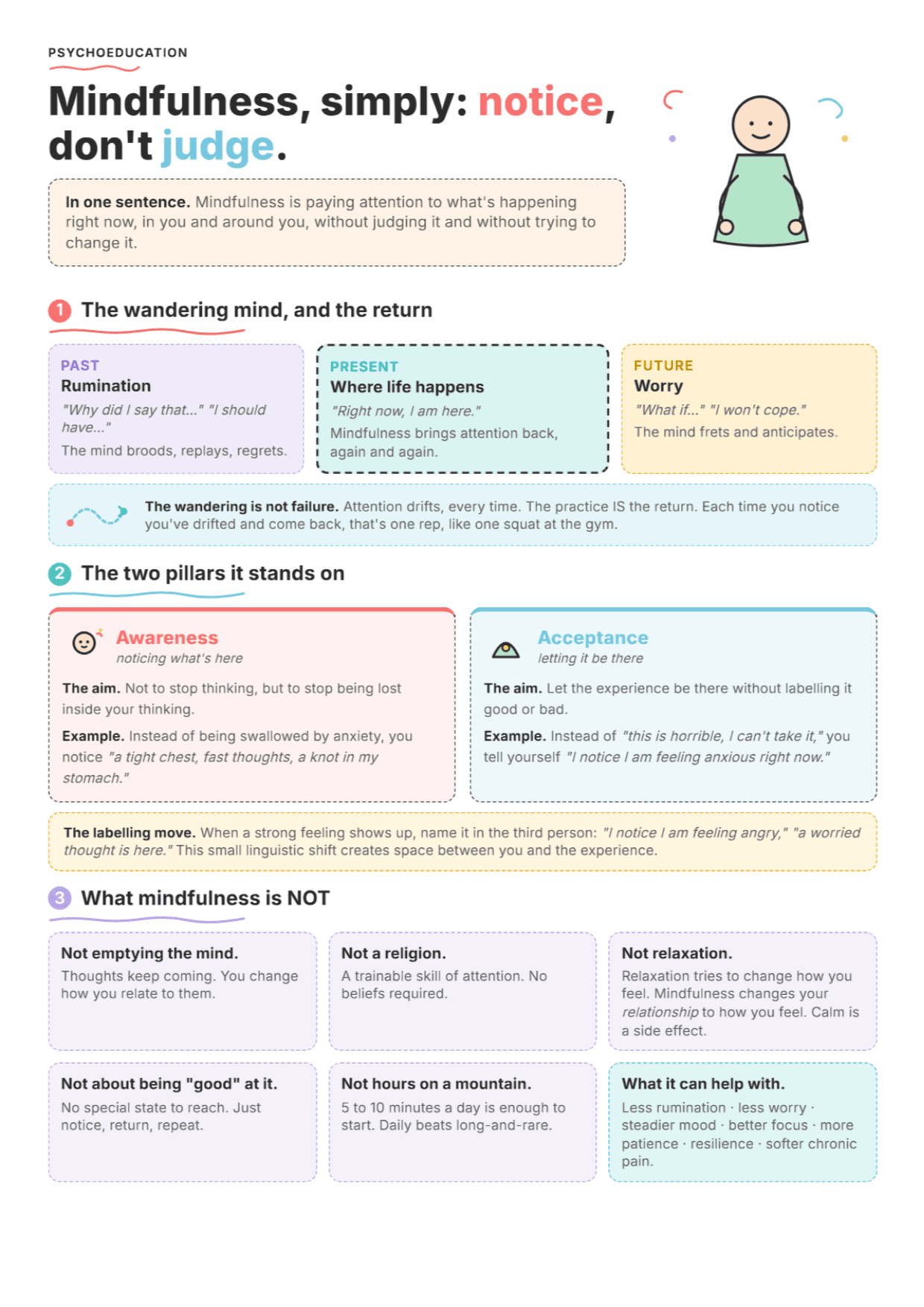
What Is Mindfulness? PDF Worksheet, Tools and Exercises for Clinical Practice
A visual PDF worksheet, exercises, and tools to explain mindfulness clearly in session and give patients a concrete reference they can keep.
AnxietyMood & depression

Handout
Worry Coping Cards: PDF Worksheet, Tools and Exercises for Children
A printable PDF fiche with 11 visual coping strategies organized into three functional families, designed to help clinicians explain and hand off worry management tools to children in session.
AnxietyThoughts & cognition
Handout
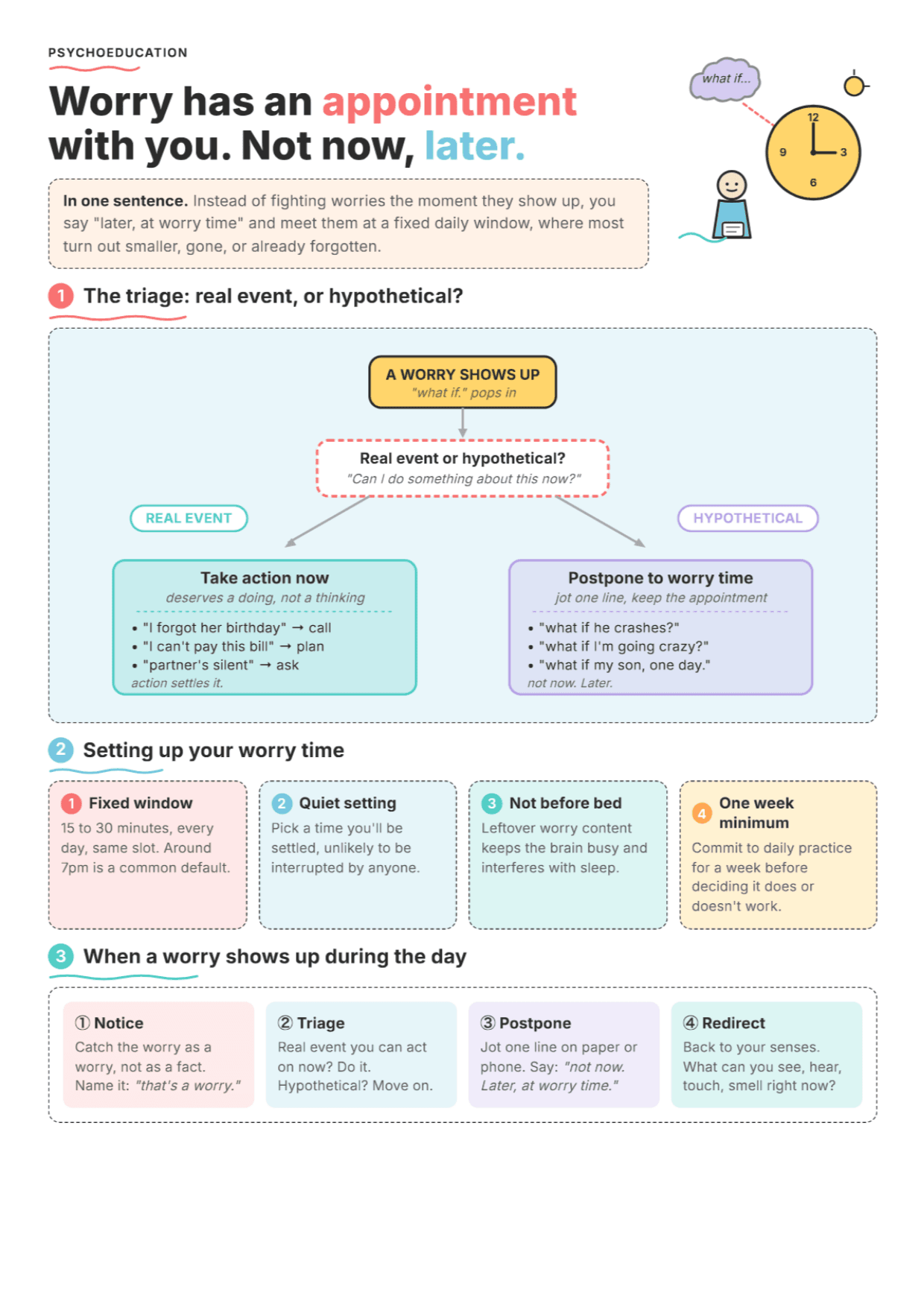
Worry Postponement: PDF Worksheet, Tools and Exercises
A visual PDF worksheet to explain and introduce the worry postponement technique in session, with a triage protocol, worry time setup, and pitfall guidance.
AnxietyEmotions & stress