
Motivational Interviewing: Clinical Tools for Behaviour Change
Motivational Interviewing (MI), also known as motivational enhancement therapy in certain protocol-driven contexts, is a collaborative, goal-oriented communication style designed to elicit and consolidate a patient's own motivation for change. This page is addressed to clinicians, whether psychologists, therapists, psychiatrists, or allied health professionals, who integrate MI principles into individual or group care. The resources gathered here, spanning structured exercises, psychoeducation programs, and printable worksheets, translate core MI techniques into session-ready clinical tools. Each has been selected to support the full arc of motivational work: from ambivalence exploration to commitment and follow-through.

The Spirit of MI and Its Core Processes
Motivational Interviewing rests on four guiding principles, frequently abbreviated as PACE: partnership, acceptance, compassion, and evocation. Unlike directive models, MI positions the clinician as a guide who draws out the patient's own arguments for change rather than supplying them. This distinction is not stylistic. It reflects a specific theoretical model of change: that ambivalence is a normal feature of the pre-contemplation and contemplation stages, and that confrontation tends to entrench resistance rather than dissolve it.
The four core MI processes (engaging, focusing, evoking, planning) form a sequence that is iterative rather than strictly linear. A patient may cycle back from planning to evoking when a new obstacle surfaces, or may remain in the focusing phase for several sessions before the therapeutic alliance is strong enough to carry genuine evocational work. Clinicians should resist the urge to rush toward action planning before the motivational groundwork is laid.
MI draws heavily from Carl Rogers' person-centred tradition but adds directionality: the clinician has a deliberate therapeutic aim (movement toward change) while maintaining unconditional positive regard. This tension, between warmth and purposefulness, is one of the more demanding competencies to develop in supervised practice.
Change Talk, Sustain Talk, and the Righting Reflex
Change talk (statements reflecting desire, ability, reasons, need, or commitment to change) is the primary linguistic target of MI. Clinicians trained in MI learn to differentially reinforce change talk through reflections, affirmations, and open questions, while softening sustain talk without dismissing it. The righting reflex, the clinician's instinct to argue for change when the patient seems reluctant, is one of the principal obstacles to effective MI. Recognising and suppressing it is a foundational skill.
Discord in the therapeutic relationship, formerly conceptualised as "resistance," is reframed in MI as interpersonal rather than intrapsychic: it signals a misalignment between where the clinician is pushing and where the patient currently stands. Rolling with discord, rather than countering it, is both a relational and a technical intervention.
Identifying Ambivalence in the Clinical Encounter
Presentations That Signal a Motivational Focus
Patients rarely arrive describing themselves as ambivalent. More commonly, clinicians observe repeated cycles of partial engagement followed by disengagement, goal abandonment after initial enthusiasm, or a striking discrepancy between the patient's stated values and their behaviour. These presentations call for a motivational lens before any cognitive-restructuring or skill-building work begins.
In chronic illness contexts, patients presenting with poor treatment adherence often have a motivational profile rather than a knowledge deficit. Similarly, patients presenting with problematic digital habits may articulate the problem clearly but struggle to act. A Problematic Phone Use: A Structured Clinical Exercise can help the clinician and patient map the specific patterns maintaining the behaviour, surfacing the ambivalence that standard psychoeducation tends to miss.
Screening for Motivational Stage
A brief stage-of-change assessment at intake allows the clinician to calibrate the level of directive input. Patients in pre-contemplation require a very different conversational posture than those in preparation or action. Using the Readiness Ruler (a quick 0-10 scaling technique) is one low-burden method; asking two open questions, one about importance and one about confidence, generates a rapid two-axis picture of motivational readiness.
Where ambivalence is pervasive and tied to a specific behavioural decision, structured tools add clinical precision. The Decisional Paralysis: A Structured Risk-Appraisal Exercise operationalises the decisional balance technique, guiding patients through a systematic appraisal of short- and long-term gains and costs for both change and status quo.
Core MI Techniques: Clinical Application in Session
OARS in Practice
The mnemonic OARS (Open questions, Affirmations, Reflective listening, Summaries) describes the essential microskills of MI. Of these, reflective listening is both the most technically demanding and the most therapeutically potent. A simple reflection mirrors content; a complex reflection infers meaning, emotion, or implication. Clinicians who default to questioning often find that replacing every third question with a reflection shifts the session dynamic substantially.
To support this skill transfer, the Reflections: A Communication Skill, PDF Worksheet, Tools and Exercises provides a structured reference for clinicians to use in supervision or to share with trainees, covering the taxonomy of reflection types with clinical examples.
Evoking and Strengthening Commitment
Once change talk begins to emerge with greater frequency and depth, the clinician's task shifts to consolidating commitment language (statements of intention, activation, or taking steps). A key technique here is the transition from exploring motivation to collaborative goal-setting, which must be specific, time-bound, and intrinsically generated to hold.
The Structured Goal-Setting Exercise to Help Patients Commit to Change translates this transition into a printable tool the patient completes partly in session and partly between appointments. Its structure scaffolds the move from vague aspiration to concrete, patient-owned action. When paired with a follow-up conversation focused on anticipating obstacles, it significantly reduces the probability of early disengagement.
Working with Motivational Dips Post-Commitment
An often underappreciated phase in motivational work is the post-commitment dip: the loss of momentum that predictably follows initial action. Patients may interpret this dip as evidence of fundamental inability to change, which risks rapid return to pre-contemplation. Normalising motivational fluctuation is a preventive intervention in its own right.
The Motivational Dips in Practice: A Guided Clinical Exercise addresses this phase directly, helping patients and clinicians identify the specific triggers and cognitive patterns associated with motivational loss, and co-construct personalised re-engagement strategies. It functions well as a between-session resource assigned when early signs of disengagement appear.
Comorbidities, Differential Diagnosis, and Motivational Complexity
When Low Motivation Is Not Ambivalence
Not all motivational difficulty reflects MI-targetable ambivalence. Anhedonia and avolition in the context of major depression or psychotic spectrum disorders require pharmacological and structured behavioural intervention before MI techniques become fully operative. Attempting evocational work with a severely depressed patient may produce self-critical change talk rather than genuine mobilisation.
Alexithymia presents a different challenge: patients who struggle to identify internal states may not be able to report meaningful desire or need for change, even if behavioural change is clinically indicated. In these cases, a slower psychoeducational entry point is often more productive.
Motivational Interviewing in the Context of Personality Pathology
With patients presenting borderline or narcissistic features, the standard MI posture requires careful adaptation. The affirmation component must be delivered with particular precision: inflated or poorly timed affirmations may reinforce grandiosity or trigger shame-driven reactivity. Conversely, the emphasis on patient autonomy in MI tends to be well-received by patients whose primary relational fear is control or engulfment.
For patients with pervasive interpersonal difficulties, MI-informed work on personal development axes can provide a structured, less threatening entry point. The Mapping Personal Growth Axes: A Guided Clinical Exercise allows patients to identify domains of valued growth without the pressure of immediate behavioural commitment, which suits the pre-contemplation and early contemplation stages.
Integrating MI Resources into the Care Plan
Sequencing Printable Tools Across Sessions
The resources in this category are designed to complement, not replace, the relational work of MI. Their sequencing matters. As a general framework:
- Session 1-2 (Engaging and Focusing): Use open psychoeducation to establish a shared language around change and motivation. The Finding Motivation for Change: A Psychoeducation Program provides a structured multi-step introduction to the concept of intrinsic vs. extrinsic motivation, suitable as a take-home or in-session reading.
- Session 3-4 (Evoking): Introduce the decisional balance. The Decisional Paralysis: A Structured Risk-Appraisal Exercise formalises this work and gives the patient a concrete artefact to reflect on between sessions.
- Session 5-6 (Planning): Consolidate commitment with a goal-setting structure. The Structured Goal-Setting Exercise to Help Patients Commit to Change anchors abstract motivation to specific, reviewable actions.
- Session 7+ (Maintenance and relapse prevention): Monitor for motivational dips and use the Motivational Dips in Practice: A Guided Clinical Exercise proactively rather than reactively.
- Across all phases: Reinforce reflective communication as a shared skill. The Reflections: A Communication Skill, PDF Worksheet, Tools and Exercises supports both in-session modelling and the patient's own self-reflective capacity.
Group and Psychoeducational Formats
MI principles translate well into psychoeducational group formats, particularly in addictology, chronic disease management, and rehabilitation settings. In these contexts, the Finding Motivation for Change: A Psychoeducation Program can anchor a first session, providing a common conceptual framework before group members explore their individual change scenarios.
When the group includes members at varying motivational stages, the facilitator's task is to prevent action-stage members from inadvertently applying social pressure on pre-contemplators. Normalising heterogeneity of readiness is itself an MI-consistent intervention.
> Clinical vignette: A 38-year-old patient presents following a third referral for weight management. She articulates all the health reasons to change her diet but has disengaged from every prior program. In session two, rather than reviewing nutritional guidelines, the clinician introduces the Decisional Paralysis: A Structured Risk-Appraisal Exercise. What emerges is not ambivalence about health, but a deep ambivalence about identity: thinness is associated with a period of severe anxiety in her twenties. The remainder of the treatment shifts accordingly, with motivation work now addressing values clarification rather than information gaps.
Points of Vigilance and Limits of Motivational Interviewing
Fidelity, Training, and Competence Drift
MI fidelity is a documented clinical concern. Studies using the Motivational Interviewing Treatment Integrity (MITI) coding scale consistently show that clinicians who self-report using MI often demonstrate limited adherence to its core processes. The most common drift is toward information-giving and advice, both of which are discouraged in the evoking phase unless explicitly invited by the patient.
Supervision using recorded sessions remains the gold standard for MI skill development. Reading and role-playing are insufficient on their own. Clinicians introducing MI into their practice are encouraged to seek supervision with a MINT (Motivational Interviewing Network of Trainers) member or equivalent.
Ethical Considerations in Directive Motivational Work
Because MI is directional, it raises questions about therapeutic neutrality and patient autonomy that purely client-centred approaches sidestep. The clinician has a view about what change is desirable; the technique is designed to move the patient toward that change. This is clinically appropriate in many contexts but warrants ongoing reflection, particularly when working across cultural difference or with patients whose values diverge significantly from mainstream health norms.
The concept of equipoise is useful here: the clinician genuinely holds both sides of the ambivalence with the patient before beginning to tip the balance. Resources that externalise this balance, such as structured decisional tools or growth-mapping exercises, can make the process more transparent and, by extension, more ethically grounded.
Tools in this category

Handout
Stages of Change: PDF Worksheet, Tools and Exercises for Clinical Practice
A visual psychoeducation worksheet placing patients on the change spiral, naming ambivalence precisely, and reframing relapse as data rather than defeat.
Behaviours & addictionsEmotions & stress
Handout
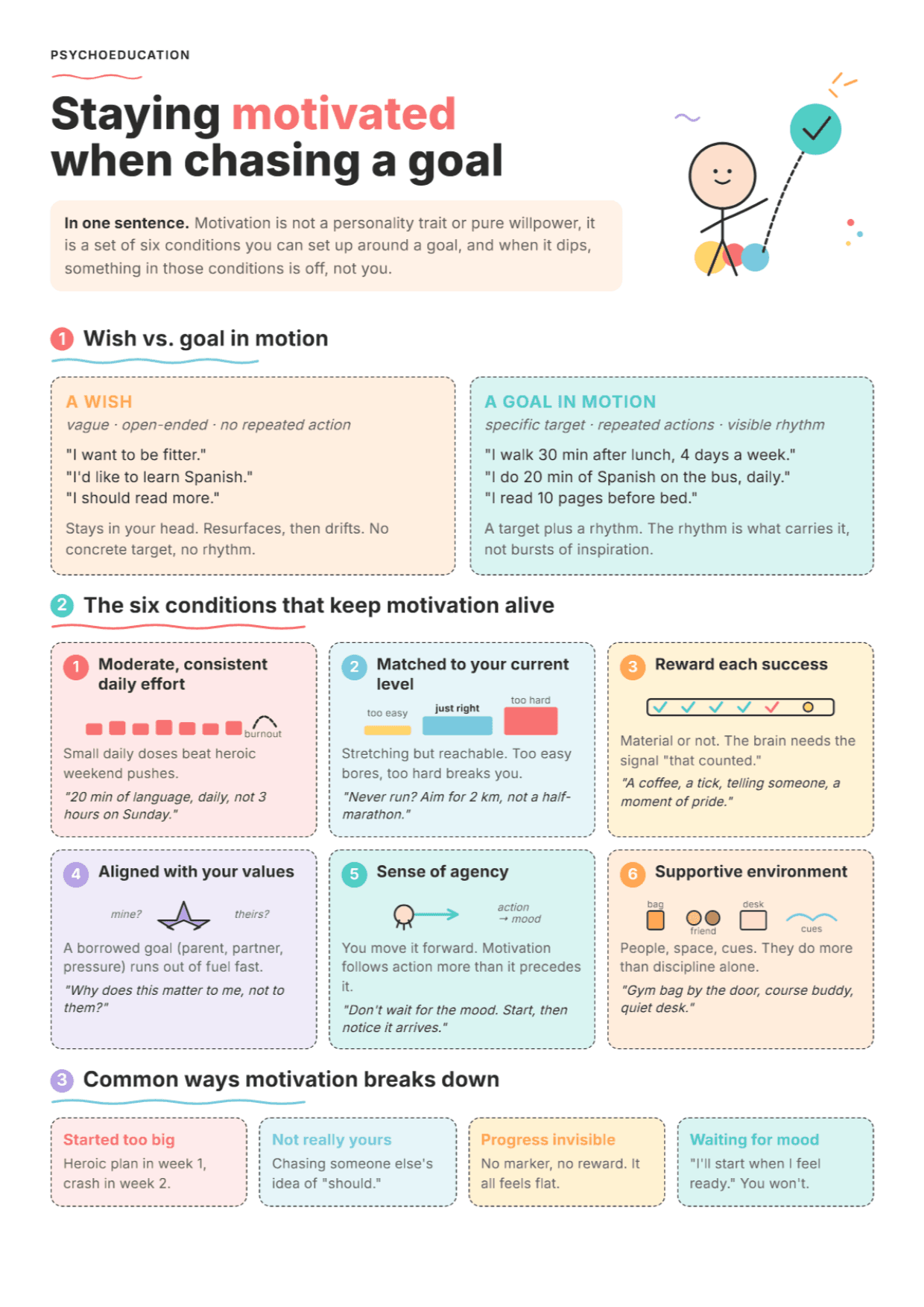
Staying Motivated: PDF Worksheet, Tools and Exercises for Clinical Practice
A structured PDF worksheet with tools and exercises to explain the six conditions of sustainable motivation, identify what has broken down, and give patients a concrete lever to adjust this week.
Self & identityLife transitions
Handout
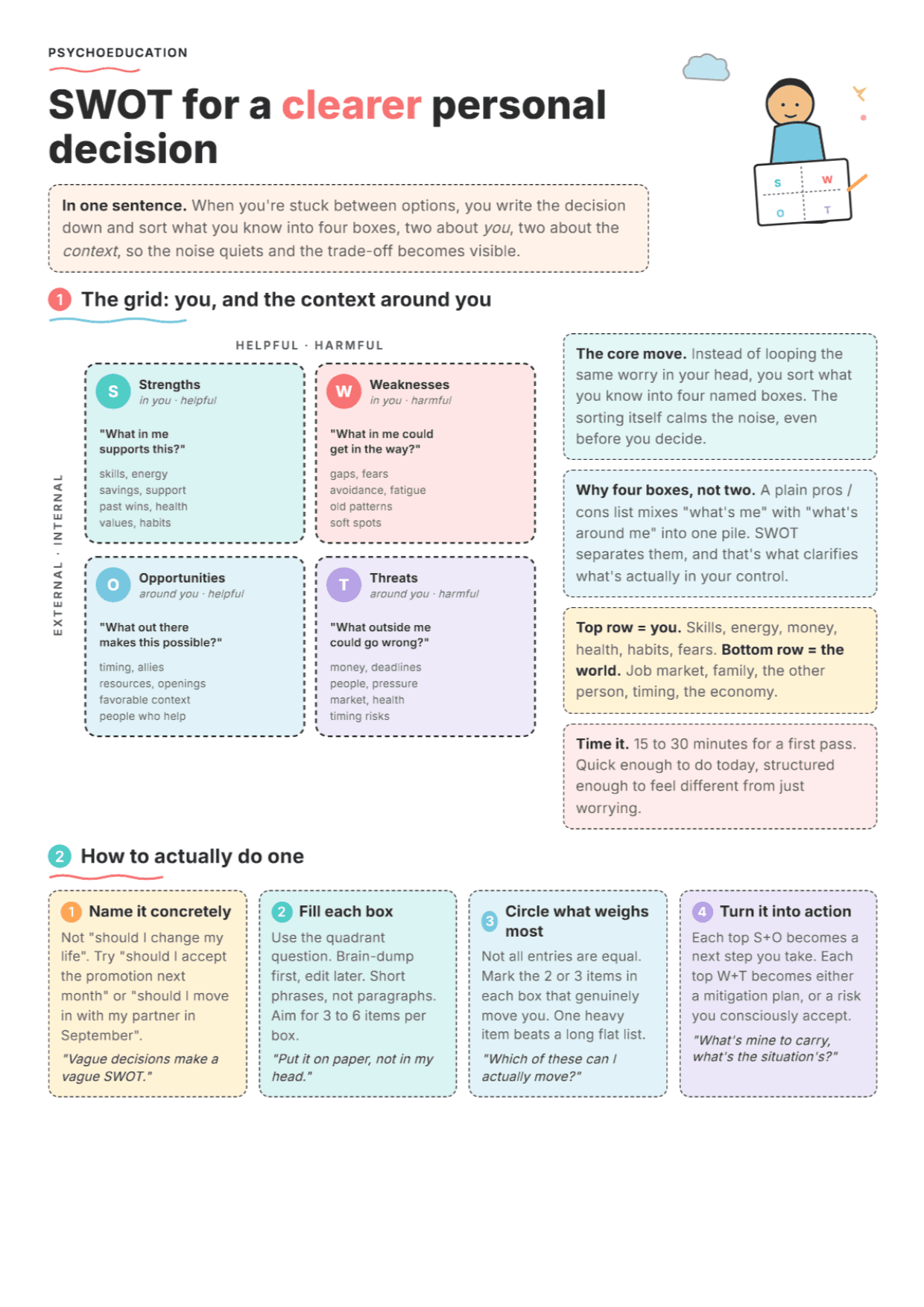
SWOT Analysis: PDF Worksheet, Tools and Exercises for Clinical Practice
A structured visual PDF worksheet helping clinicians externalise complex decisions with patients, separate internal from contextual factors, and turn looping deliberation into a concrete action plan.
Life transitionsEmotions & stress
Handout
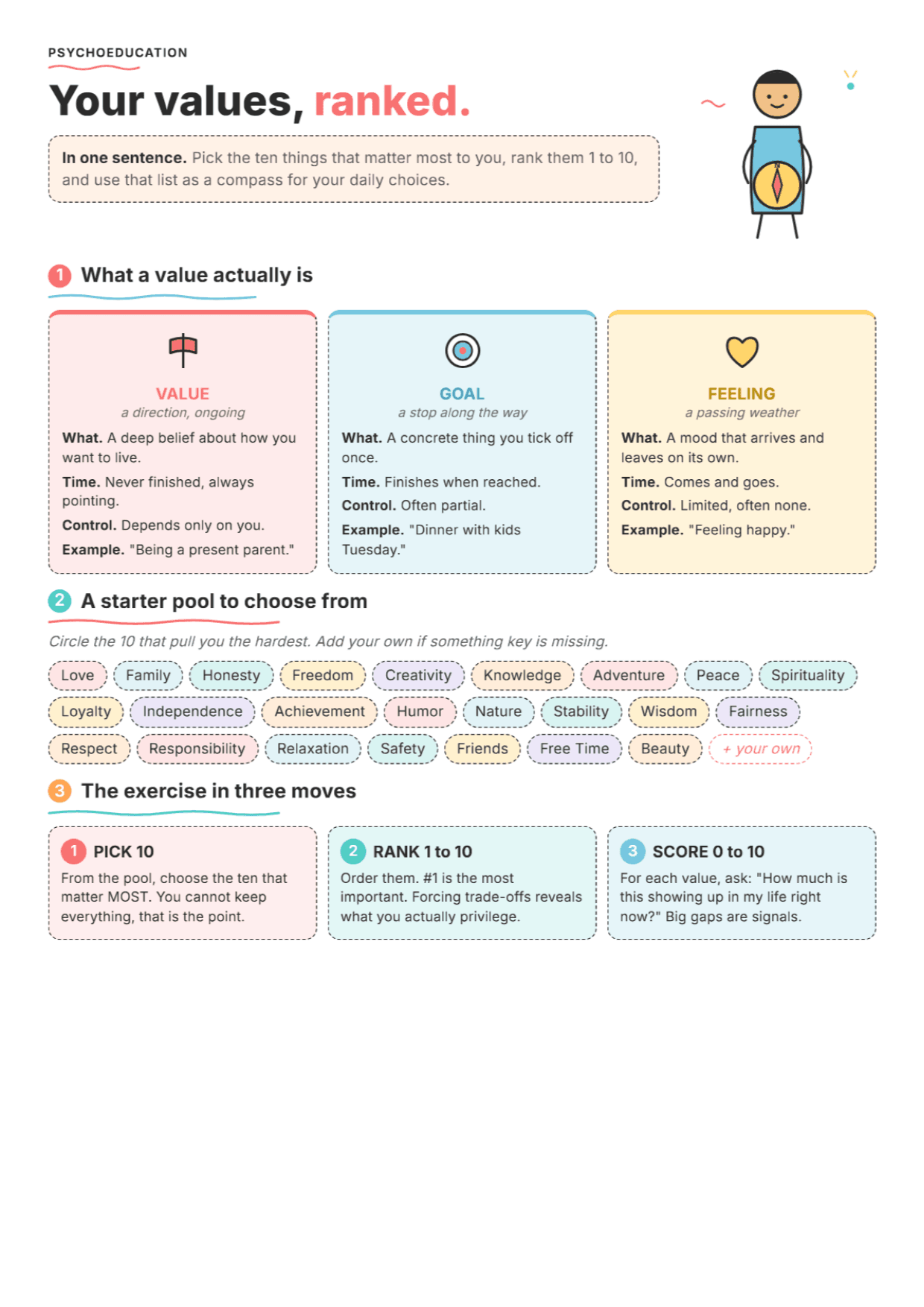
Values Clarification: PDF Worksheet, Tools and Exercises
A structured PDF worksheet with visual panels to help clinicians guide patients through values ranking, gap analysis, and committed action in ACT-informed practice.
Self & identityLife transitions
Handout
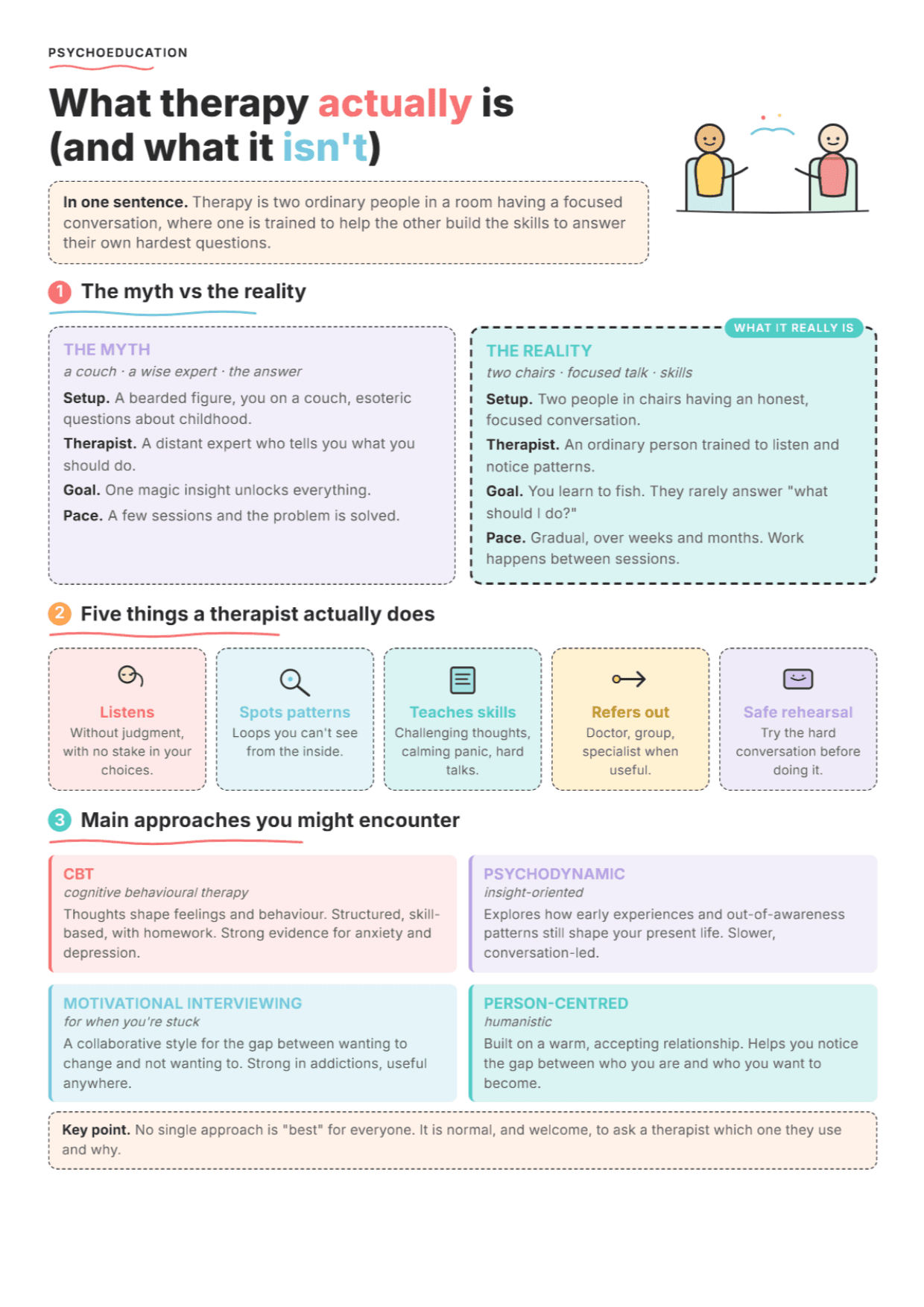
What Is Psychotherapy? PDF Worksheet, Tools and Exercises for Clinical Practice
A visual psychoeducation PDF worksheet with tools and exercises to orient patients to the therapeutic frame from the first session.