
Metacognitive Therapy (MCT): Clinical Resources for Practitioners
Metacognitive Therapy (MCT), also referred to as metacognitive treatment or the Wells metacognitive model, is a transdiagnostic psychotherapy grounded in the premise that psychological distress is maintained not by the content of thoughts but by the metacognitive processes that govern how patients relate to, monitor, and respond to their own thinking. This page is designed for clinicians integrating MCT into individual or group practice. It gathers printable worksheets, psychoeducation programs, and guided exercises specifically selected to support key MCT interventions: interrupting the Cognitive Attentional Syndrome, modifying metacognitive beliefs, and reducing maladaptive coping strategies such as rumination and reassurance-seeking.

The Self-Regulatory Executive Function Model
The Self-Regulatory Executive Function (S-REF) model, developed by Adrian Wells and Gerald Matthews, provides the theoretical backbone of MCT. It posits that emotional disorders arise from a particular mode of processing: a perseverative, self-focused cognitive style that locks the patient into sustained negative self-appraisal. The S-REF model distinguishes between object-level cognition (the content of a specific thought) and metacognition (beliefs about thinking itself, including its controllability, meaning, and consequences).
In clinical terms, what matters most is not whether a patient thinks "I am worthless" but what they believe about having that thought, how long they dwell on it, and whether they attempt to control, suppress, or neutralise it. This shift in focus is what separates MCT from traditional cognitive restructuring, and it carries direct implications for the selection and sequencing of interventions.
The Cognitive Attentional Syndrome
Central to MCT is the concept of the Cognitive Attentional Syndrome (CAS), a cluster of three interacting processes that maintain distress across diagnostic categories: worry and rumination, threat monitoring (attentional bias toward perceived danger), and maladaptive coping behaviours (reassurance-seeking, avoidance, thought suppression). The CAS is not a symptom cluster in the traditional sense; it is a processing style that feeds on itself.
Identifying the CAS in a patient's presentation gives the clinician a concrete, formulation-driven target. All three components are addressable within an MCT framework, and the grouped resources on this page map directly onto each of them.
Identifying the CAS in Clinical Consultation
Worry and Rumination as Active Maintenance Processes
Rumination and pathological worry are not simply symptoms of depression or anxiety; within MCT, they are active maintenance processes driven by positive metacognitive beliefs ("Ruminating helps me understand myself", "Worrying keeps me prepared"). Before targeting these processes therapeutically, the clinician needs to establish that the patient experiences them as somewhat volitional and as having perceived utility.
Clinically useful screening questions include: "When you notice a negative thought, what do you tend to do with it?", "Do you feel that going over things in your mind is in some way useful or necessary?", and "How much time per day would you estimate you spend dwelling on problems or worries?" The answers help distinguish CAS-driven rumination from ordinary problem-solving and orient the initial psychoeducation. The Rumination: A Structured Psychoeducation Program for Clinicians provides a sequenced framework for delivering this psychoeducation across multiple sessions.
Positive and Negative Metacognitive Beliefs
Wells distinguishes between two categories of metacognitive beliefs that sustain the CAS. Positive metacognitive beliefs concern the usefulness of worry or rumination ("Analysing my past mistakes stops me from repeating them"). Negative metacognitive beliefs concern the uncontrollability and danger of thoughts ("My worrying could make me lose my mind", "Having this thought means something terrible about me").
Both categories must be assessed in the formulation. Negative metacognitive beliefs are particularly prominent in OCD, health anxiety, and PTSD, and they often drive the secondary layer of distress, the patient's distress about their distress. Targeting them requires not just cognitive debate but behavioural experiments and the suspension of coping strategies that inadvertently confirm those beliefs.
Comorbidities and Differential Positioning of MCT
Transdiagnostic Reach and Condition-Specific Presentations
MCT was originally developed for Generalised Anxiety Disorder and has since accumulated a substantial evidence base across major depressive disorder, OCD, PTSD, health anxiety, and social anxiety disorder. The transdiagnostic utility stems from the fact that the CAS is present across these conditions, even if its surface content differs. In depression, the CAS predominantly manifests as rumination; in GAD, as uncontrollable worry; in OCD, as obsessional reasoning and neutralising rituals.
When deciding whether MCT is the primary approach or a complementary module within a broader care plan, the key clinical indicator is the presence of a well-developed CAS. A patient who engages in extended ruminative episodes, holds strong positive beliefs about the usefulness of dwelling, and uses reassurance-seeking as a primary coping strategy is an excellent candidate for a structured MCT course, regardless of the DSM diagnostic label.
MCT Versus Standard CBT: Conceptual Distinctions With Practical Implications
Clinicians trained primarily in standard CBT will notice that MCT explicitly discourages several classic CBT techniques, including thought records aimed at disputing thought content, thought stopping, and extended problem-solving during ruminative episodes. From an MCT perspective, these techniques can inadvertently reinforce the metacognitive belief that thoughts need to be controlled or evaluated, thereby sustaining the CAS.
This does not render CBT-oriented resources incompatible with an MCT approach, but their integration requires careful formulation. The Is This Thought Worth My Time? A Guided Clinical Exercise is one resource that bridges this distinction usefully: it does not ask the patient to dispute the content of a thought but to evaluate whether engaging with it serves a functional purpose, a metacognitive reorientation rather than a cognitive one.
Using These Resources in the MCT Session
Psychoeducation and CAS Conceptualization
The first phase of any MCT intervention involves socialising the patient to the model, specifically the concept of the CAS and the distinction between thoughts as events versus thoughts as valid representations of reality. This requires more than a brief verbal explanation; most patients benefit from a structured, visual, and interactive delivery.
The Rumination: A Structured Psychoeducation Program for Clinicians offers a complete multi-session programme covering the mechanics of the CAS, the role of positive metacognitive beliefs, and the rationale for suspending rumination. It is particularly suited to the early-to-middle phase of treatment, once a working alliance is established and before behavioural experiments are introduced.
Targeting Specific CAS Behaviours: Rumination, Reassurance-Seeking, and Obsessional Reasoning
Once the formulation is shared and the patient understands the maintenance cycle, session work shifts to practising metacognitive control over CAS processes. This is where structured exercises become clinically valuable, not as homework in the traditional CBT sense but as tools for building the experiential knowledge that thoughts can be noticed without extended engagement.
- The Rumination Guided Exercise: Interrupting Negative Thought Loops provides a session-ready protocol for interrupting the ruminative chain, helping patients practise detached awareness rather than re-engagement.
- The Reassurance-Seeking: A Clinical Exercise to Break the Loop addresses one of the most clinically tenacious CAS behaviours, one that is frequently underassessed and that maintains both anxiety and negative metacognitive beliefs about uncontrollability.
- For OCD presentations involving obsessional reasoning and inferential confusion, the Challenging Obsessional Reasoning: A Guided CBT Exercise offers structured scaffolding that is compatible with MCT case conceptualization, provided the clinician positions it at the metacognitive rather than content level.
> Clinical vignette. A patient presenting with recurrent depression and chronic low self-esteem has been in standard CBT for eight sessions with limited progress. Review of session recordings reveals that a significant portion of each session is spent elaborating the content of self-critical thoughts. Reformulating the case through an MCT lens, the clinician identifies a strong positive metacognitive belief: the patient believes that "analysing where I went wrong helps me become a better person." Introducing the Is This Thought Worth My Time? A Guided Clinical Exercise in session produces a pivotal shift: the patient begins to distinguish between brief problem-solving and extended ruminative self-criticism, reducing daily rumination time from roughly two hours to under twenty minutes within three weeks.
Integrating MCT Resources into the Care Plan
Suggested Sequencing Across the Treatment Arc
The following sequence reflects standard MCT practice and can guide how the printable resources on this page are deployed:
- Assessment and CAS mapping: identify rumination, worry, threat monitoring, and safety behaviours; administer the Metacognitions Questionnaire (MCQ-30) if not already done.
- Socialisation to the model: deliver psychoeducation on the CAS and the distinction between thoughts as triggers versus extended mental processing, using structured psychoeducation materials.
- Introducing detached mindfulness: brief in-session experiments with tiger-thought exercises, postponement trials, or attention training, before introducing written exercises.
- CAS-targeted behavioural experiments: systematic suspension of rumination, reassurance-seeking, and safety behaviours, supported by in-session guided exercises.
- Modifying metacognitive beliefs: verbal reattribution and behavioural experiments targeting both positive and negative metacognitive beliefs.
- Relapse prevention: building a personalised CAS profile and a maintenance plan that specifies early warning signs.
Combining MCT Resources With Other Modalities
MCT resources integrate well with Acceptance and Commitment Therapy (ACT) components, particularly psychological flexibility exercises and defusion techniques, provided the clinician maintains clarity about which model is driving the case formulation at any given moment. They can also complement Schema Therapy when working with patients whose metacognitive beliefs are deeply embedded in early maladaptive schemas, though the sequencing requires careful clinical judgment.
In group settings, the psychoeducation program and the rumination exercise are particularly adaptable. Group delivery offers the additional benefit of social comparison: patients often discover that their ruminative style is not evidence of a uniquely broken mind, which itself begins to modify negative metacognitive beliefs about uncontrollability.
Clinical Vigilance and Limits of MCT-Oriented Resources
When MCT Is Contraindicated or Requires Adaptation
MCT is not the treatment of first choice in acute psychosis, active suicidal crisis requiring stabilisation, or severe dissociative presentations where metacognitive access is impaired. In complex PTSD, the model remains applicable but requires adaptation: the clinician must attend carefully to the patient's window of tolerance before introducing metacognitive control experiments, as premature suspension of safety behaviours may temporarily heighten distress.
Printable exercises, however carefully designed, carry inherent limits. They function as scaffolding for in-session processes and should not substitute for the relational work of collaboratively constructing a metacognitive formulation. A patient who completes a worksheet mechanically without internalising the underlying metacognitive rationale is unlikely to generalise the skill.
Supervision and Fidelity Considerations
Given the degree to which MCT diverges from standard CBT in its technical prescriptions, clinicians new to the model are advised to work under MCT-specific supervision, particularly when deciding which standard CBT techniques to suspend and which to retain. Fidelity to the MCT model is not merely a research concern: it has direct clinical implications for patient progress and for the coherence of the formulation shared with the patient.
The resources gathered here support fidelity by keeping the metacognitive rationale visible throughout the exercises, orienting patients and clinicians alike toward process rather than content as the primary focus of change.
Tools in this category
Handout
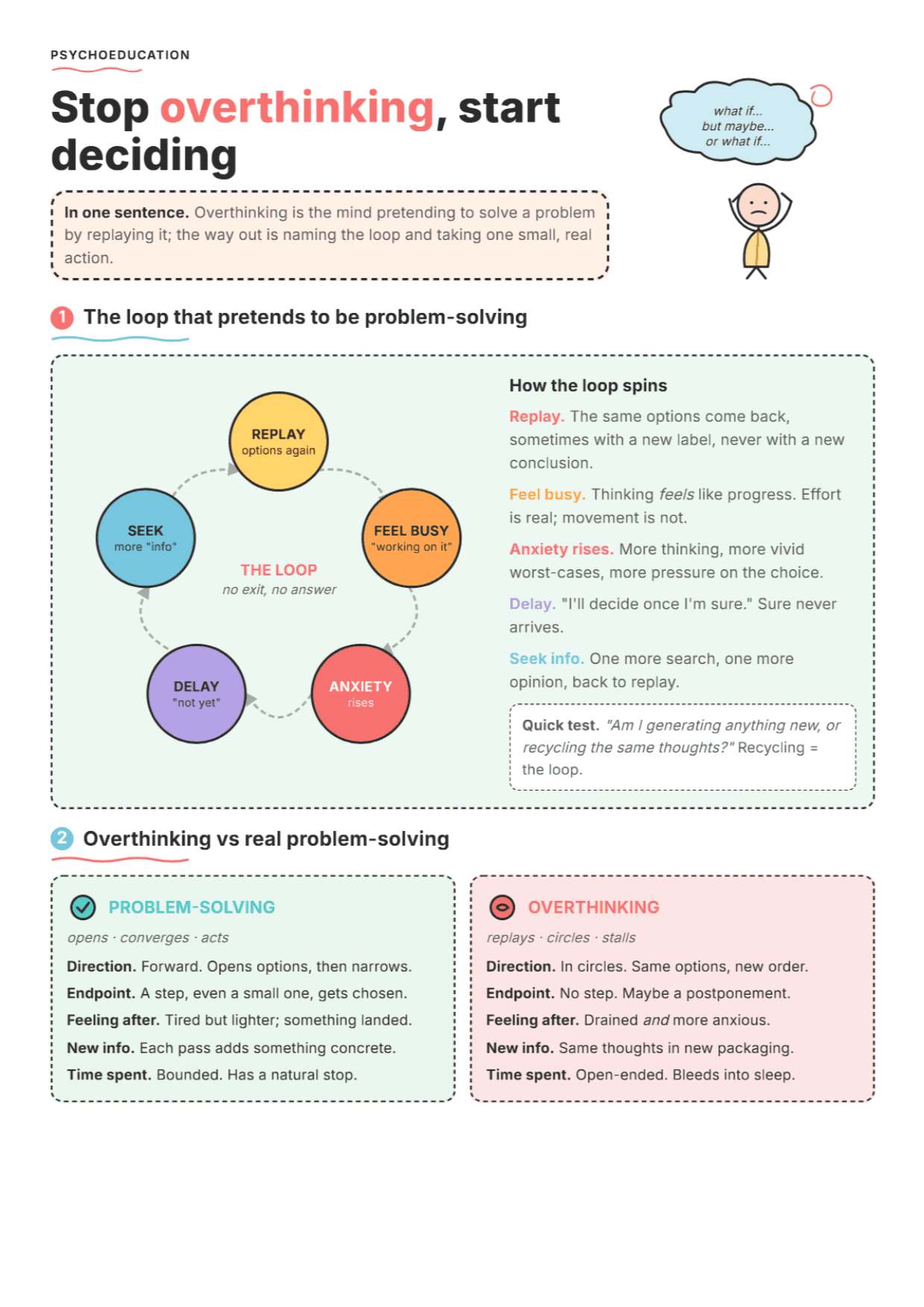
Stop Overthinking: PDF Worksheet, Tools and Exercises for Clinical Practice
A printable PDF worksheet to make the overthinking loop legible in session, with tools and exercises that help patients name the pattern and take one real step.
AnxietyThoughts & cognition
Handout
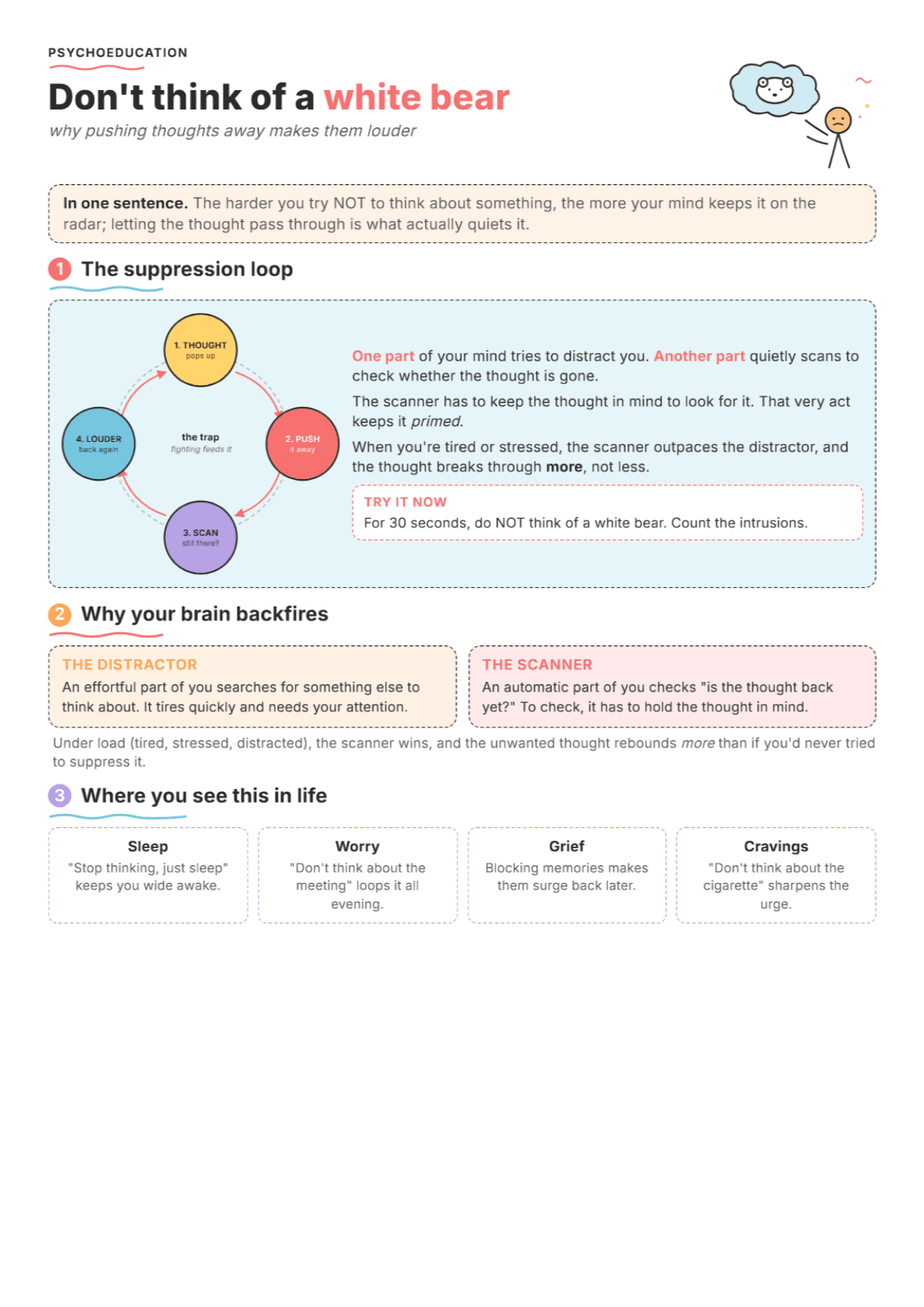
Thought Suppression and Intrusive Thoughts: PDF Worksheet, Tools and Exercises
A printable psychoeducation fiche helping clinicians explain the suppression paradox in session, with visual tools, exercises, and ready-to-use phrases for CBT and ACT work.
AnxietyTrauma & PTSD

Handout
Thought-Action Fusion: PDF Worksheet, Tools and Exercises
A printable PDF worksheet with tools and exercises to explain thought-action fusion in session, ground intrusive-thought work, and give patients a concrete visual reference they can keep.
AnxietyThoughts & cognition

Handout
What Is Worry? PDF Worksheet, Tools and Exercises for Clinical Practice
A visual psychoeducation worksheet helping clinicians explain the worry chain, the real-event vs hypothetical distinction, and the normal-to-excessive continuum in session.
AnxietyThoughts & cognition
Handout
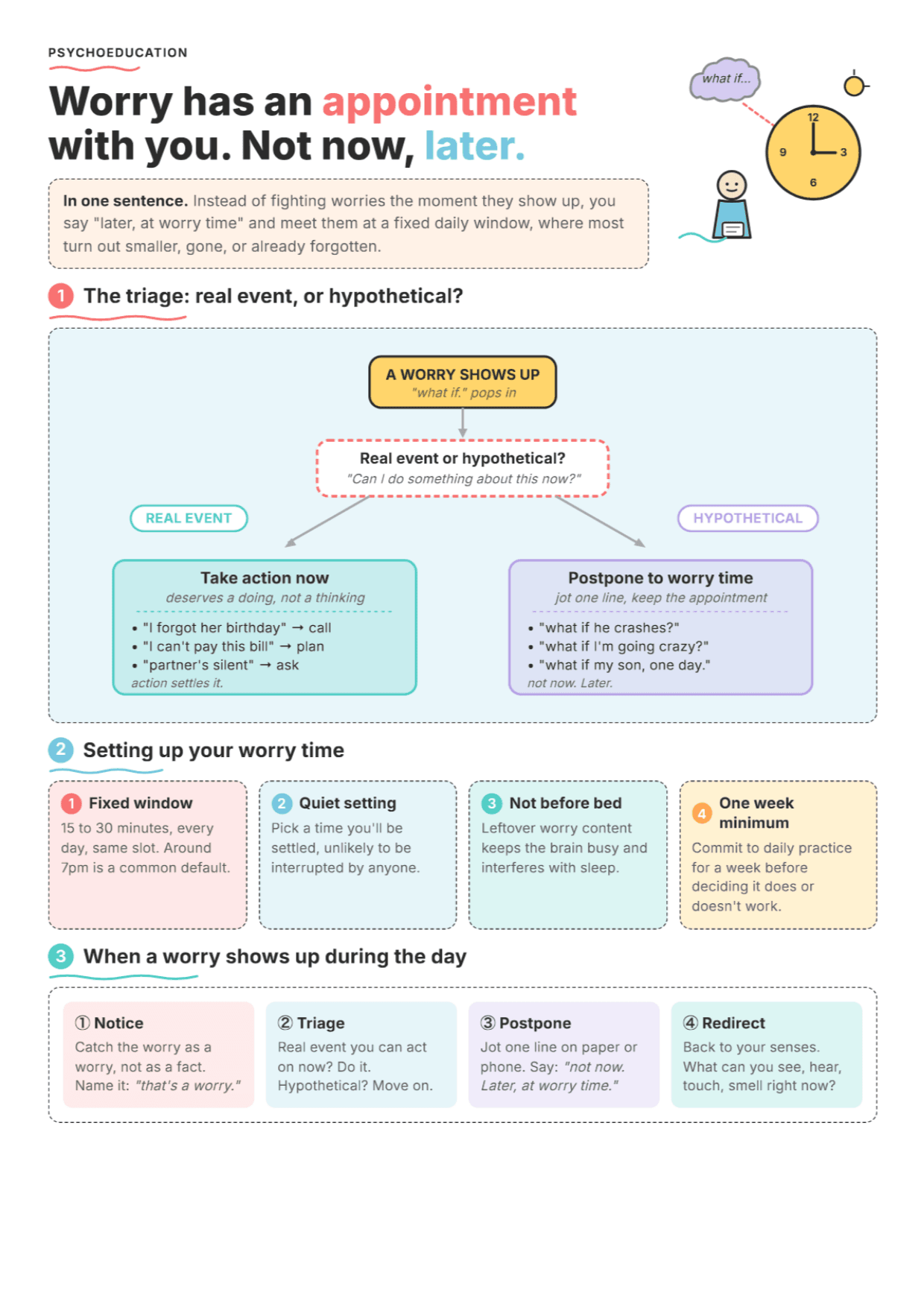
Worry Postponement: PDF Worksheet, Tools and Exercises
A visual PDF worksheet to explain and introduce the worry postponement technique in session, with a triage protocol, worry time setup, and pitfall guidance.
AnxietyEmotions & stress